China’s Soccer Team Misses World Cup, But Fans Find Their Pride in a Referee
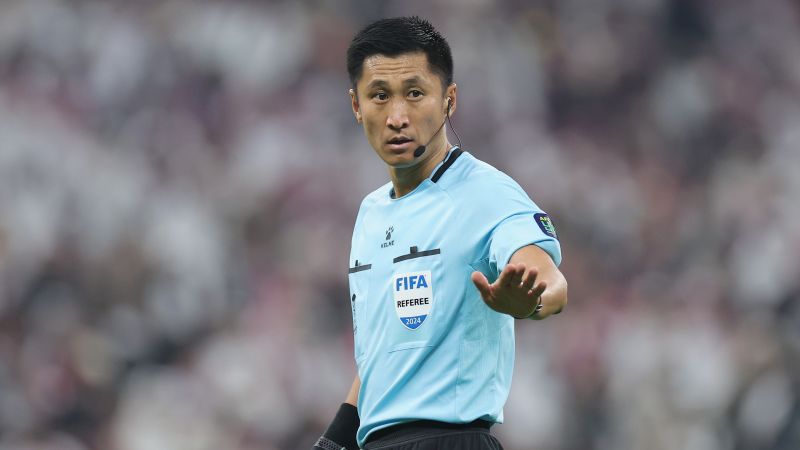
Sandego.net – In the grand tradition of World Cup send-offs, players are often celebrated with formal ceremonies, donning elegant suits and waving goodbye to supporters before heading overseas to represent their nations on the global stage. Yet, this year’s event in China took a different turn. The national soccer team, which has struggled to qualify for the tournament for over two decades, faced another disappointment. Despite this setback, Chinese fans have found a new source of pride in an unexpected figure: Ma Ning, a referee whose strict and unyielding style has earned him the moniker “Card Master.”
A Divisive Figure Turned National Icon
Ma Ning, 46, has long been a polarizing presence in domestic football. While his decisions have sometimes sparked heated debates among fans, his reputation as a disciplined enforcer has grown steadily. A defining moment in his career came in 2015 during an intense Shanghai derby, where he issued nine yellow cards and three reds in a single match. The dramatic penalty calls and aggressive calls instantly went viral on social media, cementing his nickname and drawing attention far beyond the pitch.
Interestingly, Ma’s journey from controversy to admiration mirrors the broader hopes and frustrations of China’s soccer community. While the national team continues to face challenges, the referee has become a symbol of resilience. His presence at the World Cup has sparked a wave of support on platforms like RedNote and Weibo, with hashtags related to him generating millions of views. “Other countries watch their own teams play matches, we watch our own referee hand out cards,” wrote one RedNote user, highlighting the unique cultural connection fans feel toward Ma.
“His luggage is probably all filled with yellow and red cards,” quipped a Weibo user, adding a touch of humor to the growing enthusiasm. Another RedNote follower joked, “You don’t need a boarding card, just show them a red one.” These lighthearted remarks underscore the shift in public sentiment, as Ma’s role has transcended that of a mere official to become a national mascot.
A Star on the World Stage
Ma’s World Cup debut in 2022 as a fourth official marked a milestone in his career. Now, he is returning to the global spotlight, this time as a central figure. His participation has not only brought attention to Chinese referees but also highlighted the country’s growing investment in soccer infrastructure. Sponsors like Lenovo and Hisense have joined the celebration, recognizing Ma as a representative of China’s aspirations in the sport.
“I only know famous players like Cristiano Ronaldo, Messi, and Mbappé,” said Debbie Wang, a self-proclaimed non-fan of soccer, to CNN. “I’m extremely curious about how many cards Ma Ning will issue.” Her words reflect a broader trend: even those unfamiliar with the game are tuning in to watch Ma’s matches. For Ted Cui, a Beijing-based fan, Ma’s performance is a source of pride. “(Ma) is our only one going to the World Cup,” Cui explained. “I think we will support him.” He praised the referee as “one of the best in China and even in all of Asia,” despite his controversial reputation.
Ma’s influence extends beyond the pitch. He has officiated international games for the Asian Football Confederation (AFC) Champions League and the Chinese Super League, where his work has been both admired and scrutinized. The league, which once signed high-profile foreign stars in ambitious deals, has now turned its focus inward, with Ma becoming a key figure in showcasing China’s capabilities. “During the World Cup, we will earnestly learn from the world’s most outstanding referees, and bring valuable experience back to China to contribute strength to the training and development of Chinese referees,” Ma told state media before departing for the Americas, emphasizing his role as a bridge between local and international standards.
China’s Long Road to the World Cup
China’s absence from the World Cup since 2002 is a stark reminder of the challenges the country faces in the sport. That initial appearance, which ended in the group stage with no goals scored, was a brief moment of glory. Since then, the nation has aimed to become a global soccer power, with leaders like President Xi Jinping pledging to achieve this goal. In 2011, Xi expressed his three wishes for China: to qualify for the World Cup, to host it, and to win it.
Despite these ambitions, progress has been slow. The Chinese Super League, once a beacon of hope, faced financial missteps, allegations of corruption, and the disruptions of the pandemic. These factors have hindered the development of the sport. However, Ma’s selection for the World Cup has reignited optimism. He is joined by two other Chinese officials—assistant referee Zhou Fei and video assistant referee Fu Ming—marking a small but significant step toward greater representation.
The referee’s journey also reflects the evolving landscape of Chinese football. While the national team continues to struggle, the sport has seen improvements in infrastructure and coaching. Ma’s role as a global referee symbolizes this progress, offering a tangible example of China’s commitment to excellence. “We will go all out to showcase the style and demeanor of Chinese referees on the World Cup stage,” he said, channeling the aspirations of a nation that has long sought recognition in the sport.
A Hopeful Turn for Chinese Soccer
Ma’s rise to fame is a testament to the power of individual achievement in the face of collective disappointment. While the national team remains a work in progress, the referee has become a figure of hope. His ability to balance strict enforcement with national pride has turned a once-controversial icon into a symbol of unity. For many fans, Ma’s presence at the tournament is a reminder that success in soccer is not solely dependent on players but also on the officials who uphold the game’s integrity.
As the World Cup games kick off across Mexico, Canada, and the US, Ma’s matches will be watched with anticipation. The time difference, though challenging, has not dampened enthusiasm. His story resonates beyond the stadium, inspiring conversations about the future of Chinese soccer. Whether or not his card-wielding reputation translates into success on the field, Ma Ning has proven that even in the absence of a qualifying team, a nation can find pride in its referees. His journey from the Shanghai derby to the World Cup stage is a unique chapter in China’s soccer history—one that blends tradition, resilience, and a touch of humor.
In the years following the 2002 World Cup, China unveiled a bold plan to become a “first-class soccer superpower” by 2050. While this goal remains distant, Ma’s participation in the tournament serves as a small victory. It is a reminder that the path to success is often paved with incremental steps, and for now, the Card Master has become the face of that journey. As the games unfold, his performance may not only shape the perception of Chinese referees but also reignite a collective dream that has persisted for decades.