A Desperate Night at Madison Square Garden Ruins the Knicks’ Fairytale Story. The Real Work Starts Now
The Knicks’ Edge Wanes in a Defining Moment
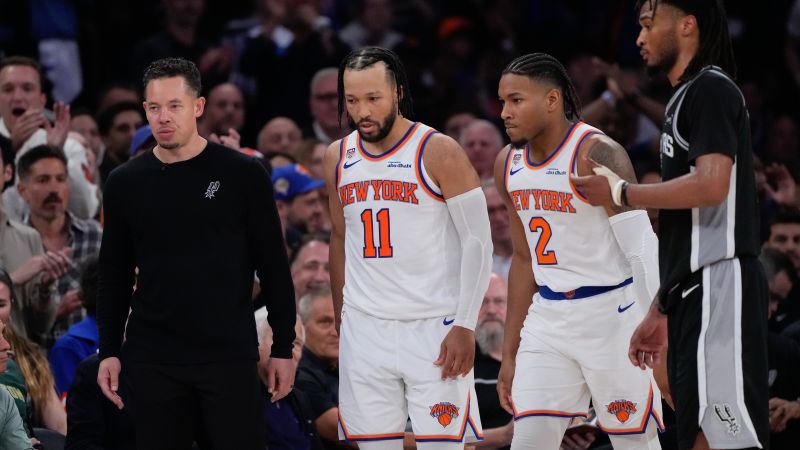
Sandego.net – The New York Knicks faced their most pivotal challenge yet in Game 3 of the NBA Finals, a match that unfolded at Madison Square Garden under the weight of expectation. Though they had already secured a 2-0 series lead, the game became a test of resilience as the San Antonio Spurs, led by the ever-reliable Victor Wemanyama, threatened to dismantle the Knicks’ dream run. The outcome—a 115-111 loss—marked the end of an improbable chapter and the beginning of a grueling playoff stretch.
“Got to keep playing desperate and be the more desperate team,” Mikal Bridges said the day before the Finals returned to New York for the first time since 1999. His words carried the echoes of past struggles, referencing the Phoenix Suns’ infamous collapse in the 2021 Finals after a 2-0 deficit. The Knicks, like those Suns, were now navigating a familiar path: the peril of overconfidence when the stakes are high.
Mike Brown, the first-year head coach who inherited a tight-knit group from a previous season’s near-miss, emphasized the need for intensity. “The goal was to try to match or exceed the level of desperation we anticipated from the Spurs,” he explained, echoing a theme that had defined his coaching philosophy. This wasn’t just about strategy; it was about mindset. Brown had used the term “desperation” repeatedly, framing it as a counterbalance to the complacency that can settle in after a prolonged playoff run.
For Knicks fans, the emotional stakes were as high as the physical ones. Decades of anticipation had turned into a collective longing, a feeling that transcended the sport itself. The team’s underdog story had become a cultural touchstone, symbolizing the city’s resilience and the hope that had long been deferred. Yet, as the game unfolded, the narrative began to shift. The Knicks, once invincible in their pursuit of a title, now faced the reality of a harder fight ahead.
The Weight of Expectation and the Illusion of Control
Sports often create a paradoxical sense of agency. Fans believe they can shape the outcome of a game, even when the odds are stacked against them. The Knicks’ Game 3 loss was not just a statistical setback—it was a symbolic blow to the city’s collective imagination. For years, New Yorkers had clung to the hope of a championship, and the Knicks’ journey had become a mirror of that enduring yearning.
The phrase “must win” carried a different meaning in this context. Unlike a typical playoff scenario, this game was imbued with a sense of inevitability. The Knicks had already rewritten the story of the season, turning a 2-0 deficit into a narrative of triumph. But as the Spurs tightened their grip on the series, the illusion of control began to fray. The real test was not whether the Knicks could win, but whether they could adapt to the relentless pressure of a championship chase.
“Desperation is something you feel in spite of yourself,” Brown remarked, capturing the essence of the Knicks’ plight. “It’s not just a strategy—it’s an emotional state that defines the moment.”
The Knicks’ fans, in their fervor, had become both participants and victims of this narrative. They wore jerseys, chanted slogans, and celebrated every step of the journey as if it were a script written in advance. The game’s drama was amplified by the city’s unique energy, with a crowd that blended pride, anxiety, and aching anticipation. Yet, the Spurs’ presence in Madison Square Garden was a reminder that the story was far from over.
Victor Wemanyama’s performance in Game 3 was a turning point. The Spurs’ young star, still in his early 20s, embodied the relentless drive of a team that had never before reached the Finals. His energy and precision contrasted sharply with the Knicks’ struggles, which included turnovers, defensive lapses, and moments of self-doubt. The crowd, once a force of unity, now felt the pressure of a split decision.
A City’s Dream and the Cost of Defiance
The Knicks had been the embodiment of New York’s spirit, a team that thrived on defiance and underdog resilience. Their journey to the Finals had been a fever dream, a blend of talent, strategy, and luck that had carried them through a season of unpredictability. But as the series progressed, the narrative of inevitability gave way to a more sober reality. The Spurs, with their disciplined play and deep bench, were not merely competitors—they were obstacles that had to be overcome.
Historically, the Knicks had never dominated a series in the way the Spurs had. The Spurs’ reputation as a team of the future, built on sustainability and strategic depth, stood in stark contrast to the Knicks’ whirlwind ascent. This was not just a matchup of teams—it was a clash of philosophies. The Knicks had relied on individual brilliance and a surge of momentum, while the Spurs had leaned on collective effort and calculated execution.
The loss in Game 3 was a humbling reminder that championships are won by teams that can withstand adversity. The Knicks, once a symbol of hope, now found themselves in a position where every game would demand more than just talent. It would require discipline, resilience, and a willingness to accept the brutal reality of the playoffs. The fans, who had cheered the team on with a mix of joy and desperation, now watched as the story they had imagined began to unravel.
As the series shifted toward San Antonio, the Knicks faced a new chapter. The pressure of a potential sweep was replaced by the urgency of survival, and the city’s dream of a fairytale ending had taken a hit. Yet, this was where the true test lay. The Knicks had proven their ability to rise under pressure, but could they sustain it? The answer would determine not just the fate of the team, but the legacy of a city that had waited over five decades for a championship.
The Road Ahead
The Spurs’ victory in Game 3 was not just a statistical triumph—it was a psychological one. The Knicks had been lulled into a sense of complacency, believing their playoff run was a foregone conclusion. Now, with the series back in San Antonio for at least Game 5, the challenge was clear: the Knicks would have to rediscover the urgency that had defined their journey. This was not the time for nostalgia; it was the time for action.
The loss also served as a reminder of the power of narratives in sports. While the Knicks had built their story on the promise of redemption, the Spurs had carved their own narrative of perseverance and patience. The game’s outcome highlighted the gap between perception and reality, between the fan’s emotional investment and the cold calculus of the sport. As the series continued, the Knicks would need to prove that their story was more than just a temporary flicker of hope.
New York had always been a city of dreams, and the Knicks’ playoff run had been one of the most thrilling chapters in recent memory. But as the game ended and the crowd dispersed, the realization set in: the fairytale was over. What remained was the hard work of a playoff series, the kind that tests not just athletes, but the very spirit of a city. The Knicks had learned the lesson of desperation, and now, the real story would begin to unfold.