Supreme Court Lets Ballroom Work Continue
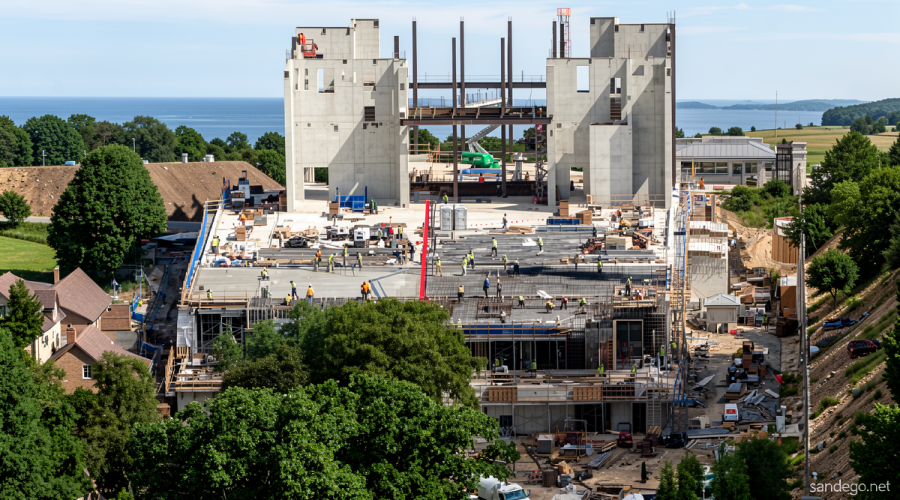
Sandego.net – Supreme Court temporarily allows construction of the White House ballroom to proceed after Chief Justice John Roberts issued a one-justice stay Friday afternoon, freezing a lower-court injunction that would have forced a midnight work stoppage. Crane operators and steel crews returned to the site Saturday morning without interruption, continuing what the administration describes as a project already 65 percent complete.
Scope of the Emergency Stay
The order is procedural, not substantive. Roberts did not rule on whether a president may demolish and rebuild a major portion of the executive mansion without congressional authorization. Two federal courts have already answered that question in the negative. What the stay accomplishes is narrow: it removes the enforcement mechanism that would have halted work at midnight Friday. Because it was issued by a single justice acting on an emergency application from the D.C. Circuit, there is no written opinion, no vote tally, and no dissent. In practical terms, the Supreme Court temporarily allows construction to continue at full speed until the full bench weighs in. Roberts is expected to circulate the matter to all nine justices in the coming days, shifting the question from one judge’s desk to a nine-member deliberation.
Scale of the Operation
A filing the administration submitted to the Supreme Court describes roughly 250 workers on site around the clock, logging 20-hour days seven days a week. The complex includes not only the event space itself but a deeply buried bunker beneath it. Judge Richard Leon had permitted workers to continue building the bunker even after ordering the ballroom above ground to stop, accepting the argument at that stage that the two structures were functionally separate. Senior officials have since reframed the entire structure — bunker included — as a national-security necessity, citing recent assassination attempts on the president’s life and giving the administration additional rhetorical ground to argue that halting work endangers the executive branch.
How the Case Reached the High Court
The litigation began in December when the National Trust for Historic Preservation, the country’s oldest preservation organization, filed suit challenging the project. Judge Leon, sitting in federal district court in Washington, issued an injunction ordering the president to cease ballroom construction until Congress affirmatively authorizes the work. The administration appealed to the D.C. Circuit and lost in a divided 2-1 decision issued in early August, with the panel ordering all work to stop beginning August 21.
The majority opinion was blunt about the separation-of-powers principle at stake:
“Whether or not a massive ballroom should be constructed is for Congress to decide and is not a matter for Executive self-help.”
The court went further on the broader constitutional question of presidential authority over the executive mansion:
“The National Trust has shown, compellingly, that Congress has not ceded unfettered authority to the Executive Branch to dramatically redesign, reshape, and reconstruct the White House – the People’s House – to fit a particular President’s desires.”
FAQ
What does the stay actually accomplish? The order means the Supreme Court temporarily allows construction to proceed while the full Court deliberates. It does not declare the ballroom lawful, does not endorse the administration’s position, and does not resolve the underlying constitutional question.
When will the full Court act? No deadline has been imposed. Roberts is expected to circulate the matter to all nine justices in the coming days, after which the question moves from a single-justice emergency review to a nine-member deliberation.
Can workers keep building while the case is pending? Yes. Because the stay removed the enforcement mechanism that would have forced a work stoppage, construction may proceed at full speed until the full Court issues a further directive.