Supreme Court faces scrutiny over potential: Supreme Court Faces Scrutiny Over Prediction Market Loopholes Justices Respond to Growing Concerns Sandego.net
Supreme Court Faces Scrutiny Over Prediction Market Loopholes
Justices Respond to Growing Concerns
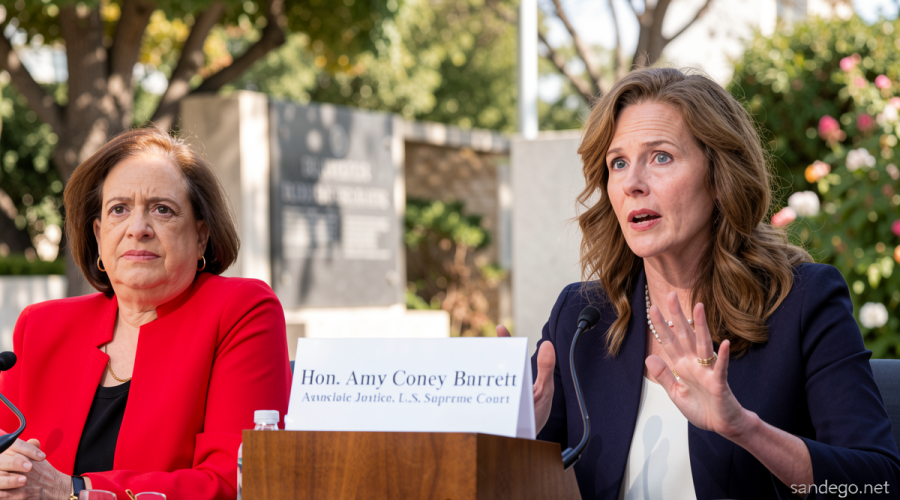
Sandego.net – During a recent Senate hearing, Justice Amy Coney Barrett offered a swift response when questioned about whether the Supreme Court had taken meaningful steps to address the rapid expansion of prediction markets and the ethical challenges these platforms create for the judiciary. “That’s already covered,” she stated with assurance while making a rare public appearance to advocate for millions in additional security funding. Justice Elena Kagan provided a nearly identical response just moments later.
Despite these reassuring statements from both justices, mounting pressure continues to build for the high court to formally prohibit employees from engaging in trading activities on platforms such as Kalshi and Polymarket. These prediction sites allow users to wager on numerous outcomes, ranging from specific appellate decisions to whether any Supreme Court justice might face federal criminal charges.
Watchdog organizations argue that prediction markets create particularly complicated ethical dilemmas for a governmental branch that conducts much of its operations behind closed doors. Justices and their clerks working within secluded chambers frequently learn case outcomes with significant global financial and political consequences months before public announcements through carefully orchestrated opinion releases.
Legislative Push for Clearer Standards
“It is vitally important that the American public have trust in the courts, and taking further action to create a clear standard is critical to regaining that trust,” Sen. Chris Van Hollen, a Maryland Democrat, wrote to the Supreme Court on Tuesday in a letter reviewed by CNN. Van Hollen encouraged Chief Justice John Roberts to contemplate “clearly and expressly prohibiting” justices, judges, staff members, clerks, and other personnel from participating in these markets entirely.
This renewed effort coincides with other federal government branches implementing at least partial measures to restrict insider trading on prediction platforms. The Senate established a rule prohibiting senators and their personnel from trading on these markets. Several House members have similarly implemented officewide restrictions for their employees. Congress is currently evaluating multiple legislative proposals that would either ban or limit justices and other federal government workers from utilizing these sites.
Additionally, certain governors have issued executive orders preventing state employees from leveraging job-related insider information to generate profits on prediction platforms.
Broader Context and Remaining Concerns
A teleprompter operator who previously worked for President Donald Trump at the White House now faces investigation by federal regulators for reportedly executing trades on Kalshi’s “mention markets.” These markets enable users to wager on which words and phrases public figures will utter during public events or speeches. White House press secretary Karoline Leavitt stated that Trump considered the situation “deeply unfortunate and frankly a disgrace” and noted the employee was cooperating with investigators while being placed on unpaid leave.
Barrett and Kagan indicated that existing court policies already address concerns raised by court watchdogs and other stakeholders. They informed lawmakers that they would examine these policies regarding what Kagan characterized as an “incredibly important area.” “We don’t want loopholes,” Barrett emphasized.
A Supreme Court spokesperson declined to comment when contacted for this report. No allegations have emerged suggesting court staff or justices have misused prediction markets.
Legal Framework Under Examination
Following multiple news reports concerning luxury travel provided to certain justices, the court implemented a pioneering code of ethics in 2023. This document prohibits the nine justices from utilizing “nonpublic information acquired in a judicial capacity for any purpose unrelated to the justice’s official duties.” A separate code prevents judicial employees from employing “any confidential information” for “personal gain.”
However, the court’s ethics code has faced widespread criticism for lacking any enforcement mechanism. Furthermore, the language does not seem to prohibit a clerk from wagering on an issue that may eventually reach the court but is not currently pending, or from betting on potential actions by other government branches—situations that could still generate questions about impartiality.
“The current code of conduct should prohibit judges and justices from using insider knowledge to make money,” Rep. Greg Landsman, an Ohio Democrat who has introduced a bill th
Related SEO Topics
- Home
- Artikel terkait Supreme Court faces scrutiny over potential
- Supreme Court allows Texas to require age verification for mobile apps
- The 9 Senate seats most likely to flip in 2026
- 5 things to know for June 26: Immigration, Venezuela earthquakes, Iran strike, Bible curriculum, Europe heat wave
- Trump administration identifies more than 500 migrant children for removal from the US, senator says
Frequently Asked Questions
Apa itu Supreme Court faces scrutiny over potential?
Supreme Court faces scrutiny over potential adalah topik utama yang dibahas di artikel ini dengan konteks praktis agar pembaca memahami informasinya dengan jelas.
Mengapa Supreme Court faces scrutiny over potential penting?
Supreme Court faces scrutiny over potential penting karena membantu pembaca membandingkan pilihan, menghindari kesalahan umum, dan mengambil keputusan yang lebih tepat.
Bagaimana cara memakai panduan Supreme Court faces scrutiny over potential ini?
Gunakan poin utama, contoh, dan tautan terkait di halaman ini sebagai rujukan awal, lalu cek detail terbaru sebelum mengambil keputusan final.