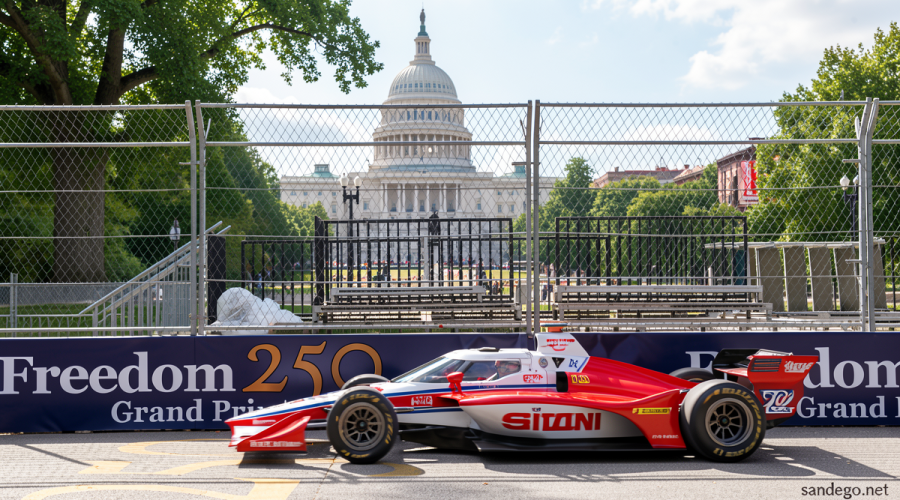
Engines Roar Past the Capitol: Washington’s Streets Become a 1.66-Mile Circuit
Sandego.net – For one weekend in late August, the marble colonnades of the National Mall and the limestone facades of the Smithsonian museums will share their airspace with open-wheel racing machines screaming past at up to 180 miles per hour. The Freedom 250 Grand Prix, a two-day IndyCar street race threading through the heart of the American capital, kicked off its first day of activity on Saturday with thousands of spectators already lining the barriers despite a light morning drizzle. By midday, several thousand fans had gathered along the course, drawn by the rare spectacle of high-speed motorsport unfolding against the backdrop of the nation’s most recognizable civic architecture.
A Track Woven Through Monuments and Museums
The circuit is a study in urban geography compressed into racing geometry. It launches from a stretch of 3rd Street — its asphalt repainted in red, white, and cobalt blue, with a bold black-and-white checkered-flag stripe running alongside the ordinary crosswalk markings — then sweeps along the National Mall directly opposite the Washington Monument. From there the course hooks onto Pennsylvania Avenue, the broad boulevard that fronts the White House, before kinking sharply onto 9th Street NW. That tight corner proved treacherous during Saturday’s practice sessions, with more than one driver overshooting the apex and having to reverse course to rejoin the track.
The layout continues along Constitution Avenue, bisecting the Mall at 7th Street, then swinging onto Independence Avenue past the Smithsonian’s Air and Space Museum. A final turn onto Maryland Avenue feeds drivers back onto 3rd Street, completing a loop of fewer than 1.7 miles and seven corners. Pennsylvania Avenue’s generous width was deliberately selected to accommodate a pit lane where IndyCars will pull in for tire swaps, refueling, and mechanical work during Sunday’s main event.
The Political Engine Behind the Event
The race did not arrive through ordinary municipal channels. President Donald Trump signed a January executive order that fast-tracked the event, effectively overriding local permitting and bureaucratic processes that would typically consume years. The result: a race pitched by Penske Corporation President Bud Denker became a reality in under twelve months. The White House confirmed that Trump himself plans to attend Sunday’s main race, taking a ceremonial lap aboard the presidential limousine — colloquially known as “The Beast” — before dropping the green flag from his seat to signal the start.
The timing is deliberate. The Freedom 250 Grand Prix caps a summer of nationwide celebrations marking the republic’s 250th anniversary. Sunday’s race will run 147 laps, a number chosen to echo the semi-quincentennial milestone, covering a total distance of 250 miles. Organizers project nearly 300,000 attendees across both days.
Fans Make the Pilgrimage
Hardcore racing enthusiasts traveled from across the country for the weekend. Tom Lantz drove his family from Altoona, Pennsylvania, including his 12-year-old son Levi Steele, who was experiencing a major motorsport event for the first time.
“I’m just glad I’m here,” Levi said.
Scott Talbott, visiting from Dallas, framed his excitement in terms of place rather than speed.
“The nostalgia of DC, the heritage — I’ll take this any day,” Talbott said.
Along the barriers, fathers lifted small children onto their shoulders for a clearer sightline. Where grandstand seating was unavailable, rows of small concrete blocks spaced every few yards gave standing spectators a few extra inches of elevation. The smell of high-octane fuel hung in the cooling evening air as preliminary support races filled the Saturday schedule, building momentum toward Sunday’s headliner.
Citywide Disruption and Institutional Precautions
The event’s footprint extends well beyond the track itself. District officials have imposed sweeping traffic and parking restrictions across multiple neighborhoods, meaning residents who never set foot near the barriers will still feel the race’s gravitational pull on their commutes. The Federal Aviation Administration announced a temporary suspension of departures from Ronald Reagan Washington National Airport from 10:15 a.m. to 1:15 p.m. on Sunday, though those windows remain subject to adjustment.
Several Smithsonian institutions sit directly in the racing path, and visitors will need a Freedom 250 Grand Prix event ticket to enter them during race hours. The National Gallery of Art, whose galleries adjoin the pit lane, disclosed that it completed an “extensive vibration study” prior to the event and implemented a suite of protective measures for both its collections and its guests.
For Washington, a city whose identity is built on monuments and memory, the weekend represents an unusual collision of cultures: the slow, contemplative pace of civic tourism interrupted by the shriek of turbochargers and the thunder of 147 consecutive laps around the symbols of American governance. Whether that collision feels like celebration or disruption will depend, for many residents, on which side of the fence they happen to be standing.
Related Reading
Frequently Asked Questions
What is Inside DC s historic heart an IndyCar?
Inside DC s historic heart an IndyCar is the main topic of this guide. The article explains the context, practical details, and next steps readers should understand.
Why does Inside DC s historic heart an IndyCar matter?
Inside DC s historic heart an IndyCar matters because readers are looking for a useful answer, not just a short summary. Good content should match search intent and help them decide what to do next.