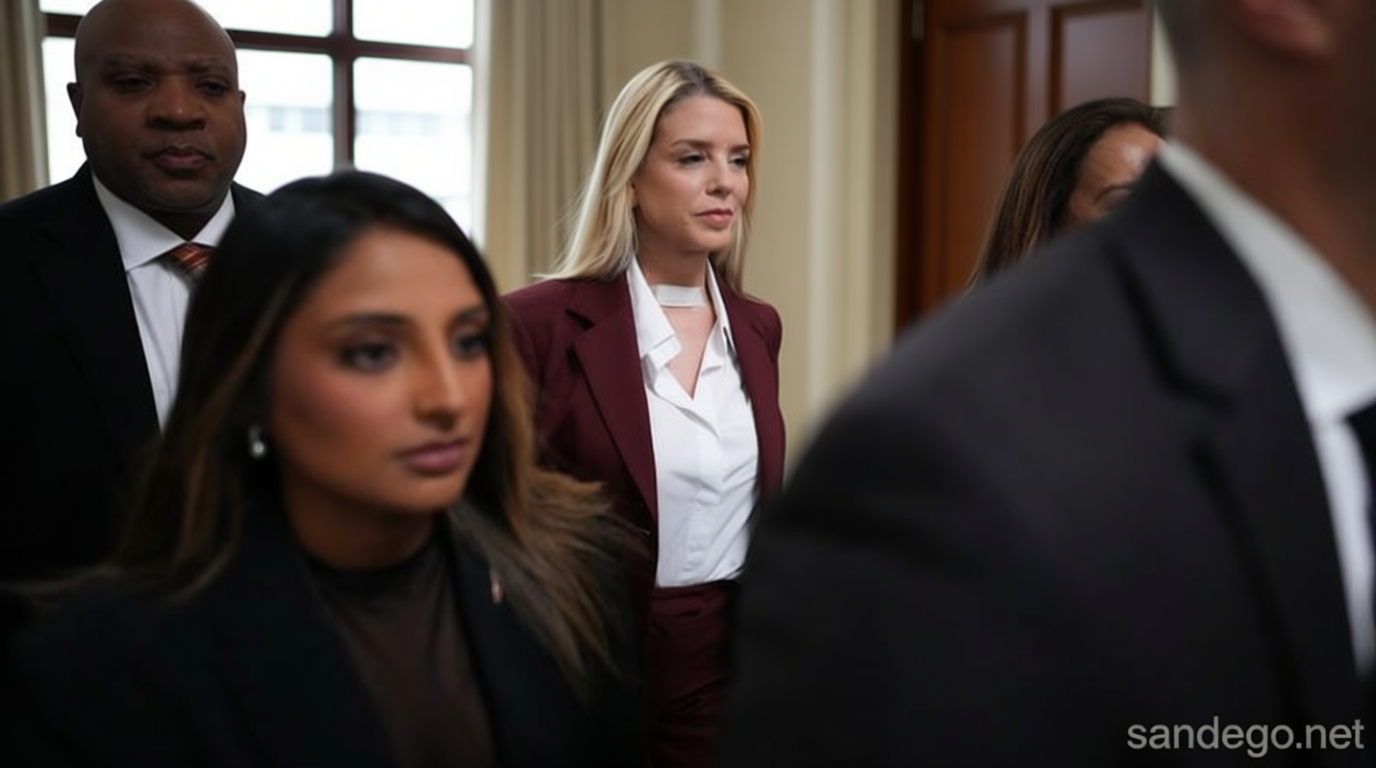
Bondi defends DOJ’s Epstein file handling
Sandego.net – Former Attorney General Pam Bondi maintained her stance during a House interview, asserting that the Justice Department’s approach to managing the Jeffrey Epstein files was sound. While Democrats criticized her answers as vague and evasive, Bondi insisted that the DOJ had shown “an unprecedented commitment to transparency.” The meeting, held in a closed-door session, brought to light internal conflicts within Trump’s administration, particularly around the release of documents tied to Epstein’s criminal activities. Lawmakers pressed Bondi to clarify the extent of President Donald Trump’s involvement, but she offered limited details, emphasizing that her successor, Todd Blanche, was central to the process.
Delegation as a Key Argument
Bondi’s defense centered on her delegation of responsibilities to Blanche, stating that he had overseen the entire investigation. “Acting Attorney General Blanche was managing the entire process,” she said, according to Rep. Robert Garcia, the top Democrat on the House Oversight Committee. However, critics argued that this explanation was more about shifting blame than addressing the core issues. “She sought to place the responsibility on Blanche rather than confronting the questions about Trump’s knowledge of Epstein’s crimes,” Garcia claimed, highlighting the lack of direct answers during the session.
In a social media post, Bondi refuted claims of evasion, stating that her remarks were accurate. “NOT TRUE,” she wrote on X, noting that she had praised Blanche’s leadership and described his ethical standards as “beyond reproach.” She also emphasized that as a high-ranking official, she had delegated many tasks to other senior leaders, including the release of Epstein-related documents. “The DOJ’s handling of the files was a collective effort,” she said in a prepared statement, framing her role as one of oversight rather than direct control.
Accusations of Avoidance
Democrats accused Bondi of dodging key questions, particularly about Trump’s awareness of Epstein’s crimes. Rep. James Walkinshaw noted that Bondi hesitated when asked about the president’s knowledge, responding with “I’m not certain to the extent of his knowledge.” Meanwhile, Rep. Dave Min labeled the interview a “sham,” arguing that Bondi’s responses failed to engage with the committee’s inquiries. A DOJ official, Harmeet Dhillon, defended the delegation, calling it a standard practice. “Leadership often involves entrusting others with specific responsibilities,” Dhillon explained, suggesting that the division of labor was routine.
Despite Dhillon’s support, lawmakers believed Bondi had been shielded from accountability. Rep. Robert Garcia claimed that Dhillon had “stopped Ms. Bondi multiple times from answering questions,” according to a source. This, the Democrats argued, was an attempt to limit her involvement in the process. Yet, Bondi maintained that her delegation was intentional, not a cover-up. “I delegated tasks to ensure the department’s handling of the Epstein files remained consistent,” she said, reinforcing her position that the process was well-managed under her supervision.
Comments on Maxwell and Contextual Shifts
Bondi’s testimony also touched on Ghislaine Maxwell, Epstein’s accomplice. She called Maxwell “evil” and expressed strong views about her sentencing. “She should not receive a pardon,” Bondi said, according to a source. She also mentioned her lack of prior knowledge about Maxwell’s prison transfer, which was reportedly due to security concerns. “Transfers are common when there are risks involved,” she explained, framing her absence as a result of procedural decisions rather than personal oversight.
The interview occurred just days after Bondi revealed her cancer diagnosis, adding a personal touch to the proceedings. During the meeting, she was visibly affected by her recent thyroid surgery, unable to move her head from side to side. Instead, she used body movements to communicate, a detail that underscored the physical challenges she faced. Despite this, she remained focused on the DOJ’s handling of the Epstein files, which had become a central issue in the Trump administration’s scrutiny. Her testimony highlighted both her commitment to transparency and the complexities of leadership in high-stakes investigations.