Emergency Two-Year Ban Placed on Three Kratom-Derived Compounds Sold in Everyday Retail Settings
Sandego.net – The Drug Enforcement Administration, operating under the US Department of Justice, has moved to classify three semisynthetic, opioid-like substances derived from kratom chemistry as Schedule I drugs — the same federal category that houses heroin, LSD, and cannabis. The designation, announced on August 25, takes effect immediately and will remain in force for two years under emergency scheduling authority. Two of the three compounds are already appearing in consumer-facing products such as powdered supplements, chewable tablets, and liquid energy shots stocked at gas stations, smoke shops, and convenience stores across the country.
The move signals a sharp escalation in federal oversight of a product category that has grown rapidly in the American wellness market over the past decade. By placing these substances in Schedule I, the government is declaring that they have “no currently accepted medical use and a high potential for abuse,” effectively freezing commercial distribution and research until the two-year window closes or the classification is revisited.
What the Three Compounds Actually Are
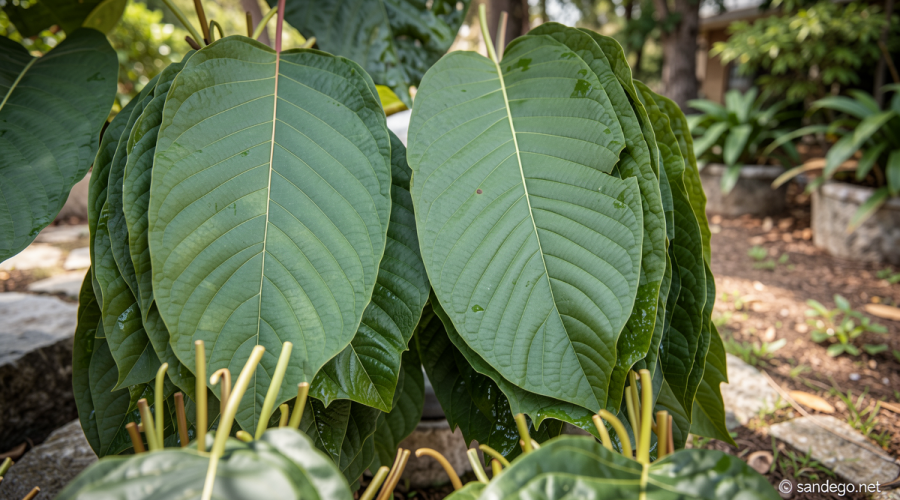
Kratom itself comes from the leaves of Mitragyna speciosa, a tropical tree indigenous to Southeast Asia. The plant contains more than 40 naturally occurring alkaloids — nitrogen-bearing organic molecules capable of producing pronounced physiological effects in humans. Morphine and caffeine are well-known examples of alkaloids from other plants. In kratom, the most abundant psychoactive alkaloid is mitragynine. When the leaf is metabolized by the body or subjected to drying during manufacturing, mitragynine converts into 7-hydroxymitragynine, commonly abbreviated as 7-OH. In natural leaf products and certain extracts, 7-OH typically accounts for only 1 to 2 percent of total alkaloid content.
The three newly scheduled substances are not natural kratom. They are laboratory-derived, semisynthetic modifications of 7-OH:
Mitragynine pseudoindoxyl (MGPI) — a high-potency, chemically rearranged derivative of 7-OH. MGM-15 and MGM-16 — additional semisynthetic derivatives of the same parent compound. The Justice Department noted that MGM-16 had not yet been confirmed in consumer products at the time of the announcement, but agencies acted preemptively out of concern that it would surface “as a substitute for related substances” once competitors in the market shifted formulations.
Clinicians Report a Surge in Dependence Cases
Medical professionals who treat substance-use disorders say the regulatory action tracks what they have been observing in exam rooms for roughly the past year. Dr. Myles Jen Kin, a physician board-certified in both addiction medicine and emergency medicine, serves as medical director at the Recovery Centers of America’s Massachusetts location. He described a dramatic uptick in patients presenting with dependence on kratom-derived products.
“A year ago, I might see maybe one a week, and now we’re probably seeing 10 cases a week,” Jen Kin said. “I think this is a necessary regulation that needs to happen.”
The Justice Department cited preclinical research demonstrating opioid-like effects in animal models as part of its justification. Jen Kin’s clinical observations, along with those of other addiction specialists, provide the human-side corroboration that the compounds carry genuine addiction potential comparable to other opioid-class substances.
Where Consumers Have Been Buying These Products
The compounds have been reaching consumers through ordinary retail channels — gas-station coolers, smoke-shop shelves, and convenience-store supplement aisles. One product line, a ready-to-drink beverage marketed under the name “Feel Free,” has drawn particular attention from users who describe feeling trapped in cycles of dependence, mounting debt, and repeated rehab admissions. The Department of Justice emphasized that many of these products carry labeling that obscures their true pharmacological risks, leaving buyers unaware they are ingesting concentrated, opioid-acting molecules.
Kratom-related poisoning calls to US poison-control centers have spiked more than 1,200 percent since 2015, a trend that tracks the product’s expansion from niche herbal shops into mainstream retail.
Regulatory Timeline and What Comes Next
The federal alarm on concentrated, semisynthetic 7-OH was first sounded in July 2025, when the Department of Health and Human Services recommended Schedule I classification for the substance — notably without accompanying data at that time. Many products marketed as semisynthetic 7-OH also contain MGPI or MGM-15, though not universally. HHS has extended the public-comment period on a proposed scheduling threshold for 7-OH under the Controlled Substances Act until September 10, giving stakeholders additional time to submit scientific and economic input before a final rule is set.
Warnings for People Already Using These Products
Both Jen Kin and Dr. Caleb Banta-Green, a research professor of psychiatry and behavioral sciences at the University of Washington School of Medicine, cautioned that the new classification could push some dependent users into abrupt withdrawal or toward unregulated alternatives. Banta-Green noted that individuals with opioid use disorder sometimes turn to natural or semisynthetic kratom-related products as perceived lower-harm options or as a means of managing withdrawal symptoms after discontinuing prescription opioids.
“If you stop taking any of these chemicals and you are feeling sick, immediately seek care at the closest addiction medicine or treatment center in the area,” Jen Kin said. “If you’re having a life-threatening crisis, then obviously you should go to the hospital.”
He added that attempting to stop using these products without medical supervision can produce worse effects than a monitored taper.
Research Freeze and Broader Implications
Because Schedule I status restricts the conditions under which a substance may be studied, the DOJ decision will also impede any ongoing or planned investigation into whether these compounds might hold genuine medicinal value. Researchers will face heightened regulatory hurdles before they can design controlled trials, potentially delaying answers about safe dosing, therapeutic windows, and long-term safety profiles. For a product category already navigating questions about standardization, labeling transparency, and public-health oversight, the two-year emergency window represents both a consumer-protection measure and a significant constraint on the scientific record that future policy will ultimately depend upon.
Related Reading
Frequently Asked Questions
What is DEA makes kratom related compounds Schedule?
DEA makes kratom related compounds Schedule is the main topic of this guide. The article explains the context, practical details, and next steps readers should understand.
Why does DEA makes kratom related compounds Schedule matter?
DEA makes kratom related compounds Schedule matters because readers are looking for a useful answer, not just a short summary. Good content should match search intent and help them decide what to do next.