A Perfectly American Start to the USA’s 2026 World Cup
The Opening Match
Sandego.net – The U.S. men’s national team’s debut in the 2026 World Cup was nothing short of iconic, a moment that encapsulated the nation’s spirit in a way that felt both nostalgic and forward-thinking. Folarin Balogun, the Nigerian-born Englishman who now calls himself a proud American, captured the essence of the game with a single word: “Dreamy.” His description, though simple, carried the weight of a nation rediscovering its passion for soccer, a sport that has long been a source of both pride and frustration for Americans.
Balogun’s unique background—a blend of Nigerian heritage and a childhood steeped in English culture—reflects the American identity itself. Growing up in a country that has always prided itself on cultural diversity, his perspective offers a lens through which the World Cup’s opening clash could be seen as a metaphor for unity. The game, played in the gleaming state-of-the-art SoFi Stadium, was more than a match; it was a celebration of shared dreams and collective energy. Fans filled the streets and the stands, their enthusiasm a testament to the sport’s power to bring people together.
A Crowd Like No Other
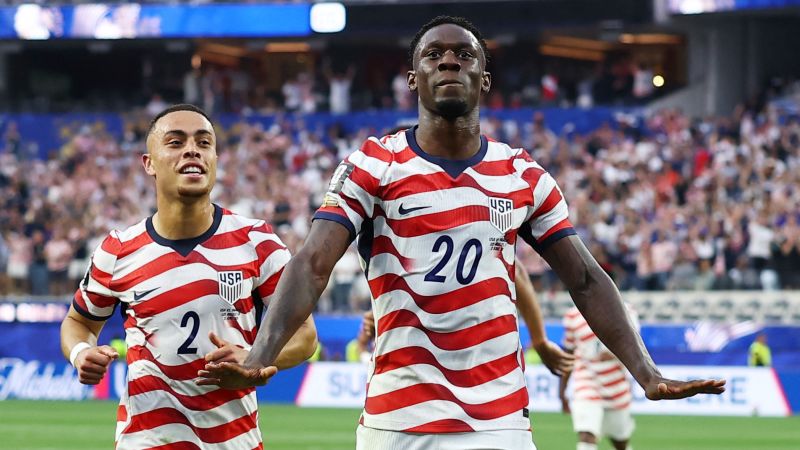
The atmosphere in Los Angeles was electric, a fusion of tradition and modernity that left no room for doubt. From the moment the first whistle blew, the stadium buzzed with a patriotic fervor that mirrored the Fourth of July. Fans dressed in every imaginable variation of the American flag—striped shirts, red-white-blue canopies, and even full-scale replicas of the Statue of Liberty—created a visual spectacle that rivaled Hollywood’s most ambitious productions. The cheers of “U-S-A!” echoed through the air, blending seamlessly with the strains of “The Star-Spangled Banner,” a rendition so powerful it seemed to overshadow the very stars who had once graced the screen.
Among the throngs of supporters, celebrities added their own flair to the occasion. Tom Cruise, known for his blockbuster roles, was seen chatting with David Beckham in the stands, while Kareem Abdul Jabbar received a standing ovation from fans who recognized his legendary status. Even Paris Hilton, ever the social media sensation, was too absorbed in selfies to notice the camera’s gaze. The stadium’s energy was infectious, a reminder that soccer’s appeal transcends borders and backgrounds, uniting fans in a way that feels almost magical.
Christian Pulisic, the team’s star player, played a pivotal role in the victory but not without a minor setback. Early in the second half, he was forced to exit the field after sustaining an injury to his left calf. Yet, the U.S. team’s performance remained unshaken, with Pulisic later expressing his confidence in the team’s support. “Having this crowd behind us, seeing the red, white and blue, all of our striped shirts, it was awesome,” he said. “Hearing the USA chants, it really pushed us forward.” His words underscored the transformative power of the moment, a rare instance where the American public’s collective enthusiasm translated into tangible success on the field.
A Historic Moment
The 4-1 victory over Paraguay marked a significant milestone for the U.S. team, its first three-goal margin of success in a World Cup since 1930. It was a moment that felt both triumphant and symbolic, a rare occasion where American soccer fans could celebrate without the shadow of doubt. For decades, the U.S. had struggled to make a mark in international football, often reliant on imported talent and a team that felt more like a collection of individual stars than a cohesive unit. But this game hinted at a new era, one where the team’s professional credentials and cultural cohesion might finally combine to create something extraordinary.
Historically, American soccer has been a tale of contrasts. While the country excels in other sports, its national team has often found itself in the shadows of European and South American rivals. The 2026 World Cup, hosted in the U.S., Canada, and Mexico, represents a chance to change that narrative. The team’s roster, filled with players who have honed their skills in top-tier leagues around the world, is a reflection of this globalized era. Yet, their journey began with a spark of homegrown pride, a reminder that the heart of the game lies in the nation’s own soil.
The opening match also served as a narrative device, blending the familiar with the fantastical. The stadium, a modern marvel, was adorned with every symbol of American identity, from American flags to patriotic banners. The music playing in the background—David Bowie and Queen’s “Under Pressure”—added a layer of irony, as if the world’s burdens were being lifted by the team’s commanding performance. Seven minutes into the game, the tension broke, and the U.S. took control, culminating in a goal that belonged to Damián Bobadilla, the first Paraguayan to score for the U.S. in the tournament.
This victory was more than a win; it was a catalyst. The U.S. team now carries the weight of expectations, a generation tasked with redefining American soccer’s place on the global stage. The 2026 World Cup is not just an opportunity to showcase talent but to rewrite the story of a sport that has long been considered a secondary passion in the U.S. With every goal, every tackle, and every chant, the nation’s love for soccer is being rekindled, proving that the dream of greatness is not just possible—it’s within reach.
As the players celebrated their hard-earned triumph, the message was clear: this was a turning point. The U.S. had finally found a way to bridge the gap between its sporting prowess and its cultural mosaic. Whether through the efforts of players like Pulisic or the creative expressions of fans, the game was a reminder that when the country comes together, even the most unlikely of dreams can become reality. The World Cup, after all, is not just about the ball or the goals—it’s about the people, the passion, and the shared belief that they can achieve something extraordinary.