
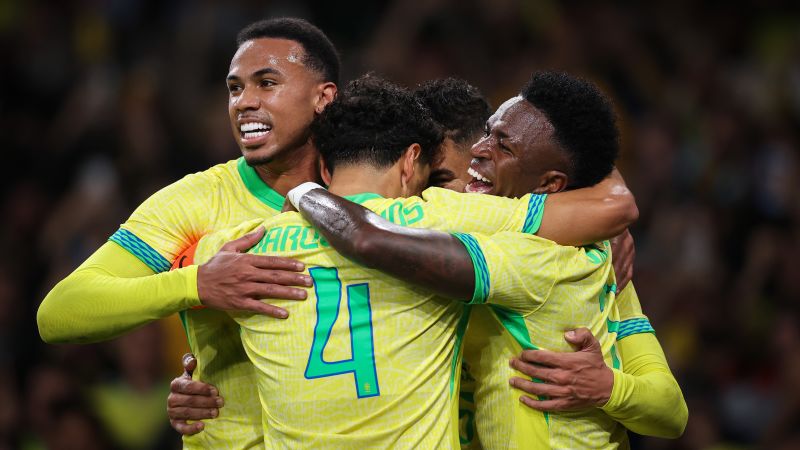
Brazil Aims to End 24-Year World Cup Drought in 2026
Sandego.net – The 2026 World Cup represents Brazil’s pivotal opportunity to break a 24-year championship drought, reigniting hopes for a sixth title. Fans and players alike are watching closely as the Seleção prepares to challenge the world’s best teams in what promises to be a high-stakes campaign. While the nation’s footballing legacy remains unmatched, the absence of a World Cup victory since 2002 has left a lingering sense of urgency. This year’s tournament could be the moment Brazil reclaims its throne, but the pressure is immense, with expectations rising as the team faces an array of formidable opponents.
A Legacy in the Balance
Brazil’s football history is steeped in triumph, yet the 24-year gap since their last World Cup success has created a narrative of near-misses and missed chances. From the 2006 quarterfinal exit to the 2014 7-1 defeat by Germany, the team has struggled to maintain its dominance. Recent campaigns in 2018 and 2022 further underscored this trend, with Brazil faltering in the knockout stages. However, the emergence of young talents like Vinícius Júnior and the strategic overhaul under new management have given the nation a renewed sense of possibility. The question now is: can Brazil finally end this 24-year wait for glory?
Despite past disappointments, the current squad carries the weight of history on its shoulders. The 2002 title remains a touchstone for fans, a reminder of Brazil’s ability to shine on the global stage. Yet, the 2014 disaster, where the team was humiliated 7-1 in the semifinals, has become a symbol of vulnerability. That match at Mineirão Stadium, where Brazil trailed 5-0 by halftime, remains a defining moment of this era. For many, it’s a scar that needs healing, and a World Cup win this year could be the key to overcoming that legacy of heartbreak.
Struggles and Scandals
Brazil’s journey to the 2026 World Cup has been marked by both on-field challenges and off-field controversies. The nation’s qualifying campaign was a test of resilience, with a 4-1 loss to Argentina in May 2025 serving as a catalyst for change. Captain Marquinhos called the defeat “embarrassing” and took responsibility, stating, “I’m sorry for our fans.” This moment of humility led to the resignation of Dorival Júnior and the appointment of Carlo Ancelotti, a coach with a proven track record in European leagues. The hope is that his leadership will guide Brazil past the hurdles of the 24-year wait for a World Cup title.
The 2014 semifinal loss to Germany, often referred to as “Mineiraço,” is still fresh in the minds of many. It wasn’t just the scoreline that shocked the world—it was the sheer scale of the defeat, with Brazil unable to mount a comeback. The 7-1 margin has since become a metaphor for crushing defeats, a term that lingers in Brazilian football culture. Tim Vickery, a respected South American soccer analyst, noted that this moment has etched itself into the nation’s psyche. For Brazil to end their 24-year wait, they must not only overcome their past but also redefine their identity on the global stage.
A New Era of Possibility
The 2026 World Cup offers Brazil a chance to rewrite its recent history. With the Seleção now boasting a mix of seasoned veterans and emerging stars, the team has the potential to challenge the world’s elite. Players like Neymar, who has been a cornerstone of Brazil’s attacking play, are expected to lead the charge, while the new coaching staff aims to streamline tactics and improve consistency. The 24-year wait for a World Cup title has created a generation of fans who have never seen Brazil triumph, but their passion remains undimmed. This tournament could be the turning point that restores the nation’s pride in football.
As the World Cup approaches, the focus is on Brazil’s ability to adapt and deliver. The 2002 team, led by Ronaldo Nazário, remains a benchmark of success, but the current squad must carve its own path. The 2014 disaster is a cautionary tale, yet it also serves as motivation for a team determined to end the 24-year wait. With the right strategy and a collective belief in their potential, Brazil has the chance to reclaim their place as the world’s footballing power. The road to redemption is long, but the 2026 tournament could be the final stretch they’ve been waiting for.