Africa’s diplomatic balancing act gives Russia room to advance
Sandego.net – Vladimir Putin used a Moscow gathering with African leaders to make a familiar case: Russia, he said, can offer the continent a partnership distinct from the approach taken by Western powers. But the leaders who attended are pursuing their own priorities, using a crowded international field to seek security, investment, food supplies, energy cooperation and diplomatic leverage.
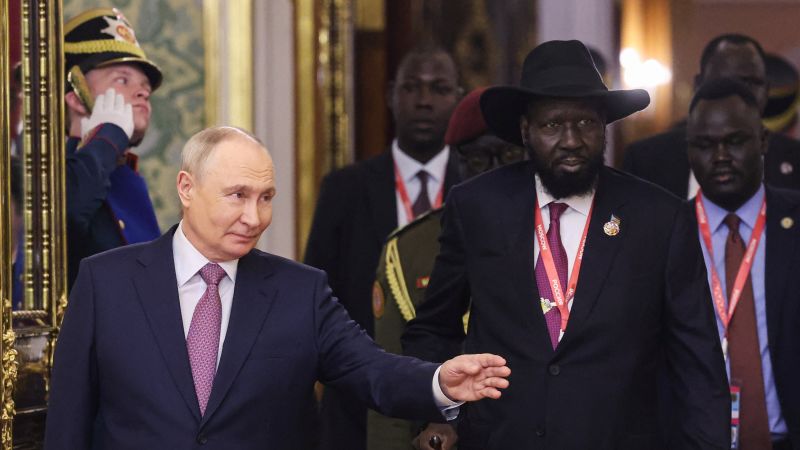
The third Russia-Africa Summit brought delegations from 48 of Africa’s 54 countries to Moscow for two days. Kremlin aide Yury Ushakov said 22 countries sent heads of state, up from 17 at the 2023 summit and 43 at the inaugural event in 2019. For Moscow, those images carry political value at a time when the war in Ukraine and Western sanctions have deepened Russia’s isolation from many European and North American governments.
For African states, engagement with Russia does not necessarily mean an exclusive shift away from Europe, the United States, China or other partners. Their approach is often one of practical diversification, shaped by national circumstances rather than ideological loyalty.
Putin’s message to African governments
At the summit, Putin accused Western countries of continuing colonial-era patterns through control of resources and debt. He presented Russia as a partner willing to expand trade and technological ties while allowing both sides to benefit.
“Our business does not engage in the predatory, neo-colonial exploitation of natural and human resources,” Putin said, adding that Russian companies supported local job creation and tax revenues.
The message is designed to resonate in countries where memories of colonial rule remain politically important and where frustration over unequal global economic relationships is widespread. It also serves a wider Russian goal: demonstrating that Moscow retains international partners despite pressure linked to its invasion of Ukraine.
Will Brown, an Africa policy specialist at the European Council on Foreign Relations, has argued that the summit’s visual symbolism may be more consequential than any individual agreement announced there. Photographs and video of Putin meeting African presidents can be used by Russian influence networks to project relevance across Africa and the broader Global South.
In that sense, the event itself becomes part of the strategy. A well-attended summit allows the Kremlin to challenge the impression that it has been diplomatically isolated, while giving visiting governments a prominent stage to signal that they retain multiple foreign-policy options.
Non-alignment, adapted for a changing world
Tighisti Amare, director of the Africa Program at Chatham House, describes the approach of many African governments as “diversified non-alignment.” Rather than placing themselves firmly in a Russian or Western camp, they maintain ties across competing blocs and pursue deals that serve immediate domestic needs.
Those needs differ sharply from one country to another. Some governments want military assistance amid insurgencies or political instability. Others are focused on agricultural products, electricity and energy projects, trade opportunities, or support in international forums. Competition between outside powers can also provide African leaders with bargaining power when seeking stronger commitments from traditional Western partners.
This is not simply a contest in which African governments are passive recipients of outside influence. Leaders can use relationships with Moscow, Beijing, Western capitals and regional partners to negotiate from a stronger position. The outcome may be temporary alignment on a particular issue rather than a permanent geopolitical choice.
Russia’s expanding security role
Russia has made notable gains in parts of the Sahel, particularly Mali, Burkina Faso and Niger. Military-led governments in those countries moved closer to Moscow after breaking with former Western security partners. Russian support has become a significant component of their efforts to confront armed groups and reinforce state authority.
A central instrument of that presence is the Africa Corps, a paramilitary organization that took over much of the work previously associated with Wagner after the mercenary group’s 2023 mutiny against the Kremlin. The transition was not merely a rebranding exercise. Africa Corps operates more openly under the authority of Russia’s Defense Ministry and military intelligence.
Many of its personnel previously fought with Wagner, but its role places greater emphasis on training and advising local forces, as well as guarding strategically important sites. Russia’s military footprint is therefore increasingly linked directly to the state rather than to the semi-autonomous mercenary structure that had become prominent across several African countries.
The Sahel is a major focus, but Russian-linked security activity extends beyond it. Anna Ida Rock, a researcher at the Swedish Defense Research Agency, says Africa Corps has a reported presence in Burkina Faso, the Central African Republic, Equatorial Guinea, Libya, Mali and Niger. Russian instructors have also been linked to the Republic of Congo, Madagascar and Togo, although claims concerning Togo remain disputed.
Moscow is also seeking access to the Red Sea through a proposed naval facility in Sudan. Such a foothold would have strategic importance because the Red Sea is a vital maritime route connecting the Mediterranean and the Indian Ocean.
Security partnerships bring mixed outcomes
Russian military support has produced uneven results. In Mali, Russian forces assisted government troops in recapturing Kidal, a north-eastern city of major political and military significance. Yet insecurity has continued to deteriorate, and Africa Corps has sustained substantial losses.
In Burkina Faso, Russian personnel have concentrated on protecting the government during a period of political turbulence. Their footprint in Niger has been more limited. In the Central African Republic, Russian forces have helped the government remain in power, but persistent insecurity means many civilians have not experienced a corresponding improvement in safety.
The contrast highlights a central challenge for Russia’s African strategy. Security agreements may help governments shore up control in the short term, but they do not automatically resolve the deeper conflicts, weak institutions and local grievances that fuel instability. The political benefits of outside military support can therefore coexist with continuing danger for ordinary residents.
Influence exceeds economic weight
Russia’s political and security profile on the continent remains larger than its commercial relationship with Africa. Trade was estimated at $27 billion, a figure that underscores the gap between Moscow’s strategic ambitions and its economic reach.
That gap does not eliminate Russia’s influence. Arms, security training, political messaging and high-level diplomacy can carry considerable weight, especially where governments feel dissatisfied with existing partners. But African leaders are likely to continue treating Russia as one option among many rather than as a replacement for every other external relationship.
The Moscow summit therefore reflected two simultaneous realities. Putin sought evidence that Russia remains an influential global player. African governments, meanwhile, used the occasion to preserve flexibility, advance national interests and keep multiple doors open in an increasingly competitive international landscape.
Related Reading
Frequently Asked Questions
What is Putin wants Africa on his side?
Putin wants Africa on his side is the main topic of this guide. The article explains the context, practical details, and next steps readers should understand.
Why does Putin wants Africa on his side matter?
Putin wants Africa on his side matters because readers are looking for a useful answer, not just a short summary. Good content should match search intent and help them decide what to do next.