
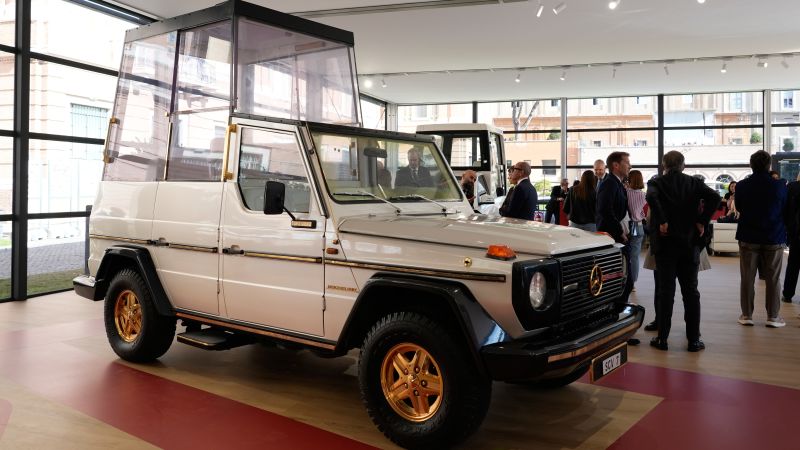
Vatican Museums Prepare a Century-Spanning Popemobile Display
Sandego.net – The Vatican is marking nearly 100 years of papal travel with an exhibition devoted to the distinctive vehicles that have carried popes through Rome, across Italy and around the world. The Vatican Museums unveiled a preview on Wednesday of “A Century of the Popemobile,” an exhibition bringing together eight Mercedes-Benz vehicles used by popes since 1930. The show is scheduled to open to visitors on Thursday.
For many people, the word “popemobile” brings to mind the high, glass-enclosed vehicle seen during major public events. The exhibition shows that the idea developed gradually. Its earliest examples were formal automobiles adapted for a pope’s particular needs, while later versions increasingly emphasized visibility, access and security during pastoral journeys.
The vehicles on display illustrate how papal travel changed over the decades. They were not simply ceremonial cars. Each was designed to help the pope be recognized by large crowds while maintaining a practical, protected setting for public appearances. As papal visits expanded beyond the Vatican, the design of these cars had to respond to different routes, audiences and forms of encounter.
A Vehicle Designed Specifically for Pius XI
The oldest automobile in the exhibition dates to May 23, 1930, when it was presented to Pope Pius XI. The Mercedes-Benz Nürburg 460 was created expressly for papal use and offered an especially ornate interior, including a silk-brocade armchair, fine wood elements and metal detailing.
Its appearance also helps explain why the popemobile has become a recognizable category of vehicle rather than merely a standard car used by a pope. Sandro Barbagallo, curator of the Historical Collections Department at the Vatican Museums, said the model clearly demonstrated the shift from a production vehicle to something singularly adapted for the papacy.
“It was specifically built, designed, and prepared for papal use, so much so that just by comparing it, you can see how it transitions from the serial to the unique,” Barbagallo said.
The 1930 vehicle reflects a period when a papal car could retain the visual language of a luxury automobile while being reshaped for a highly particular role. The pope needed to travel with dignity and comfort, but the vehicle also had to make his presence legible to those gathered along a route. That balance became more prominent in subsequent designs.
“From this point, it is clear how all the cars were then made, precisely to allow the pope to be seen, but to be seen and to see in total safety and, I would even say, comfort,” Barbagallo said.
From Formal Transport to Public Encounter
Several later Mercedes-Benz models trace the evolving relationship between the pope and the crowds attending public appearances. In 1960, Pope John XXIII received the 300 d Landaulet. Its removable rear side windows pointed toward a more open style of papal travel, allowing the future saint to reach out to people encountered along the way.
That detail may seem modest beside the more familiar transparent enclosures of later decades, but it represented an important change. The vehicle was becoming a place from which a pope could engage more directly with the faithful, rather than a closed car solely intended to move him between destinations.
A further change arrived in 1980, when St. John Paul II visited Germany. Mercedes-Benz developed the 230 G for the trip, incorporating a tall clear dome at the rear. The transparent structure was intended to provide protection while still allowing the vast crowds gathered for the visit to see the pope clearly.
The design also captures the central tension that has shaped popemobiles over time: the pope must remain visible and approachable, while the vehicle must answer the practical demands of travel and safety. Later papal appearances added another familiar element, as popes used these vehicles to greet people at close range and, in more recent years, bless babies brought forward from the crowd.
Pope Leo XIV Praises Innovation and Partnership
The exhibition preview coincided with a separate meeting between Pope Leo XIV and senior Mercedes-Benz executives. Leo, who is Chicago-born and known as an enthusiastic car lover, thanked the company for its longstanding partnership with the Holy See.
In his remarks, the pope linked the development of automotive technology with the changing nature of papal travel. He described the popemobile as more than a means of getting from one place to another, emphasizing its role in helping the pope meet the people gathered for liturgies, visits and public celebrations.
“Over the decades, the popemobile has evolved from a means of transportation into an instrument of encounter, enabling the pontiff to draw closer to the faithful during pastoral visits and public celebrations,” Leo said.
“In this way, your work has helped facilitate the church’s mission of reaching out to people and bringing a message of faith, of hope and of charity to the world.”
The remarks place the exhibition in a broader context. The cars are historical objects, but they are also part of how modern popes have conducted a visible public ministry. Their design has helped turn a journey through a city street or a large square into an occasion for direct contact between the pontiff and the faithful.
Leo also referred to the electric popemobile Mercedes-Benz presented to Pope Francis, a vehicle that reflected the Argentine pope’s environmental priorities. The reference connected the long history of papal vehicles with current questions about technology, sustainability and public responsibility.
“In this spirit, I encourage you to continue placing technological innovation at the service of human dignity, care for creation and the common good,” he said.
For visitors, “A Century of the Popemobile” offers a chance to see how those themes took physical form over successive generations. From the richly appointed Nürburg 460 of Pius XI to vehicles built for greater openness, clearer visibility and changing technological expectations, the exhibition presents the papal car as both a practical tool and a highly visible symbol of public connection.
Related Reading
Frequently Asked Questions
What is The Vatican unveils its holy garage?
The Vatican unveils its holy garage is the main topic of this guide. The article explains the context, practical details, and next steps readers should understand.
Why does The Vatican unveils its holy garage matter?
The Vatican unveils its holy garage matters because readers are looking for a useful answer, not just a short summary. Good content should match search intent and help them decide what to do next.