
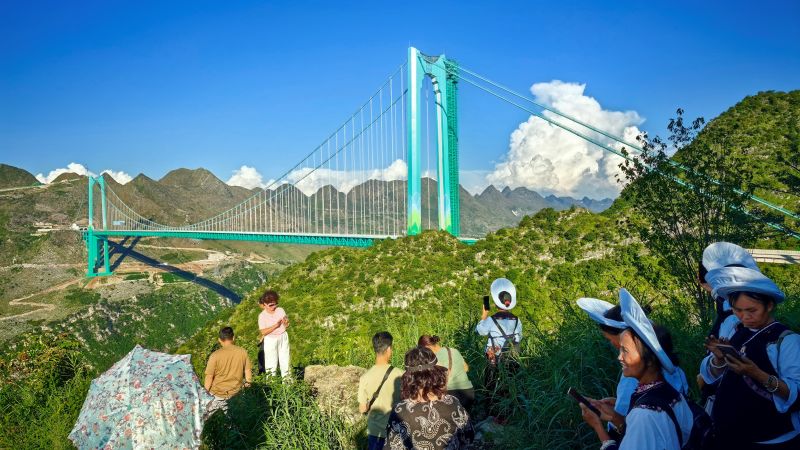
A Bridge That Turned a Mountain Gorge Into a Destination
Sandego.net – High above the Beipan River in southwestern China, the Huajiang Grand Canyon Bridge has become far more than a route across a remote gorge. Since opening in September 2025, the vast structure in Guizhou province has drawn visitors eager to look down into the canyon, walk alongside its roadway and, for the boldest travelers, leap from it on a bungee cord.
The bridge stands 625 meters, or 2,051 feet, above the river below. Guinness World Records recognizes it as the highest bridge on Earth. Its roadway rises almost nine times higher over the water than San Francisco’s Golden Gate Bridge, placing motorists and visitors amid a dramatic sweep of ancient mountain peaks.
Originally built to solve a practical transportation challenge, the project has also created a new kind of attraction. Crossing the canyon once required a journey of roughly two hours. The bridge reduces that trip to about two minutes, linking rural communities with the wider road system while putting an isolated landscape on the tourism map.
Engineering spectacle meets adventure tourism
Stretching nearly 2.9 kilometers, or 1.8 miles, across the canyon, the bridge is defined by two towering teal-colored pylons. From a distance, the gorge appears to vanish into the surrounding mountains. Up close, the scale becomes even more striking: visitors can enter sections of the structure and stand on glass viewing platforms suspended above the canyon.
Other attractions offer a more exposed experience. A walkway beneath the roadway allows guests, secured by harnesses, to move along the side of the bridge with open air beneath them. The route provides a perspective unavailable from inside a vehicle, where the bridge’s engineering and the vastness of the landscape can be harder to grasp.
Bungee jumping has become one of the site’s most visible draws. Before a jump, staff inspect the safety gear as participants wait on a platform below the road deck. Then comes a brief but intense descent toward the canyon floor. One jumper fell for seven seconds before the oversized cord carried him back upward, prompting cheers from spectators watching with phones in hand.
The activity captures the unusual transformation underway at Huajiang: an infrastructure project designed for mobility is now also a place where people travel specifically to experience height, scenery and spectacle.
Visitors bring new opportunities to canyon villages
The bridge has attracted about 3.3 million visitors from its opening through August 2026, based on figures provided by local officials. The influx has created possibilities for residents in villages that previously received few outside travelers.
For Lin Guoquan, the arrival of the bridge prompted a return home. After working as a chef in Yunnan, Zhejiang and Guangdong provinces, he went back to Guizhou and began restoring older properties for visitors. His grandparents’ house was among the buildings converted into guest accommodation.
His early plans were modest. The homestay began with nine rooms, but demand grew rapidly as travelers began arriving to see the bridge and surrounding mountains.
“When we first opened, we only had nine rooms. Now we have expanded to 52, and we still don’t have enough rooms for all our guests,” Lin said.
Tourism around the bridge has surged during major holiday periods. More than 300,000 visits were recorded at its service area during the nine-day Chinese New Year holiday in February 2026, exceeding the population of Buffalo, New York.
Lin has also used social media to introduce viewers to village life beneath the bridge. He has gained more than 100,000 followers on Douyin, China’s equivalent of TikTok, through livestreams that feature the local scenery and the bridge overhead. The audience has translated into bookings as visitors seek advice before planning their trips.
“Lots of people book rooms at my homestay after watching my videos. They ask me for travel advice,” he said.
A physical crossing and a digital connection
The tourism boom has highlighted another need in the mountain region: reliable mobile service. Reaching a dramatic destination by road is only part of the visitor experience; travelers and small businesses also depend on connectivity for navigation, reservations, payments and sharing images from the site.
Mobile coverage in the area had previously been limited. China Mobile, the state-owned telecom operator, and Huawei have expanded the network with additional base stations to support the rising number of visitors.
“What people see is this mighty physical bridge,” said Zhou Jianguo, a member of Huawei’s China strategy and business development division. “Yet a bridge in the digital world is equally necessary.”
That pairing of engineering and connectivity helps explain why Huajiang has developed into a broader destination rather than simply a faster crossing. The bridge has shortened travel times, created a focal point for adventure tourism and offered nearby residents new ways to welcome travelers and promote their communities.
In a province long defined by difficult terrain, the Huajiang Grand Canyon Bridge shows how a piece of transport infrastructure can reshape the experience of place. For drivers, it is a remarkably quick route over a canyon. For visitors, it is a platform for extraordinary views. For communities below, it has become an opening to a much larger audience.
Related Reading
Frequently Asked Questions
What is How the world s highest bridge?
How the world s highest bridge is the main topic of this guide. The article explains the context, practical details, and next steps readers should understand.
Why does How the world s highest bridge matter?
How the world s highest bridge matters because readers are looking for a useful answer, not just a short summary. Good content should match search intent and help them decide what to do next.