Curfews Introduced as France Grapples With Widespread Unrest
Sandego.net – French authorities have moved to restrict nighttime activity in several cities after a weekend of protests and rioting left at least two people dead, led to more than 2,000 arrests, and caused extensive damage to public and private property.
The measures include limited curfews in parts of Paris, Lyon, Marseille, Nice and communities in the northern Nord department. Prime Minister Sébastien Lecornu urged local officials to consider partial restrictions aimed at protecting residents, businesses and public spaces as tensions remained high on Monday.
The unrest began with demonstrations focused on schools and living costs, but rapidly grew into a broader expression of frustration over unemployment, affordability, inequality and dissatisfaction with the government. Although officials and political figures have stressed that most participants have protested peacefully, some gatherings descended into violence, particularly after dark.
Restrictions Across Major Cities
In Paris, Place de la République was placed under curfew from 11 p.m. Monday until 6 a.m. Tuesday. Streets surrounding Les Halles faced restrictions from 10 p.m. Monday through 6 a.m. Tuesday.
Lyon prohibited gatherings on public roads between 6 p.m. and 9 p.m. Monday, followed by a curfew in parts of the city lasting until Tuesday morning. Marseille barred demonstrations and public gatherings from midday until 8 p.m. local time.
Nice introduced a nighttime restriction for minors in its downtown area, running from 9 p.m. Monday to 6 a.m. Tuesday. Lille, Douai, Wattignies and Denain were also included in curfew measures from 8 p.m. Monday until 6 a.m. Tuesday.
The decisions reflect growing concern that disturbances could intensify after evening demonstrations, when groups of masked individuals were involved in looting, arson and confrontations with police.
Violence Overshadows a Larger Peaceful Movement
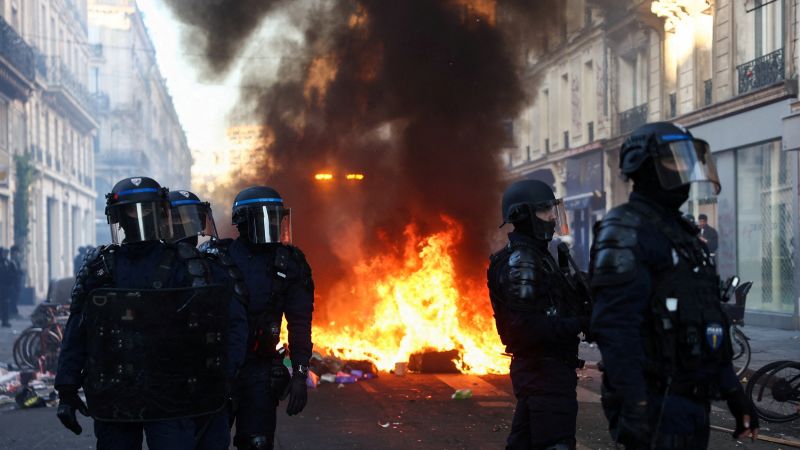
Police used tear gas during clashes with black-clad and hooded rioters in multiple locations. Fires were set, shops were broken into and government buildings were targeted. Serious injuries were recorded, including two people who lost their hands.
In Paris, masked groups set fires and looted businesses. Protesters in Lyon set the city’s tourist office ablaze. In Limoges, a 143-year-old town hall spire collapsed after being engulfed by flames, an image that stirred difficult memories of the Notre Dame Cathedral fire for many French residents.
Yet the violence represented only part of a much larger national mobilization. More than half a million people demonstrated throughout France on Saturday, with many marches remaining orderly. Jean-Luc Mélenchon, the leader of the far left, described the Paris gathering as moving calmly.
The contrast between peaceful crowds and destructive incidents has become central to the political debate. Demonstrators have sought to draw attention to social pressures affecting families, workers and students, while authorities have focused on identifying those responsible for violence and property destruction.
“Those who destroyed must pay. Those who looted must pay back. Those who sought to bring down the Republic will be held accountable.”
President Emmanuel Macron made those remarks Sunday evening, promising meetings during the week to consider concrete proposals and hear protesters’ concerns. Whether that outreach can ease public anger remains uncertain, especially with an election to choose Macron’s successor only six months away.
From School Strike to Nationwide Demonstrations
The movement first emerged in September, when students and teachers at a high school in the Paris suburbs went on strike. They called for more personnel and greater resources. Their immediate demands were met, and the strike ended, but the protest helped trigger wider action.
Students across France, already frustrated by overcrowded classrooms and staff shortages, soon organized their own demonstrations. At times, those protests turned confrontational. Public anger intensified after footage showed a police officer using a prohibited headlock on a girl, with critics viewing the incident as evidence of an excessively forceful response.
Within weeks, the demonstrations expanded beyond education. The movement began to encompass concern over the rising cost of living, lack of economic opportunity, perceived government inaction and a widening gap between rich and poor.
“This can’t go on. There’s the cost of living. There’s unemployment. There’s a bunch of things. A young person will go looking for work, we’ll promise him a lot, and he’ll end up with nothing.”
Maria Pallas, 57, a member of a major French trade union, voiced those concerns during Saturday’s Paris protest. Her comments captured the broader message heard across the country: for many participants, the demonstrations are not limited to one policy dispute but reflect accumulated dissatisfaction with daily economic pressures and uncertainty about the future.
Political Pressure and a European Concern
As France assesses the damage from the weekend, criticism is mounting over whether the government adequately anticipated the scale of the crisis. The intensity of the unrest has created a difficult challenge for officials who must respond to violence while addressing demands from a movement that includes many peaceful participants.
The situation also carries implications beyond France. Similar cost-of-living demonstrations have begun appearing in nearby countries, raising concern that the frustration fueling French protests may resonate elsewhere in Europe.
For residents in affected cities, the curfews are an immediate effort to restore calm and reduce the risk of further damage. For the government, however, restoring order is only one part of the challenge. The larger test will be whether meaningful engagement with concerns about education, jobs and living costs can prevent the unrest from deepening in the months ahead.
Related Reading
Frequently Asked Questions
What is Several French cities impose curfews after?
Several French cities impose curfews after is the main topic of this guide. The article explains the context, practical details, and next steps readers should understand.
Why does Several French cities impose curfews after matter?
Several French cities impose curfews after matters because readers are looking for a useful answer, not just a short summary. Good content should match search intent and help them decide what to do next.