Trump’s Late-Campaign Agenda Puts GOP Candidates in a Difficult Position
Sandego.net – With the 2026 midterm elections approaching, many Republican candidates appear eager to create distance between their own campaigns and President Donald Trump. The president’s recent public focus helps explain why: he has continued to spotlight proposals that draw overwhelming opposition from voters, even as his party tries to limit political damage.
Trump is entering the midterms as a historically unpopular president, and his administration has repeatedly embraced ideas with little evident public support. In recent weeks, two particularly striking proposals became symbols of that broader problem: a plan to use taxpayer money for advertisements promoting Trump, and a proposal to live stream the execution of Fort Hood shooter Nidal Hasan.
Both ideas now appear to have been abandoned. Trump said campaign funds, rather than public money, would be used for the ads. He also said Thursday that Hasan’s execution would not be broadcast live.
The reversal on the execution came hours after a Washington Post-ABC News poll found that registered voters opposed a live stream by 80% to 19%. A Reuters-Ipsos poll conducted the previous week found an even wider rejection of taxpayer-funded political advertising, with 89% calling it inappropriate and only 9% supporting it.
Those figures are unusually lopsided, even by the standards of contentious Trump-era policies. One comparable example was the issue of pardons for violent January 6 defendants, which a Washington Post poll found registered voters opposed by 83% to 16%.
A Campaign Message That Repels More Voters Than It Reaches
The political concern is not simply that the proposals were controversial. The timing is equally important. Ideas that might have generated internal debate at another point in a presidency were being considered and promoted during the final stretch of an election year, when Republican candidates are attempting to persuade skeptical voters that their focus is on everyday concerns.
Live streaming Hasan’s death also carried consequences beyond domestic politics. Critics, including some Republicans, warned that such a broadcast could serve extremist propaganda by creating a highly visible public martyr. The episode raised questions about whether advisers were reluctant to challenge Trump and Defense Secretary Pete Hegseth, or whether internal objections were dismissed too easily.
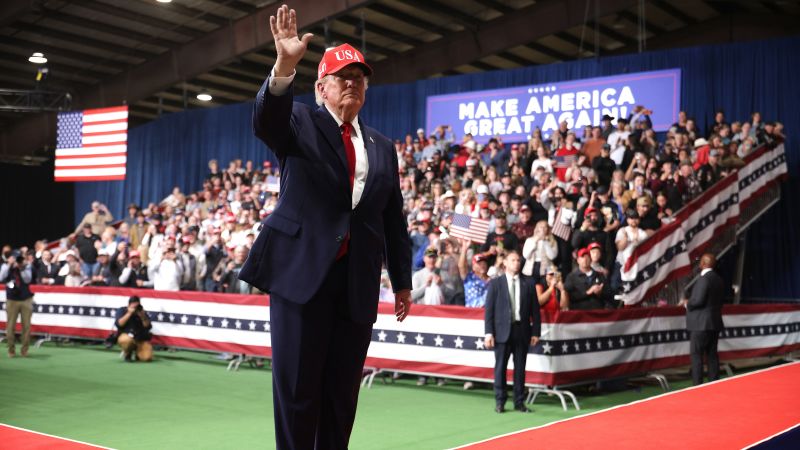
Trump’s rally speeches on Wednesday showed that these were not isolated cases. In Arizona, he again highlighted his trade conflict with Canada and repeated ideas about making Canada or Greenland the 51st state.
“They are brutal, and we don’t take that crap anymore,”
Trump said while discussing Canadian trade policies toward the United States.
“They’ll end up being the 51st state, because it’s the only way it works.”
He later added:
“Just like Greenland.”
Trump then returned to the subject of Greenland, saying he had not intended to invade the territory, despite having publicly kept that option open in the past.
Canada, Greenland and Tariffs Remain Major Vulnerabilities
The combination of tariff rhetoric, pressure on Canada and renewed comments about Greenland highlights several issues that have already produced significant public opposition. In a February poll, 72% disapproved of Trump’s handling of Greenland. Proposals to make Canada the 51st state were opposed by either 75% or 80% of respondents in polls last year.
His recent tariffs on Canada were also unpopular when they were launched. Americans opposed them by 57% to 20%, nearly a three-to-one margin. More recent polling from Fox News, AP-NORC and CNN has pointed in the same direction, with roughly seven in 10 Americans or registered voters disapproving of Trump’s handling of tariffs. Each survey showed his weakest ratings on the issue so far.
There is a political difference between defending an existing policy and choosing to make that policy a centerpiece of a campaign message. Trump’s tariffs are not an unavoidable response to a crisis; they are an elective course that he has chosen to pursue and promote with less than three weeks remaining in the campaign.
That makes the approach especially difficult for Republicans running in competitive races. Candidates can try to emphasize local issues, affordability or their independence from Washington, but the president’s rallies can quickly pull attention back to policies that voters broadly reject.
The Economy Remains the Central Test
Trump also continued on Wednesday to describe the economy in highly positive terms in both Arizona and Montana. He argued that tariffs do not produce inflation and said the country was becoming wealthier because of the tariffs and elevated oil prices.
“Our country is making more money than it’s ever made because of the fact that oil is so high,”
Trump said in Bullhead City, Arizona.
“I care more about the little person than I care about the big person,”
he added, while saying that oil-producing states were “making a fortune.”
For more than a year, Trump has argued that inflation is not a serious problem and that the economy is experiencing a “golden age.” Yet the persistence of that message has not persuaded many voters. A Pew Research Center poll last month found that 42% of Americans rated the economy poorly, underscoring the gap between the administration’s message and the public’s lived perception of economic conditions.
That disconnect is central to the Republican challenge. Voters do not necessarily judge an economy through broad claims about national wealth, trade revenue or oil prices. They often measure it through household costs, financial security and whether official assurances match their own experience.
As Election Day nears, Trump’s instinct to revisit unpopular fights may leave Republican candidates with little room to define their own priorities. The political question is no longer merely whether the president can energize his loyal supporters. It is whether repeatedly elevating widely rejected proposals makes it harder for his party to win over the voters who will decide the midterms.
Related Reading
Frequently Asked Questions
What is Trump s worst political instincts are?
Trump s worst political instincts are is the main topic of this guide. The article explains the context, practical details, and next steps readers should understand.
Why does Trump s worst political instincts are matter?
Trump s worst political instincts are matters because readers are looking for a useful answer, not just a short summary. Good content should match search intent and help them decide what to do next.