
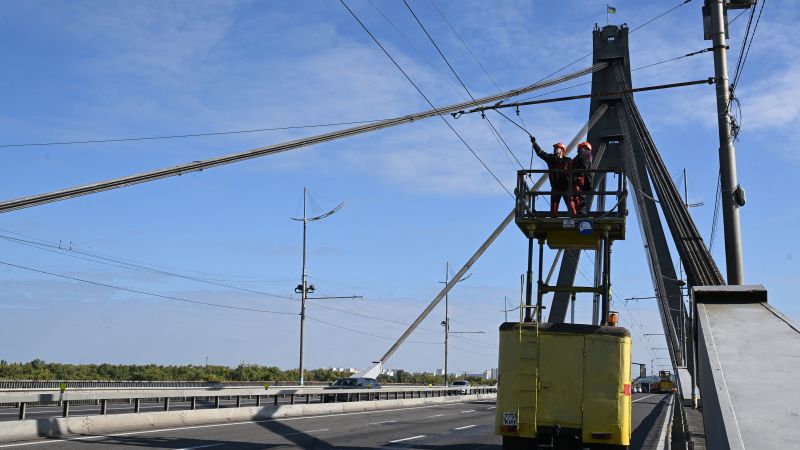
Kyiv Faces New Pressure After Strike Damages Northern Bridge
Sandego.net – Kyiv’s transport network came under renewed pressure on Saturday after a Russian strike damaged the capital’s Northern Bridge, adding to disruption already caused by repeated attacks on another crucial river crossing.
Two people were injured in the latest attack, Mayor Vitaliy Klitschko said. The strike damaged part of the road and affected the electricity supply used by trolleybus services. Authorities also imposed limits on some traffic moving across the Dnipro River.
The incident followed a severe assault on Kyiv’s Southern Bridge, which was struck five times in less than 24 hours on Friday. That bridge supports both road traffic and the city’s subway system, making it a particularly important connection between the two sides of the capital.
River Crossings Become a Critical Concern
The Southern Bridge has remained closed, while the Northern Bridge is operating with restrictions. Together, the closures and limits have created major travel problems in Kyiv since Thursday and raised concerns about how residents, workers and emergency services can move through the city.
The Dnipro River divides Kyiv into two broad sections. The right bank contains many of the capital’s government institutions, offices and business districts. The left bank is largely residential and is home to at least 30% of Kyiv’s population. Disruptions to bridge access can therefore affect daily life across the city, from commuting and public transport to the delivery of essential services.
Ukrainian officials have warned that the attacks are, in effect, splitting the capital in two. The impact reaches beyond traffic congestion: damage to roads, power systems and transit links can make it harder for the city to maintain normal operations while responding to ongoing air attacks.
Russia’s Ministry of Defense said Saturday’s strike targeted the Northern Bridge because it is used to transport Ukrainian troops and military supplies. The ministry also said it had targeted a logistics center in the wider Kyiv region.
Elsewhere in the region, Kyiv regional military administration head Tymur Tkachenko said a warehouse and a production facility had been hit. Four people were injured there.
Emergency Measures as Attacks Intensify
Kyiv’s defense council convened an emergency meeting on Friday as the bridge attacks escalated. The city has faced a faster-paced Russian campaign since late August, with Moscow exploiting Ukraine’s shortage of interceptors and the limited options available to counter jet-powered drones.
The scale of the overnight threat remained substantial. Ukraine’s Air Force said Russia launched 157 attack drones and decoy drones overnight and during the early hours of Saturday. Air defenses destroyed or neutralized 131 of them.
Even when many incoming drones are intercepted, repeated launches can place heavy strain on air-defense resources and leave cities managing the risks of falling debris, damaged infrastructure and disrupted public services. For Kyiv, the latest attacks have brought that pressure directly to the routes that link its neighborhoods across the river.
The capital is in a very dire situation. And it is no longer possible to pretend that we can live as we did in peacetime.
Klitschko described the attacks as a broad assault on the city’s ability to function, citing infrastructure, logistics, homes and social facilities among the areas affected. He also said Russia had resumed efforts to damage the energy sector, a concern with practical consequences for transport, heating, communications and other vital urban systems.
The enemy is laying waste to Kyiv. Infrastructure, critical infrastructure, logistics, housing, social facilities. The aggressor has also resumed its destruction of the energy sector. We are doing everything in our power to keep the city functioning under constant destructive attacks, when it is no longer a question of our usual comforts, but of safety and survival.
The mayor called on residents to show the same solidarity demonstrated at the start of Russia’s full-scale invasion.
Unite, as we did in February 2022.
What the Disruption Means for Residents
Bridge damage carries unusual significance in Kyiv because river crossings are not easily replaced. A temporary restriction on one route can redirect vehicles and passengers onto other already busy connections, while the closure of a bridge serving both road and rail transit can amplify delays across multiple forms of travel.
For residents on the left bank, access to workplaces, government services and commercial districts on the right bank may become more difficult when crossings are limited. The effect can also be felt by people traveling in the opposite direction to return home, as well as by businesses and public services that depend on reliable movement between the two sides of the city.
Authorities now face the task of maintaining safety around damaged routes while preserving as much mobility as possible. The immediate priority is likely to remain protecting people, assessing damage and keeping essential systems operational amid continued air threats.
Saturday’s strike on the Northern Bridge underscored how attacks on transport and energy infrastructure can reshape daily life far beyond the direct site of an explosion. With one major bridge closed and another under restricted use, Kyiv is confronting a new layer of disruption as Russian attacks on the capital continue.
Related Reading
Frequently Asked Questions
What is Russia strikes another major bridge in Kyiv?
Russia strikes another major bridge in Kyiv is the main topic of this guide. The article explains the context, practical details, and next steps readers should understand.
Why does Russia strikes another major bridge in Kyiv matter?
Russia strikes another major bridge in Kyiv matters because readers are looking for a useful answer, not just a short summary. Good content should match search intent and help them decide what to do next.