Sweden Awaits a Decisive Count in a Near-Even Parliamentary Vote
Sandego.net – Sweden faces an uncertain political outcome after an exceptionally tight parliamentary election left the center-left opposition holding a tentative one-seat advantage. With votes still being counted, the result could determine whether the country reverses its recent shift toward stricter migration policy and a more influential far-right presence in national politics.
A partial tally from 4,853 of Sweden’s 6,312 voting districts put the opposition center-left alliance on 175 seats in the 349-member Riksdag. Prime Minister Ulf Kristersson’s governing right-wing bloc was projected to receive 174 seats. The narrow margin means the final result may remain unclear until overseas ballots have been processed.
The opposition is led by Social Democratic leader Magdalena Andersson. Kristersson’s Moderate Party heads the governing side, which has sought to retain power with the support of the Sweden Democrats, a party on the far right.
Overseas ballots could settle the outcome
Election-night projections underscored just how unstable the race remained. An initial exit poll had suggested a more comfortable center-left lead, with 51% of the vote. A later projection showed a far smaller gap, bringing fresh optimism to the Sweden Democrats’ election gathering.
Maria Malmer Stenergard, Sweden’s foreign affairs minister and a Moderate Party member, cautioned that a definitive answer might not arrive immediately.
“I think it will be a long night. Maybe we won’t even have the results until Wednesday when the votes that have been cast abroad arrive.”
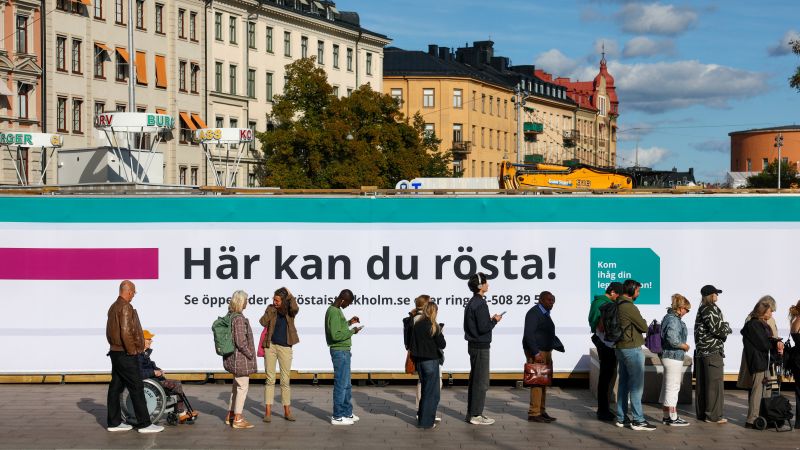
For voters, the close result has made every remaining ballot politically significant. A single-seat difference can shape the ability of either bloc to form a government, negotiate support and set the tone for Sweden’s next parliamentary term.
Migration policy at the heart of the contest
The election is not expected to alter Sweden’s broad pro-Western orientation or its support for Ukraine. Its central domestic consequence, however, concerns the country’s direction on immigration, integration and civil liberties.
Sweden, a country of about 10.6 million people, was long viewed as one of Europe’s more welcoming destinations for immigrants. That approach changed after Kristersson took office four years ago. His government ended permanent residency for refugees, tightened welfare requirements and increased expulsions for people without the legal right to remain.
Supporters of the governing bloc argue that tougher measures have been necessary, particularly in response to gang violence and immigration concerns. Many right-leaning voters see a victory as validation for policies they believe have reduced immigration dramatically and helped curb criminal networks.
Opponents contend that the government’s approach has moved Sweden away from longstanding liberal values. They argue that immigrants are being pressed to conform more closely to Swedish cultural norms or face a combination of incentives and sanctions intended to encourage departure.
The debate has taken on added importance because Kristersson broke with a previous political taboo before the election by pledging to bring the Sweden Democrats into government. The move was intended to create a durable right-wing majority, but it has also alarmed Swedes who regard formal cooperation with the party as an unacceptable step.
The Sweden Democrats’ role
The Sweden Democrats have become central to the country’s political balance. The party acknowledges that neo-Nazis and white supremacists were among its founders during the 1980s. It says it has removed extremists from its ranks and has apologized for its history.
Its leader, Jimmie Akesson, has long pressed for tighter immigration controls. While voting in Rinkeby, a suburb near Stockholm with one of Sweden’s largest Swedish-Somali communities, Akesson said the area “doesn’t look like Sweden.” The remark reflected the sharp cultural and demographic arguments that have defined much of the campaign.
For Sweden Democrats officials, the unexpectedly narrow projections made the final count especially tense. Ludvig Aspling, a member of parliament and the party’s immigration spokesperson, described the moment in deeply personal terms.
“You cannot imagine how nervous I am right now. It feels like my life’s work is hanging in the balance.”
“It is going to be super tight. We still have a chance.”
A result watched beyond Sweden
The election is being followed closely across Europe, where far-right parties have gained confidence from recent electoral advances. The anti-immigrant Alternative for Germany won a German state election the previous week, strengthening expectations among allied movements that further gains may be possible.
Far-right parties are also looking ahead to contests elsewhere on the continent, including the National Rally’s attempt to win the French presidency next year. A strong Sweden Democrats performance would be welcomed by those groups as another sign that immigration remains a potent issue for European voters.
Kristersson entered the campaign having trailed Andersson in opinion polling through much of his four-year term. In the final weeks, though, his bloc narrowed the gap as the Social Democrats lost ground. The late movement helped produce a contest in which neither side could claim a secure mandate on election night.
The remaining count will therefore decide more than the distribution of seats. It will show whether Sweden’s electorate wants to continue the governing bloc’s stricter course on migration and its closer partnership with the Sweden Democrats, or whether it prefers a center-left government led by Andersson that could halt that shift.
Until the final ballots are included, Sweden’s next government remains unresolved. The preliminary one-seat edge gives the opposition a path to power, but the scale of the uncertainty means the country may have to wait several days before knowing which political direction it has chosen.
Related Reading
Frequently Asked Questions
What is Sweden s parliamentary election heads?
Sweden s parliamentary election heads is the main topic of this guide. The article explains the context, practical details, and next steps readers should understand.
Why does Sweden s parliamentary election heads matter?
Sweden s parliamentary election heads matters because readers are looking for a useful answer, not just a short summary. Good content should match search intent and help them decide what to do next.