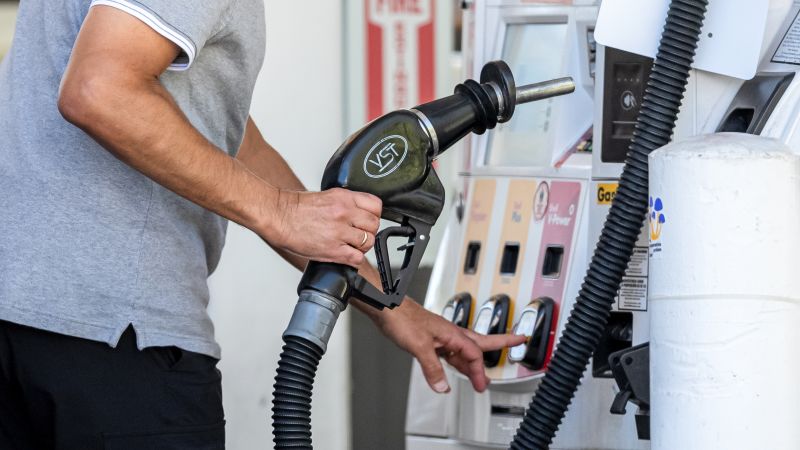
Record Labor Day Gas Prices Keep Americans Locked at Home
Sandego.net – The national average for a gallon of regular gasoline climbed to $4.15 on Monday, setting the highest Labor Day price ever recorded. The surge traces directly to the US-Iran conflict that erupted in late February, which has kept the Strait of Hormuz — a chokepoint through which roughly a fifth of global oil flows — largely impassable. With crude oil hovering around $80 per barrel, relief at the pump has proven elusive even as the calendar turns toward autumn.
For millions of households, the numbers translate into missed birthdays, abandoned road trips, and a quiet erosion of the small pleasures that once filled a summer. The pain at the pump is no longer an abstract headline; it is the reason a grandmother in Tennessee is reduced to a glowing phone screen when she wants to hold her grandchildren.
A Grandmother’s Summer of FaceTime
Linda French, 78, a retired schoolteacher in Jonesborough, Tennessee, had planned a summer visit to New York to see her elderly brother, still recovering from hip surgery, and her young great-nieces and nephews. The drive spans several hundred miles, and at current pump prices the trip simply could not be justified. Airfare offered no escape either: the ticket she purchased in March more than doubled in cost within a few months.
What remains is a video call. French says it is not the same.
“You can’t hug your family,” she said, lamenting that she can’t tickle her baby relatives’ toes and pinch their cheeks. “We’re all getting older. It’s hard not to see them.”
French has already scrapped plans to travel to Washington, DC, for Thanksgiving and to New York for Christmas. The cancellations are not a matter of preference but of arithmetic.
The Numbers Behind the Pain
AAA data show that a gallon of regular gas averaged $2.98 nationwide in late February, just before the US-Iran conflict escalated. By August, the monthly average had reached $4.07 — the highest reading ever logged for that month. Last month’s figure sat a dime above the 2022 peak, the previous major price shock triggered by Russia’s invasion of Ukraine.
Aixa Diaz, an AAA spokesperson, noted that crude oil’s persistence in the $80 range, compounded by the Hormuz blockade, has prevented the brief late-spring dip from becoming a sustained correction. Prices retreated modestly in early summer but rebounded sharply by August.
Historically, Labor Day gas had never breached the $4 mark before this year. In 2022, after June’s record $5.02 spike, prices had cooled to $3.79 by the time the holiday arrived. This year’s trajectory is steeper and, analysts warn, likely to persist.
Travel Flattens Out
Higher fuel costs did not halt Americans from hitting the road this summer, but they did terminate a multi-year streak of surging travel volumes. After steady post-pandemic growth, AAA projected that Memorial Day and July 4th trip numbers would land essentially flat against last year’s record highs. The affordability ceiling is now visible in the data.
A Young Analyst’s Commute Becomes a Tax
Colton Comstock, 28, moved back home after college with a clear plan: sock away savings for a house down payment and accelerate repayment of his $60,000 student loan. He works as a financial analyst in Johnsburg, Illinois, and commutes a 75-mile round trip daily to a door and dock service company. Recently, he paid $4.55 per gallon.
“Rising gas prices is negating the fact that I’m living at home to save money,” Comstock said.
Determined to keep setting aside roughly $500 a month toward a future purchase, he has had to trim the extra funds he was routing into his student loan account. His visits to the family lake house about 100 miles away in Wisconsin — where he stargazes and talks with his brothers from the pier — have dropped to a single trip this summer, down from several.
“I’m just trying to do nothing because you can’t afford anything,” he said. “So I just try to sit at home and chill.”
If prices remain elevated into early next year, Comstock says he may sell his 2023 Dodge Charger and trade down to a more fuel-efficient vehicle — a concession he had not anticipated when he bought the car.
Cooking, Cooling, and Cutting Back
In New Paris, Ohio, Linda Cook — a former business consultant now on disability — has swapped the hour-long drive to a lake for a small inflatable pool in her backyard. Elevated electricity bills and Medicare premiums, stacked atop the gas spike, have forced her to trim grocery spending and keep her home so warm that nighttime sleep suffers.
Cook has also had to eliminate discretionary expenses entirely. The compounding effect of fuel, energy, and healthcare costs is squeezing a fixed-income household that had no cushion to absorb the shock.
Outlook: An Expensive Autumn Ahead
Without a de-escalation in the Persian Gulf or a ceasefire between Russia and Ukraine, experts told CNN that elevated prices are likely to persist at least through the fall. Patrick De Haan, petroleum analyst at GasBuddy, framed the outlook bluntly:
“We’ll probably see our most expensive September, October and November, until something shifts with these geopolitical tensions.”
He added that the latest round of strikes between US forces and Iran makes such a shift “less and less likely.” For French, Comstock, Cook, and the millions of households caught between a record-price pump and a shrinking budget, the coming months carry the weight of that assessment.
Related Reading
Frequently Asked Questions
What is Americans are still struggling with high?
Americans are still struggling with high is the main topic of this guide. The article explains the context, practical details, and next steps readers should understand.
Why does Americans are still struggling with high matter?
Americans are still struggling with high matters because readers are looking for a useful answer, not just a short summary. Good content should match search intent and help them decide what to do next.