
Volcanic Ash From Anak Krakatau Grounds Flights Across Eight Indonesian Airports
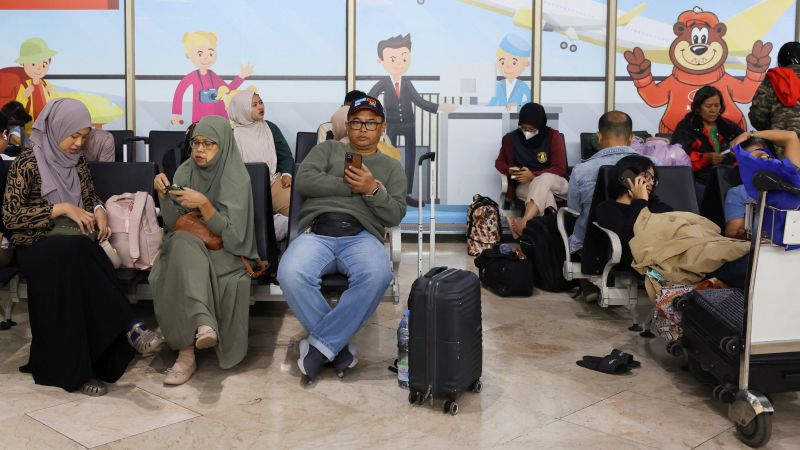
Sandego.net – Travelers across Indonesia faced a sweeping disruption early Monday as volcanic ash from Mount Anak Krakatau forced the closure of eight airports, including both facilities serving the capital, Jakarta. The transport ministry confirmed that roughly 170,000 passengers were caught up in cascading flight cancellations, leaving many stranded in terminals or unable to reach them at all.
The ash plume, generated by eruptions that began late Friday, has blanketed Jakarta and surrounding regions for over two days. Operators of Jakarta’s primary international gateway announced via their Instagram account that the airport would stay shut until 6 p.m. local time on Monday. The remaining seven closed airports — spanning provinces including Lampung and West Java — were ordered to remain grounded until at least 08:59 a.m., with no guaranteed reopening window.
Officials Warn of Prolonged Uncertainty
Transport Minister Dudy Purwagandhi acknowledged the difficulty of setting a firm timeline for restoration of normal operations.
“We cannot ascertain when this will end due to the dynamic weather,” the minister stated in a Monday briefing.
The unpredictability stems from shifting wind patterns that can carry fine particulate matter over vast distances, making it impossible for aviation authorities to declare airspace safe until ash concentrations drop below operational thresholds. Pilots and air-traffic controllers alike must wait for confirmed readings before any single runway can reopen.
Eruption Scale and Monitoring
Indonesia’s meteorological agency, BMKG, logged the most recent Anak Krakatau eruption at 8:23 p.m. on Sunday. The agency cautioned that the likelihood of additional explosive events in the near term remains elevated. Ash columns reached dramatically different altitudes on either flank of the volcano: approximately 20,000 feet (6,000 meters) above the Java-facing slope and as much as 50,000 feet (15,000 meters) above the Sumatra-facing slope. Portions of Banten province on Java also received measurable ashfall.
By Monday, Anak Krakatau had entered its second consecutive day of major eruptive activity. The sustained nature of the event distinguishes it from brief, isolated bursts and raises the probability that ash loading in the atmosphere will persist well beyond the initial closure window.
Local Health and Educational Responses
On Sunday, Indonesia’s national disaster agency urged residents to wear protective masks whenever traveling outdoors, warning that inhaling fine volcanic particulate can irritate airways and exacerbate respiratory conditions. In both Jakarta and the Lampung region, schools shifted to remote-learning arrangements to shield students from prolonged ash exposure, according to state news agency Antara.
For residents accustomed to the volcano’s periodic activity, the current episode nonetheless represents an unusual scale of disruption. The sheer volume of ash reaching populated areas — including the capital, home to over ten million people — has turned a geological event into a citywide public-health and logistics challenge.
Geological Background: The Child of Krakatoa
Anak Krakatau, whose name translates to “child of Krakatau,” occupies a position roughly midway between the islands of Java and Sumatra in the Sunda Strait. It first began to emerge from the seabed about a century ago, rising from the very waters where its parent volcano, Krakatau (historically spelled Krakatoa), once stood.
The older volcano annihilated itself in a cataclysmic series of eruptions in August 1883. The resulting tsunamis swept across the strait and beyond, killing more than 36,000 people and registering seismic shocks as far away as Australia. That event remains one of the deadliest volcanic disasters in recorded history and a foundational case study in volcanology.
Indonesia as a whole sits astride the Pacific Ring of Fire, the horseshoe-shaped belt of tectonic plate boundaries where the majority of the world’s active volcanoes and earthquakes concentrate. Frequent seismic and volcanic activity is therefore not an anomaly but a baseline condition of life in the archipelago. Yet each event still tests infrastructure, emergency planning, and the resilience of communities that have learned to live in the shadow of restless geology.
What Comes Next
Aviation authorities will continue to monitor ash concentration through satellite imagery, ground-based sensors, and pilot reports before authorizing any phased reopening. Passengers with cancelled or delayed itineraries are advised to check directly with their carriers for rebooking options, as the transport ministry has not yet announced a compensation or re-accommodation framework for the estimated 170,000 affected travelers. Until BMKG downgrades the eruption alert and wind patterns shift the plume away from populated corridors, the eight-airport closure is expected to persist into at least the latter half of Monday.
Related Reading
Frequently Asked Questions
What is Volcanic ash leaves 170 000 travelers?
Volcanic ash leaves 170 000 travelers is the main topic of this guide. The article explains the context, practical details, and next steps readers should understand.
Why does Volcanic ash leaves 170 000 travelers matter?
Volcanic ash leaves 170 000 travelers matters because readers are looking for a useful answer, not just a short summary. Good content should match search intent and help them decide what to do next.