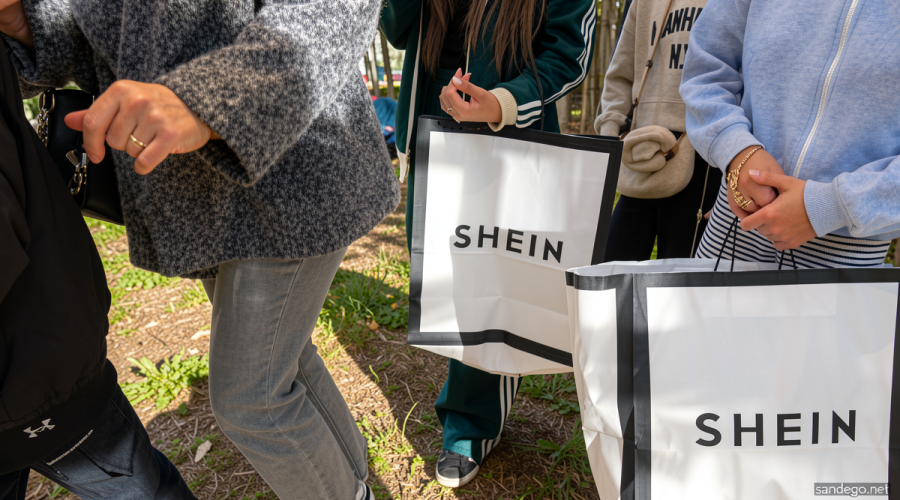
Shein’s HK IPO Slides as Headwinds Mount
Sandego.net – The moment investors had tracked for years — Shein’s long-awaited market entry into public equities — arrived with a bruised reception. On Tuesday, shares of the ultrafast-fashion retailer dropped nearly 10 percent within the first minutes of trading in Hong Kong, a reaction that underscored how thin the appetite has become for a company whose growth trajectory is colliding with trade-policy shifts, sharpening competition, and governance questions that remain unresolved.
The offering itself had already signaled a repricing. Last week’s sale raised approximately $1.7 billion and anchored the firm at a $26.5 billion valuation, a figure sitting more than 70 percent beneath the $98.2 billion peak it commanded in 2022. The distance between that earlier aspiration and the current clearing price encapsulates how rapidly the bull case has eroded.
A Speed-First Model Now Constrained by Borders
Launched in China in 2012, the company built its commercial footprint on one operational axiom: convert whatever micro-trend surfaces on TikTok or Instagram into a physical garment within days, priced so low that impulse purchase requires no deliberation. An $11 pair of jeans or a $3 crop top was not a promotional stunt; it was the structural logic of the product line. That velocity, married to a deep Chinese manufacturing base and aggressive social-media targeting of teenagers and young adults, propelled the brand past legacy players including Zara and H&M.
By last year’s revenue figures, the label ranked as the world’s third-largest apparel brand, trailing only Nike and Adidas, with Zara and H&M falling just behind it, according to GlobalData. The firm is projected to retain that position through the current year.
“Shein took the fast fashion model, which is frequent release of new products, and just put it on steroids. The way that they’ve been really disruptive is because they’re so fast – any small trend that popped up on social media, like TikTok or Instagram, they were able to supply a demand instantly,” said Louise Deglise-Favre, lead apparel analyst at GlobalData.
Yet the very logistics that powered that ascent — shipping small parcels directly to consumers, tariff-free under the United States’ de minimis exemption — have been dismantled. The US, the firm’s second-largest market after Europe, eliminated that carve-out, subjecting billions of low-value packages to steep duties. The European Union followed in July, scrapping a parallel threshold. For a business whose margins were already razor-thin, the simultaneous loss of two major tariff-free channels constitutes a structural cost shock rather than a temporary headwind.
Financial Deterioration Accelerates
The figures disclosed in the July prospectus paint a picture of rapid contraction. Net income fell 39 percent year over year last year even as revenue continued to grow — a signal that costs were outpacing top-line expansion. By the first quarter of this year, the trajectory had reversed entirely: losses ballooned to $99 million. The timing of that slide coincides almost precisely with the removal of the US de minimis carve-out, suggesting the tariff exposure is not hypothetical but already embedded in the income statement.
“It has absolutely missed the best timing for an IPO,” said Jin Lu, senior vice president of The Asia Group consultancy. “Everyone is watching to see whether there’s still room for growth, and how much room there is. And competition, if anything, has intensified.”
Controversies That Follow the Brand
The meteoric rise has been shadowed by a persistent set of criticisms. Environmental groups have questioned the ecological footprint of producing and discarding garments at such velocity. Designers and independent artists have accused the company of replicating their work without attribution or compensation. Western regulators have pressed harder on labor questions.
The most pointed scrutiny has centered on cotton sourcing from China’s Xinjiang region, a major cotton-producing area home to the Uyghur minority. A US Congressional Commission concluded in 2023 that there were “credible allegations of the company’s use of underpaid and forced labor” in the region, in violation of American law. Beijing has rejected those characterizations. The firm has consistently denied employing forced labor anywhere in its supply chain and previously stated it did not source cotton from Xinjiang or from China at all.
Nonetheless, at a UK parliamentary hearing early last year, the company’s legal counsel repeatedly sidestepped direct questions about whether Xinjiang cotton enters its supply chain. The prospectus filed for the Hong Kong listing likewise omitted any explicit reference to risks tied to the Xinjiang controversy — an omission that drew attention from analysts and regulators alike.
Frequently Asked Questions
When did Shein list on the Hong Kong Stock Exchange?
The company’s first public trading session took place on Tuesday following last week’s $1.7 billion offering, which valued the firm at $26.5 billion.
How does the current valuation compare to earlier peaks?
The $26.5 billion IPO price sits more than 70 percent below the $98.2 billion peak valuation the company commanded in 2022, reflecting a sharp repricing of growth expectations.
What regulatory changes are pressuring the business model?
The United States eliminated its de minimis tariff exemption, and the European Union scrapped a parallel threshold in July. Both moves remove the tariff-free parcel channel that underpinned the company’s direct-to-consumer logistics in its two largest markets.
What financial trend did the prospectus reveal?
Net income declined 39 percent year over year last year, and first-quarter losses this year reached $99 million, coinciding with the loss of