
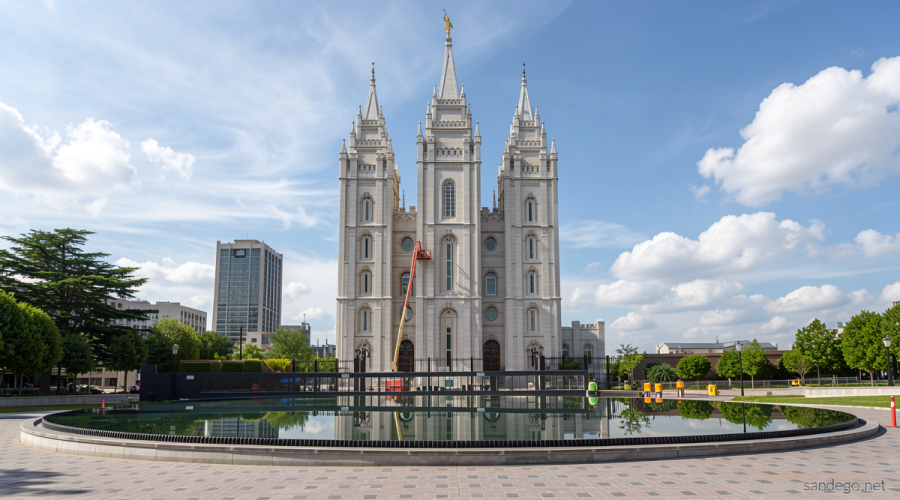
Peek Inside Salt Lake City’s Signature Temple
Sandego.net – For more than a century, the six-spired Gothic Revival structure that anchors downtown Salt Lake City has served as the spiritual epicenter of the Church of Jesus Christ of Latter-day Saints — and as a sealed sanctum invisible to outsiders. Now that secrecy is ending. After years of structural renovation and seismic upgrades, the church will open its doors to the public on April 5 for six months of guided tours, welcoming both members and curious visitors alike.
“This is such a unique, once-in-a-lifetime opportunity for the rest of the world to come and see what, for more than a century, was for members only,” Elder Matthew S. Holland, a senior church official, told CNN during a rare preview. “For this brief period of time, it will be open to the world.” Millions of visitors are expected before the tours conclude on October 1, 2027, when the building will again be reserved for faithful members in good standing.
A Once-in-a-Lifetime Public Tour
The temple — one of more than 200 LDS temples operating worldwide — has been closed since late 2019 while crews expanded interior space, reinforced the foundation, and installed seismic upgrades. To manage the anticipated surge of foot traffic, timed tickets will go on sale online beginning September 1. The denomination, which counts nearly 18 million members globally, has grown steadily since its founding almost two centuries ago in upstate New York.
Mormons have long endured persecution over their beliefs, and pop culture has alternately sensationalized them (“Big Love”) or satirized them (“The Book of Mormon”). The halls of this flagship building have fueled speculation for generations: early members weathered rumors of bloody temple rituals, and in 1911 a disgruntled ex-member hid a camera beneath his coat to snap surreptitious interior photographs in a failed blackmail attempt.
Still, the church has spent recent decades broadening its public message. Matthew Bowman, a Mormon-studies professor at Claremont Graduate University, sees the six-month opening as part of that trajectory. “For nearly 30 years now, there’s been a real public-relations push by the church to appear more open, more accessible, more friendly to the outside world,” he said. “This temple open house is going to be devoted to that — to trying to bring in as many media people as possible, as many outsiders as possible. It’s going to be a really hot ticket.”
History, Architecture, and Symbolism
The temple sits at the heart of Temple Square, the church’s central complex, which also houses a Victorian-era assembly hall, a visitor center, a reflecting pool, and the domed Salt Lake Tabernacle home to its famed choir. Utah boasts five national parks, yet Temple Square remains the state’s most-visited destination. Its location was chosen in 1847 by then-president Brigham Young just days after Mormon pioneers entered the Salt Lake Valley. Young presided over the groundbreaking but did not live to see completion; the building was dedicated in 1893 after four decades of construction.
“It was done without modern tools or equipment, carving out granite stone from a little canyon about 20 miles from the heart of Salt Lake,” Elder Holland recalled. “And it was a remarkable engineering feat in its day.” From the outside, white stonework and dramatic spires give the structure a fairy-tale-castle silhouette. Its exterior is dense with symbolism: stone carvings depict the all-seeing eye of God, and a golden statue of the angel Moroni — who, Latter-day Saints believe, guided founder Joseph Smith to buried golden plates — crowns the tallest spire, trumpet raised to herald the Second Coming.
“It’s this extraordinary piece of neo-Gothic architecture,” Bowman observed. “Temples are a space where heaven touches earth, and just like cathedrals in the Roman Catholic tradition, they are built very tall and high and narrow to make you feel as though you’re being pulled upward, right toward heaven. And the Salt Lake Temple, of all the LDS temples, I think, is the most successful at accomplishing that.” Inside, however, the design turns practical: rather than a single grand worship hall, the interior is a warren of smaller rooms where sacred ordinances — baptisms, endowments, and sealings — are performed in quiet, intimate settings.
“For this brief period of time, it will be open to the world.” — Elder Matthew S. Holland
Frequently Asked Questions
When will the public tours take place? Guided tours run from April 5 through October 1, 2027. After that date the temple reverts to members-only access.
How do I get tickets? Timed-entry tickets go on sale online beginning September 1. Because millions of visitors are expected, booking early is strongly advised.
What will visitors actually see inside? Tours will reveal the smaller ordinance rooms, the expanded interior spaces created during renovation, and architectural details previously invisible to non-members. Specific ritual areas may remain restricted, but the scope of access is unprecedented.
Is the temple open to people of other faiths or no faith? Yes. The six-month window is explicitly open to all visitors, regardless of religious affiliation.
What is the difference between a temple and a church meetinghouse? Temples are reserved for sacred ordinances such as baptisms for the dead, endowments, and sealings. Weekly worship services are held in separate meetinghouses. The Salt Lake Temple has never been used for regular congregational worship.