Trump’s Presidential Hierarchy Sparks Fierce Backlash From His Own Base
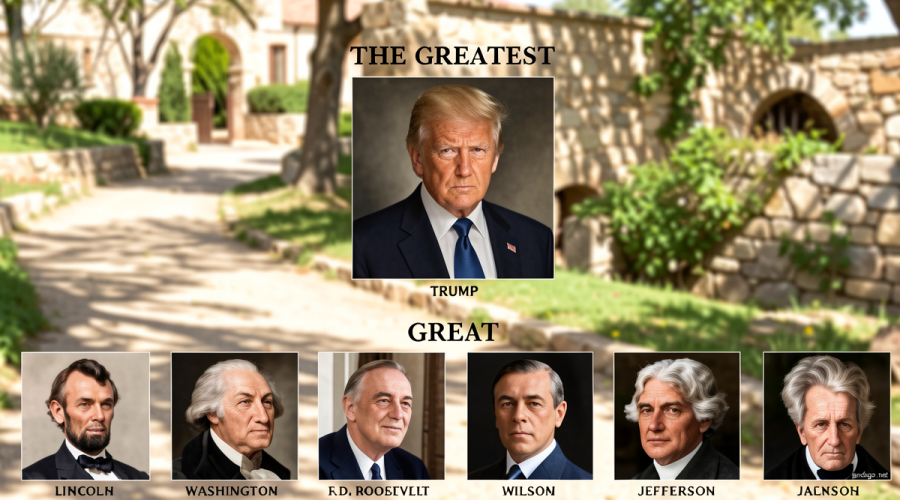
Sandego.net – A social media post published on Thursday sent shockwaves through the conservative establishment: President Donald Trump had positioned himself above every American commander-in-chief who came before him, declaring himself “the greatest” president in a graphic that placed him ahead of George Washington and Abraham Lincoln. The image, whose provenance remains unclear, appeared to be assembled with little deliberation, and within hours it became a flashpoint for a president already navigating mounting friction with the movement that propelled him into office.
The White House had not been reached for comment on the list’s origins or methodology. What was clear, however, was that the graphic’s contents would land poorly with many of Trump’s most loyal ideological allies — particularly given that his approval rating sits in the mid-30s at the time of publication.
The Conservative Calculus: FDR, Wilson, and Jackson
Among the presidents grouped alongside Washington, Lincoln, and Thomas Jefferson in the original post were Franklin D. Roosevelt, Woodrow Wilson, and Andrew Jackson — a combination that struck many on the right as almost deliberately provocative. Roosevelt, after all, architected the New Deal and presided over the most sweeping expansion of federal authority in the nation’s history. Wilson, meanwhile, oversaw his own enlargement of government, including the enactment of the federal income tax. Conservative columnist George Will has gone so far as to say Wilson
“ruined the 20th century.”
Jackson occupies a more complicated position. For decades, Democrats named their annual fundraising dinners in his honor, though that practice faded in recent years amid renewed scrutiny of his ownership of enslaved people and his treatment of Native American nations. Trump appeared to want a do-over on at least one of these three figures.
The Wilson Flip: From “Great” to “Broke” in One Day
By Friday morning, the president had posted a revised graphic that demoted Wilson from the “great” tier entirely. In the updated version, Wilson appeared among five presidents accused of having “broke” America. For conservatives steeped in anti-statist ideology, that reclassification is essentially the mirror image of the original placement — and arguably the more defensible one. Yet the rapid reversal underscored how little editorial discipline governed the exercise.
Coolidge, Johnson, and the Question of Merit
Calvin Coolidge, frequently lionized on the right as a vastly underappreciated president and a conservative icon, drew praise for his fierce opposition to the big-government progressivism that defined both Wilson’s and FDR’s administrations. Some thinkers even credit “Silent Cal” with seeding the intellectual currents that would later produce modern conservatism. His placement in the graphic raised questions about whether the ranking reflected any coherent ideological framework.
Andrew Johnson, by contrast, is routinely counted among America’s weakest presidents. His botched management of Reconstruction following the Civil War, combined with his impeachment, has cemented that reputation. The Siena Research Institute Survey of US Presidents, which periodically polls academic experts, has placed Johnson at the very bottom of the list for roughly two decades. Why Trump might regard Johnson as anything other than a failure remained unexplained.
McKinley’s Sudden Demotion
Perhaps the most jarring inconsistency involved William McKinley. Throughout much of 2025, Trump had lavished praise on McKinley, holding him up as a model of how tariffs could strengthen the nation. He even restored McKinley’s name to a mountain in Alaska, calling him
“a great president who never got credit.”
That remark, delivered in July 2025, sat in uncomfortable tension with the Thursday graphic, which apparently withheld McKinley from the highest tier. The whiplash between public encomium and quiet demotion left observers wondering which version of the president’s historical judgment was operative.
Grant and the Question of “Failure”
Ulysses S. Grant’s presidency has never enjoyed the same reverence as his wartime command that led the Union to victory, and he was hardly a natural politician. Still, labeling his administration a “failure” struck many as disproportionate. Republican Senator Tom Cotton of Arkansas, writing in a 2022 op-ed, called Grant
“one of the greatest civil-rights presidents in our nation’s history”
and accused liberal historians of besmirching an “American hero.” Cotton went further:
“This sloppy and slanderous history thankfully has been reassessed in recent years, for Grant deserves to stand forever alongside Lincoln and Washington as one of America’s indispensable men.”
Whether Cotton shared the discomfort of watching his own party’s leader participate in what he might view as historical treachery was left unstated.
The Missing Presidents and the Life Magazine Echo
Perhaps the most conspicuous flaw in the graphic was its silence on an entire cohort of modern presidents. Ronald Reagan, Gerald Ford, Richard Nixon, Lyndon B. Johnson, John F. Kennedy, Dwight Eisenhower, Harry Truman, and both George H. W. Bush and George W. Bush were absent. The reason became apparent upon closer inspection: the graphic bore a striking resemblance to a ranking that appeared in Life magazine in 1948. The deviations from that mid-century template were limited — Trump inserted into a new “greatest” category, Bill Clinton shifted into “average,” and Joe Biden, Barack Obama, and Jimmy Carter slotted into “failures.”
The selective inclusion raised pointed questions. Why did Clinton escape the fate assigned to his fellow Democrats Biden, Obama, and Carter? Why did he rank above Coolidge? Where, precisely, would Trump place Reagan, Nixon, or George W. Bush? The answers, if they existed, were not offered.
For a president whose political survival depends on the continued enthusiasm of a base that prizes ideological consistency, the episode risked confirming anxieties already circulating within conservative circles: that the man at the top of the list cared less about the substance of history than about his own position within it.
Related Reading
Frequently Asked Questions
What is The problems with Trump s ranking?
The problems with Trump s ranking is the main topic of this guide. The article explains the context, practical details, and next steps readers should understand.
Why does The problems with Trump s ranking matter?
The problems with Trump s ranking matters because readers are looking for a useful answer, not just a short summary. Good content should match search intent and help them decide what to do next.