Golf’s Internet Era Meets Its Darkest Backlash: A Driver Ad That Broke the Game’s New Rules
Sandego.net – Golf has spent decades cultivating an image of quiet reverence — caddies in pressed slacks, players murmuring apologies to the green, a sport that treats even a missed putt as a small moral event. That image is now under siege from a very different set of values: loud, fast, personality-driven content built for phone screens and algorithmic feeds. The collision between those two worlds produced a week of turbulence this month when a co-branded advertisement for a new driver, produced jointly by golf-media outfit Good Good and equipment manufacturer Callaway, ignited a firestorm of criticism that forced both companies to issue public apologies and pull the spot from circulation.
The Ad and the Moment That Broke It
The commercial opened with an image that stopped viewers mid-scroll: Garrett Clark, one of Good Good’s co-founders, delivering a shoulder-check to Alexis Miestowski, a female golfer associated with the brand, knocking her to the ground as she reached toward his driver. The implication was unmistakable — a man physically punishing a woman for touching his equipment. Within hours the clip had accumulated enough negative reaction that Callaway and Good Good removed it from their channels, and questions began piling up about how a spot depicting a violent act against a woman could have cleared internal review and reached a public audience.
Clark’s Apology and the “Obsession” Explanation
Clark took to his X account on Wednesday evening to address the fallout directly. He framed the apology as covering both his personal role and the brand’s collective responsibility.
“This is not, at all, what we stand for. The way this ad was received is not how Good Good is and not what we stand for once again. I want everyone to know that. I do not support (domestic violence), abuse or any of that.”
He then offered what he called “some clarity” on the creative concept behind the spot, drawing a parallel to the 2026 film Obsession, directed by 26-year-old YouTuber Curry Barker. In that movie, a character becomes so fixated on a single object that anyone who touches it is swept into the same consuming fixation. Clark said the ad was meant to dramatize exactly that: he was supposed to appear so obsessed with his driver that anyone reaching for it would become “possessed with the obsession.”
“Looking back, super dumb ad concept,” Clark added. “Terrible ad in general. Not the greatest idea. … Once I watched it back and it got posted, my skin was crawling. I was cringing. I mean, even just minutes after I saw it get posted, before this surfaced anywhere online, I thought it was the worst ad known to man.”
Clark characterized the public criticism as “very justified” but pushed back on the volume of personal abuse directed at Miestowski, including death threats delivered through her social-media direct messages.
“If you got hate to give, got any left in the tank, give Good Good some hate. You can give me some hate in the comments down below. I do sincerely apologize for playing the role in the ad.”
Callaway Steps In
On Tuesday, Callaway chief executive Chip Brewer acknowledged that his company had greenlit the video and offered a formal apology.
“As we deal with the consequences of our mistake and complete our investigations, I want to make it clear that we sincerely apologize for the video,” Brewer wrote in a statement posted to X. “The content was inappropriate and does not reflect our values. To be clear: We are unequivocally against discrimination, domestic violence, or threatening behavior of any kind.”
Good Good, for its part, issued its own statement after the spot was pulled on Saturday, reaffirming its stated mission of broadening participation in the sport.
“Good Good has always stood for making the game of golf more inclusive to all, and we will continue to ensure that is our mission moving forward.”
Why Good Good Matters to Golf’s Future
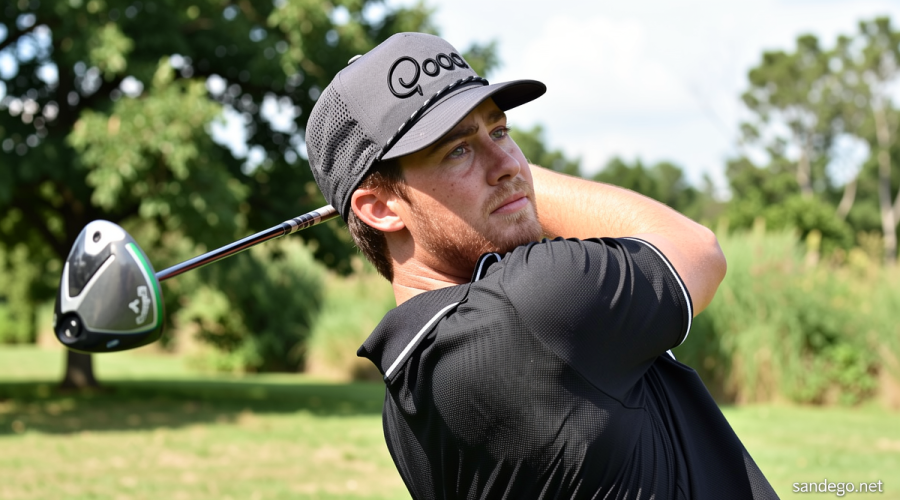
The controversy lands with particular force because Good Good occupies a unique position in the sport’s rapidly shifting media landscape. Founded in 2020, the company began as a content-creation operation built around the personalities of its founders and collaborators — loud, irreverent, and deliberately at odds with the understated demeanor that has long defined professional golf broadcasting. Over the years the brand expanded into merchandising, and its stylized “Good” caps have become a fixture on fairways from Florida to California, worn by casual players who discovered the game through social-media clips rather than through a country-club initiation.
That cultural penetration reached a new tier when Good Good was named the title partner of the Good Good Championship, a professional event scheduled for November in Austin, Texas. The sponsorship placed the brand squarely inside the sport’s upper echelon, alongside the PGA Tour’s institutional apparatus. It also meant that any misstep by the company would be read not as a niche internet blip but as a statement about the direction of golf itself.
Clark emphasized that Good Good’s founding mission has always included growing the women’s side of the game, a goal he said was formalized through the launch of Good Good Girls, a dedicated content vertical.
“Golf has historically been and is a big male sport. And we have wanted to change that by including women in all of our content and pushing the women’s side of the game,” he said. “Hopefully you guys can forgive Good Good as well as myself for being a part of it. And hopefully, we can move on and continue to grow the women’s side of golf.”
The Broader Fracture
What makes this episode more than a standard advertising gaffe is the fault line it exposes. Golf’s traditional establishment — its governing bodies, its long-tenured broadcasters, its country-club membership culture — has spent years resisting the very personalities and production styles that Good Good and similar operations have made commercially irresistible to a younger, phone-native audience. The sport’s participation numbers among millennials and Gen Z have grown largely because of that louder, faster content, yet the institutions that control the tour’s calendar, its prize money, and its sponsorship architecture remain anchored in older norms.
A driver ad that physically knocks a woman to the ground becomes, in that context, a symbol of what happens when the new world’s creative instincts are not checked by the old world’s editorial standards. Callaway’s admission that the spot passed internal review suggests that the compliance frameworks built for traditional golf marketing were not equipped to evaluate content designed for a different audience, on a different platform, with a different sense of what constitutes acceptable humor or acceptable physicality.
As the Good Good Championship approaches in Austin, the question hanging over the sport is no longer whether internet golf and traditional golf can coexist. They already do. The question now is whether the institutions that govern the game can learn to police the new content without freezing it out of existence — and whether the personalities who brought millions of new fans to the game can be held accountable for missteps without being erased from the very ecosystem that made them valuable.
For now, both companies have apologized, the video is down, and the investigation Callaway referenced in its statement is ongoing. The driver itself — a co-branded product bearing both logos — remains on the market. Whether golf’s audience, old and new alike, can separate the product from the spot that introduced it will be the next test of how far the sport’s two cultures have actually merged.
Related Reading
Frequently Asked Questions
What is A controversial ad for a driver?
A controversial ad for a driver is the main topic of this guide. The article explains the context, practical details, and next steps readers should understand.
Why does A controversial ad for a driver matter?
A controversial ad for a driver matters because readers are looking for a useful answer, not just a short summary. Good content should match search intent and help them decide what to do next.