Supreme Court Clears Path for Trump’s Mail-Ballot Restrictions — But the Fight Is Far From Over
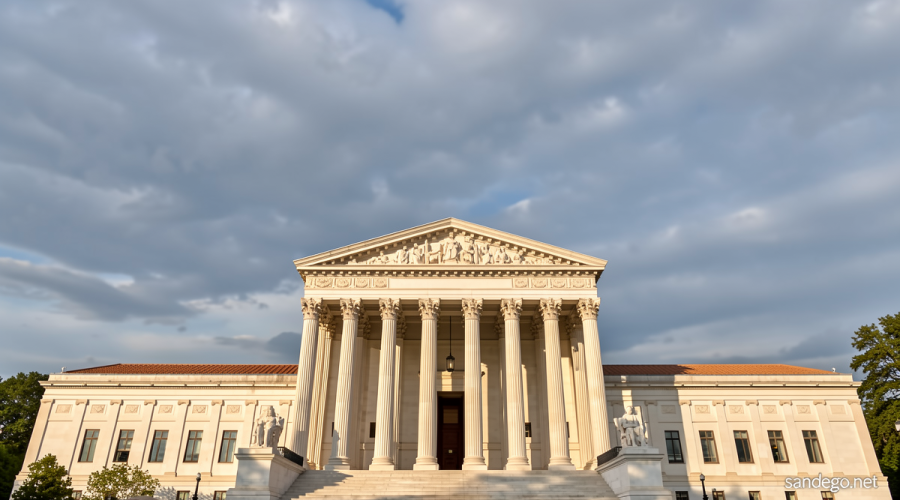
Sandego.net – The November 2026 midterm elections now face a layer of legal uncertainty that few observers anticipated just weeks ago. On Monday, the Supreme Court issued a 10-page unsigned opinion permitting the Trump administration to begin implementing selected provisions of a sweeping March executive order that reshapes how mail ballots are administered across the country. Yet the ruling, while a procedural victory for the White House, stops well short of endorsing the order’s substance. Three liberal justices dissented, and at least one lower-court injunction still stands, meaning the question of whether these new federal mandates will actually take effect before voters head to the polls remains genuinely open.
What the Court Actually Decided — and What It Did Not
The opinion, handed down without attribution to any individual justice, addressed only the timing of the legal challenge brought by a coalition of Democratic-led states. It did not rule on whether the executive order is lawful, whether Congress granted the president authority to direct the Postal Service or the Department of Homeland Security into election administration, or whether the specific mandates violate state sovereignty over voting. The justices explicitly noted that the disposition of the application “does not mean that any measure taken by the government to implement the order will necessarily be lawful,” adding, “On that score, time will tell.”
In practical terms, the ruling tells the administration it may proceed with certain steps now, while preserving the states’ right to return to court if and when concrete regulations cause them harm. The court stated plainly: “If the Postal Service’s final rule harms the states, they may challenge that rule.” That language signals the litigation is expected to continue, potentially on an emergency timeline, well into the fall.
The DHS Component: Federal Voter-Roll Lists in Blue States
One pillar of the March order directs the Department of Homeland Security to assemble state-by-state rosters of individuals it deems eligible to vote, specifically in the Democratic-led states that filed suit against the plan. This grants DHS a role in election administration that has no clear precedent in modern American governance. The court’s Monday decision allows the administration to move forward with that proposal, at least in its initial stages, while the states retain the ability to contest the final product in court.
Critics of the order have long argued that placing a cabinet department in charge of voter-eligibility determinations effectively federalizes a function reserved to state election boards. The court did not resolve that constitutional question. It simply told the parties to proceed and litigate the merits later.
The USPS Component: Tracking Mandates and a Standing Injunction
A second provision of the executive order instructs the United States Postal Service to impose new conditions on any state that wishes to deliver ballots through the mail. Under the plan, states would be required to furnish their own voter-eligibility lists to the agency and to embed identifying information in ballot envelopes so that each mailed ballot can be tracked through the delivery system. The justices gave USPS the green light to begin implementing that framework.
However, a separate lower-court action has already produced a nationwide injunction blocking the Postal Service from carrying out those mandates. Because that injunction remains in force, the USPS cannot simply activate the new requirements without first navigating additional judicial proceedings. Those proceedings could escalate rapidly — potentially reaching the Supreme Court again within days through emergency appeals — making the Monday ruling a temporary procedural checkpoint rather than a final destination.
The Dissent: Sotomayor and Kagan Push Back
Justice Sonia Sotomayor, joined by Justice Elena Kagan, wrote separately to argue that lower courts possessed the authority to rule in favor of the Democratic states immediately, without waiting for the administration to finalize its regulations. She emphasized that the majority had not touched the merits of the president’s directives.
“Today’s decision does not address whether the President’s attempts to interfere with States’ administration of the November 2026 elections are lawful. Nor does it suggest that the Executive Branch has any constitutional or statutory authority to implement the President’s directives,” Sotomayor wrote. “Instead, today’s decision merely postpones ad”
The truncated language of the dissent underscores the justices’ frustration with what they viewed as an unnecessary delay in protecting state election processes from federal overreach.
Reactions: Celebration in Washington, Caution Among Analysts
The White House framed the ruling as a decisive victory. Spokeswoman Lauren Bis issued a statement Monday declaring, “This is a major win for the security of American elections. These are commonsense measures that protect the security of mail-in ballots and ensure only Americans are electing American leaders.” She added that the administration “will continue to lawfully enact the agenda President Trump was elected on – which includes the safety and security of our elections.”
Legal scholars offered a more measured reading. Steve Vladeck, a Supreme Court analyst and professor at Georgetown University Law Center, characterized the outcome as a partial, temporary gain for the president.
“The ruling is a win for Trump for the moment, but it doesn’t fully clear the way for his effort to limit mail-in ballots to go into effect,” Vladeck said. “As soon as tomorrow, a Massachusetts district court may block the underlying USPS rule at issue — which is the real thing to watch heading into November.”
Democratic-led states, which had warned they would need to divert time and resources away from routine election preparation, confirmed they intend to pursue further challenges immediately.
Broader Context: A Year of Contentious Election Litigation
The Monday decision arrives amid an unusually intense season of election-related cases at the high court. In late April, the court’s 6-3 conservative majority struck down key provisions of the Voting Rights Act in a landmark ruling concerning Louisiana’s congressional districts — a decision from which the liberal justices dissented. That opinion, and the sharp exchanges it generated between the two ideological blocs, set the tone for subsequent election disputes and heightened the stakes of every subsequent ruling touching ballot access.
President Trump has spent years publicly asserting that mail voting is rife with fraud, even as independent studies have found no evidence of systemic abuse at the scale he describes. The March executive order translated those long-standing claims into concrete administrative mandates, assigning the Postal Service and DHS roles that had previously belonged exclusively to state election officials. The court’s Monday opinion neither validates nor rejects that philosophical premise; it simply allows the machinery to start turning while the legal questions remain queued for later resolution.
For voters in the states most directly affected, the practical upshot is a compressed timeline: within weeks, additional rulings — possibly from district courts in Massachusetts and elsewhere, possibly from the Supreme Court itself on emergency review — will determine whether the new tracking mandates and federal voter-roll compilations take effect before ballots go out in November. The Monday decision opens a door. What walks through it, and when, is still undecided.
Related Reading
Frequently Asked Questions
What is Supreme Court backs Trump s order?
Supreme Court backs Trump s order is the main topic of this guide. The article explains the context, practical details, and next steps readers should understand.
Why does Supreme Court backs Trump s order matter?
Supreme Court backs Trump s order matters because readers are looking for a useful answer, not just a short summary. Good content should match search intent and help them decide what to do next.