The Man Who Built a Fake Ancient Theater in Italy — and Sold Tickets for a Decade
Sandego.net – For ten years, travelers flocked to a hillside above the small Veneto town of Arcugnano, just over three miles south of Vicenza, to marvel at what was presented as a 2,000-year-old Greek amphitheater. They paid up to 40 euros ($46) per head to walk its tiered rows, admire its plaster statues, and listen to guided tours narrated by the site’s self-appointed custodian. All eight TripAdvisor reviews left by visitors awarded the location a perfect five-star rating. One called it “an enchanting place.” Another declared it “a world beyond space and time.” A third visitor wrote that it was “definitely one of the best places I have ever been to.” Yet another simply labeled it “unique on the planet.”
That last descriptor turned out to be accurate, though not for the reasons the reviewers intended. The structure was not Greek. It was not Roman. It was not ancient at all. Every element — the seating, the steps, the columns, the statues, even the small body of water at the center — had been fabricated in the 21st century by a local construction crew working under the direction of the site’s owner, Franco Malosso, who also used the name Von Rosenfranz.
A Nation That Takes Its Heritage Seriously
The scandal landed with particular force in Italy, a country that narrowly holds the top spot globally for UNESCO World Heritage sites, edging out China. The peninsula is dotted with genuine ancient performance spaces still in active use: the theaters at Syracuse and Pompeii host summer productions each year, while the Roman amphitheater in Verona, roughly 40 miles west of Arcugnano, transforms into a major opera stage every summer. Against that backdrop, a fabricated “ancient” site charging tourist prices represented something close to a cultural insult.
How the Fake Was Built
Court documents reveal the mechanics of the deception. Malosso engaged a regional construction firm to carve seating and stairways into the hillside. The finished surfaces were then artificially aged to simulate millennia of weathering. Cement columns and plaster statues were arranged around a shallow pool that Malosso had excavated by hand. The stone used for the seating came fresh from quarries in Puglia, bound together with modern cement. A retaining wall behind the structure was capped with polystyrene, according to evidence presented at trial.
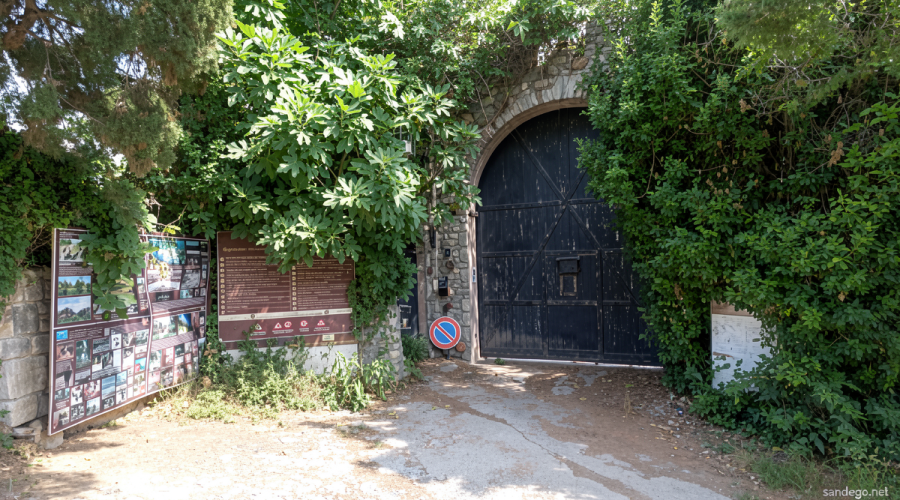
The site covered nearly 54,000 square feet and went by no fewer than three names during its operational life: Anfiteatro Berico, Anfiteatro Marittimo Berico, and Anfiteatro Porta degli Angeli. Malosso hosted concerts and performances inside the structure and personally led visitors through guided tours, presenting himself as “more or less a historian, and an excellent narrator,” in the words of one satisfied customer.
Red Flags Any Historian Would Have Spotted
For anyone with even a passing familiarity with classical architecture, the site was riddled with impossibilities. The structure was fan-shaped — the profile of a Greek theater — yet it was marketed as an amphitheater, which by definition is oval. The name “Marittimo” (maritime) implied proximity to the sea, but Arcugnano sits approximately 50 miles inland from the Adriatic coast. There was no ancient “Angels’ Gate” at the location. And the claim of Greek authorship was geographically untenable: the ancient Greeks colonized southern Italy and Sicily, not the Veneto, where Roman remains dominate the archaeological record.
Where a genuine Greek theater would have featured a stage (skene), Malosso had instead installed a photogenic pool of water. Darius Arya, an archaeologist and director of Ancient Rome Live, called the overall scheme “diabolical” and “terrible,” adding that “just the idea of it is insane.”
“Why was there a pool of water there, there were no maritime performances,” Arya said. “It’s like a folly — it doesn’t feel right.”
Discovery and Investigation
The site sat on a hillside covered in protected woodland. Local law enforcement identified it and referred the matter to the regional cultural superintendency in October 2016. A joint inspection followed, carried out by a representative of the local heritage board and officers from the Carabinieri’s Nucleo Tutela Patrimonio Artistico (TPC) — the unit colloquially known in English as the “art squad,” tasked with investigating stolen works and forgeries.
The examination was so conclusive that it wrapped up in a single day, according to Lt. Col. Giuseppe Marseglia, commander of the TPC detachment in Monza, which oversees northern Italy. He described the operation as a “truly obscene” attempt at forgery and added that in his 25 years with the force he had never encountered an entire archaeological site manufactured from nothing.
“Of all criminals, forgers are the ones with the most talent, because they are able to create works of art,” Marseglia said. “Then there are scammers … I have no respect [for Malosso]. Calling him a forger is an offense to forgers.”
The Legal Aftermath
What followed was a decade-long legal battle. This month, after ten years of proceedings, Malosso was sentenced to prison. The charges included forging works of art, carrying out construction without authorization, and destroying a protected landscape. The verdict has generated widespread outrage across Italy, where the episode has become shorthand for the lengths to which commercial greed can stretch when it collides with a nation’s deepest cultural identity.
The eight glowing TripAdvisor reviews remain posted online, a small monument to the ease with which spectacle can substitute for substance — and to the fact that, as one old saying goes, a sucker is born every minute.
Related Reading
Frequently Asked Questions
What is A sucker born every minute?
A sucker born every minute is the main topic of this guide. The article explains the context, practical details, and next steps readers should understand.
Why does A sucker born every minute matter?
A sucker born every minute matters because readers are looking for a useful answer, not just a short summary. Good content should match search intent and help them decide what to do next.