
Settlement Tender in E1 Reignites Fierce Global Pushback Days Before Israeli Vote
Sandego.net – With Israeli voters heading to the polls at the close of October, the country’s Housing Ministry released a tender inviting bids to build more than 1,200 residential units in the E1 corridor near Jerusalem — a move that has drawn sharp condemnation from governments across Europe, North America, and the Middle East. The deadline for submitting construction proposals falls just seven days before the election, a timing that critics describe as a deliberate attempt to lock in a fait accompli before a new government takes office.
What E1 Means on the Ground
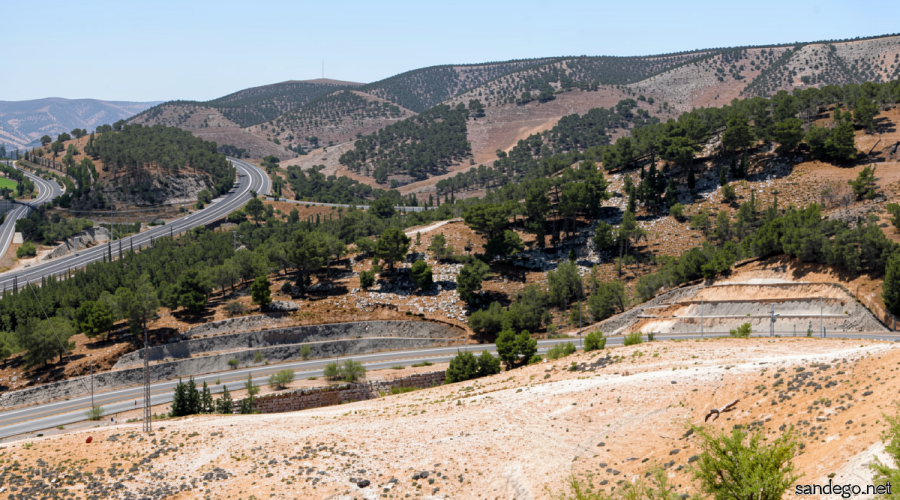
The E1 zone sits between East Jerusalem and the main body of the West Bank, a narrow strip of land that has long been treated as a potential seam in any future territorial arrangement. If developed into a continuous chain of Jewish settlements linking East Jerusalem with the West Bank, the corridor would effectively sever the territory into northern and southern halves. For Palestinians, who regard East Jerusalem as the capital of a prospective state, such a split would render a contiguous, viable Palestinian state geographically impossible.
Israel granted final approval to the E1 master plan the previous year. Far-right Finance Minister Bezalel Smotrich framed the decision at the time in uncompromising terms:
“The Palestinian state is being erased from the table, not with slogans, but with actions.”
For years, successive Israeli governments had deliberately stalled planning and construction in the corridor, citing intense diplomatic pressure and the risk of further fracturing an already fragile peace process. The current administration under Prime Minister Benjamin Netanyahu has reversed that caution, accelerating settlement approvals across the West Bank even as Western capitals have imposed targeted sanctions on figures linked to the settler movement.
A Coordinated International Rebuttal
The tender triggered an unusually swift and unified diplomatic response. On Thursday, the leaders of France, Germany, Italy, the United Kingdom, Norway, Canada, and the Netherlands issued a joint statement reiterating a warning first raised in May by Canada, Australia, and Germany, which had cautioned companies against participating in West Bank settlement construction because of “legal and reputational consequences.”
“At a time of grave instability in the West Bank with unprecedented levels of violence by settlers against civilians, and serious restrictions on the Palestinian economy, this decision is even more concerning.”
The following day, the European Commission joined the statement alongside Greece, Austria, Spain, Australia, New Zealand, and Sweden, broadening the coalition of objecting states. Canada separately advised its own businesses not to “participate in activities that directly or indirectly support or facilitate illegal Israeli settlements and associated violence.”
UK Foreign Secretary Ed Miliband labelled the advance of the E1 plans an “unacceptable and destructive act” and warned of further measures:
“Britain will not stand back and accept the destruction of the two-state solution.”
Israeli Foreign Minister Gideon Saar pushed back on X on Thursday, dismissing the British intervention:
“It is absurd for Britain to lecture the Jewish people about where they may live in their historic tiny homeland.”
Palestinian and Regional Voices
Riyad Mansour, the Palestinian ambassador to the United Nations, characterised the tender as “extremely dangerous, irresponsible, and threatening.” Speaking in an interview, he added emphatically:
“This has to be stopped.”
Cairo weighed in with its own formal rejection. The Egyptian government issued a statement condemning what it called attempts to “entrench a policy of fait accompli through the illegal expansion of settlements and the change of the legal status and demographic makeup of occupied Palestinian territory,” arguing that such steps undermine the prospects for implementing a two-state arrangement.
Legal Status and Broader Implications
Under the prevailing view of the United Nations and most of the international community, all Israeli settlements in the occupied West Bank are illegal under international law. Yet in recent years, settlers have established dozens of unauthorized outposts that were later regularised through government approvals — a pattern that observers say normalises incremental territorial changes before formal negotiations ever resume.
Peace Now, an Israeli settlement-monitoring organisation, issued a statement on Tuesday describing the tender as:
“This is a last-minute maneuver that is part of the scorched-earth policy the government is pursuing at the end of its term to secure long years of conflict and bloodshed for Israel.”
The convergence of factors — the proximity of the election, the breadth of the international objection, the ongoing violence by settlers against Palestinian civilians, and the tightening of economic restrictions on the West Bank — places the E1 tender at the centre of a debate that extends well beyond urban planning. For advocates of a negotiated two-state outcome, the corridor represents a line that, once crossed in concrete and steel, would be extraordinarily difficult to reverse. For the current Israeli government, it is a demonstration that the status quo on the ground can be reshaped regardless of diplomatic protest. The coming weeks, with ballots cast and bids due, will determine which of those trajectories gains momentum.
Related Reading
Frequently Asked Questions
What is Israel moves forward with internationally condemned?
Israel moves forward with internationally condemned is the main topic of this guide. The article explains the context, practical details, and next steps readers should understand.
Why does Israel moves forward with internationally condemned matter?
Israel moves forward with internationally condemned matters because readers are looking for a useful answer, not just a short summary. Good content should match search intent and help them decide what to do next.