A Jury Weighs Thirty Years of Silence and Noise in the Tupac Shakur Murder Case
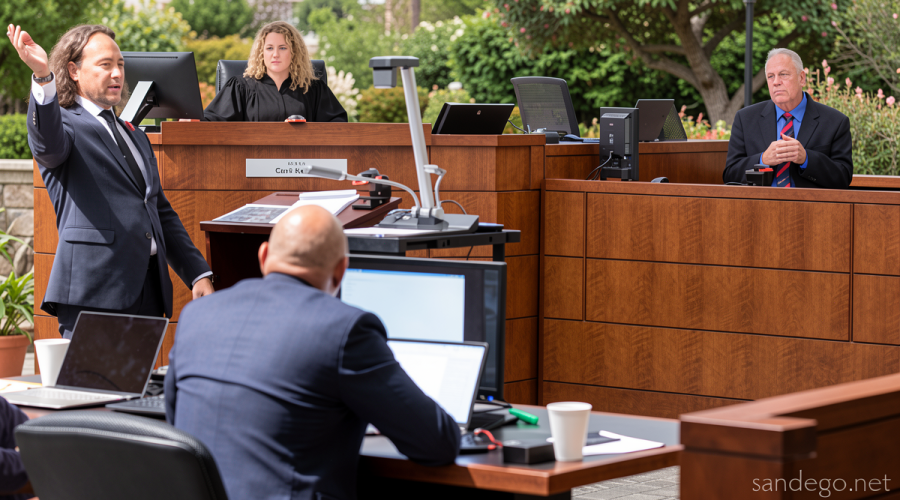
Sandego.net – While tourists zip-lined beneath Fremont Street’s canopy, escaping a desert sun that had pushed Las Vegas temperatures toward 110 degrees, a courtroom three blocks away was staging its own kind of spectacle. On Monday, August 17, defense attorney Michael Sanft stood before a jury in the downtown Regional Justice Center and told them, in effect, that everything his client had said over nearly two decades about the September 7, 1996 killing of rapper Tupac Shakur was a fabrication. The only person ever formally charged in that murder, Duane Davis — known to fans and rivals alike as “Keffe D” — faced a jury tasked with deciding whether he is a compulsive storyteller or a cold-blooded killer.
The trial, expected to run roughly a month, has pulled international attention onto a Nevada courthouse that, on any given day, processes hundreds of routine matters. Before the session began that Monday, a queue of locals snaked through the lobby waiting to settle traffic tickets. The trial’s presence was nearly invisible: buried in tiny print among hundreds of alphabetized case names on a bank of 14 video screens hung in the corridor, one entry read simply “DAVIS, DUANE KEITH.” That is how the state of Nevada files him. The rest of the world has spent three decades knowing a different name.
The Defense: A Two-Decade-Long Performance
Sanft’s opening statement framed the case as one of credibility. He walked the jury through a timeline of Davis’s public and private remarks — beginning with a confidential interview given to Los Angeles Police Department detectives in 1998, continuing through television appearances, podcast episodes, and a published book — and argued that the totality constituted a sustained work of fiction rather than a confession. On a slide projected during his remarks, the word “BULLSH*T” appeared in all capital letters, a blunt summary of the defense position.
“The length of time is going to be a huge problem for anybody to try to recall things,” Sanft told reporters outside the courtroom. “That’s why police reports are important.”
He pointed to gaps in official documentation, noting that officers never filed formal reports on several events the prosecution’s timeline depends upon, including the assault on Orlando “Baby Lane” Anderson, Davis’s nephew, at the MGM Grand. In the defense telling, that beating was the spark prosecutors claim ignited a plan for murderous retribution. Without a contemporaneous police record, Sanft argued, the episode becomes a story told and retold by interested parties until its contours blur.
The Prosecution: Silence Broken
Prosecutor Binu Palal offered the opposite reading. In his view, Davis’s decades of commentary are not fiction but a slow unraveling of guilt, and the absence of formal reports is irrelevant because the defendant supplied the narrative himself, repeatedly, in settings both private and public.
“Even in private calls, Duane Davis has repeatedly told us over and over again about the anger he felt and his own role in the revenge drive-by shooting of Tupac Shakur,” Palal told the jury.
Palal also pressed a thematic point that has recurred throughout the week: in the world of 1996 street politics, quiet was a survival strategy, and Davis was the exception who could not keep quiet.
“In this world, silence means survival,” Palal told the jury. “The one person who has a hard time being silent is Duane Davis.”
A World That No Longer Exists
Each morning of the trial has required a small act of translation. Jurors — some old enough to remember the era, some young enough to need it explained — have had to absorb how daily life operated in the summer of 1996. Mobile phones existed but were not yet universal personal equipment; the devices in circulation were for voice calls, not for scrolling feeds or posting photographs. A paper hotel folio itemizing a string of 75-cent local telephone charges, offered as evidence of where and when key figures made calls that night, now reads like a museum artifact. Surveillance footage capturing Shakur’s entourage exiting the MGM Grand after the Anderson assault carries the wavy, degraded lines of analog videotape.
“We had to maintain a VHS player in homicide to be able to view those things,” former Las Vegas police officer Dean O’Kelley told the jury from the witness stand.
Witnesses Worn by Time
The passage of nearly thirty years has left its mark on the people called to testify. Investigators who survived the intervening decades are almost universally retired; several appeared via video link, hampered by connectivity problems from homes far from Nevada. A young partygoer who watched the shooting from a passing car in 1996 now sits in the witness chair as a middle-aged woman in modest attire. Reggie Wright Jr., once the feared head of security at Death Row Records, was too weakened by Long Covid to walk to the stand and testified from an electric scooter parked in the courtroom.
Sanft, who routinely reassures witnesses that imperfect recall of events three decades old is expected, has identified that erosion as his client’s most reliable ally. The prosecution, by contrast, treats the same erosion as a reason to lean harder on Davis’s own words — words he began sharing publicly in a 2018 documentary, where he said he needed to get the story off his chest.
What the Week Revealed
The first week of testimony has made clear that this trial is as much about memory, documentation, and the politics of silence as it is about a single night in September 1996. Key figures from that era are dead. Witnesses age. Analog tapes degrade. Police reports that were never written cannot be recovered. What remains is a defendant who has spoken, publicly and privately, for twenty-five years about what he did that night, and a justice system attempting to sort confession from performance in a case that has outlived the world in which it was committed.
For Shakur’s family, for fans who grew up on his recordings, and for the broader culture that has waited nearly three decades for some form of accountability, the jury’s deliberation will carry weight far beyond the four walls of the Regional Justice Center. Whether the verdict delivers closure or merely another chapter in an unresolved story remains, for now, a question the desert sun keeps pressing down on Fremont Street while the courtroom works through its own long, slow reckoning.
Related Reading
Frequently Asked Questions
What is Gangbangers rap feuds and old tapes?
Gangbangers rap feuds and old tapes is the main topic of this guide. The article explains the context, practical details, and next steps readers should understand.
Why does Gangbangers rap feuds and old tapes matter?
Gangbangers rap feuds and old tapes matters because readers are looking for a useful answer, not just a short summary. Good content should match search intent and help them decide what to do next.