
India’s Youth Movement Forces Government Retreat After Decades of Stability
Sandego.net – For over ten years, Narendra Modi has stood as an almost untouchable figure in Indian politics. His administration has consistently outmaneuvered rivals, controlled public conversation, and limited opportunities for opposition voices within the globe’s largest democratic nation. Yet this past weekend, something unprecedented occurred. A protest movement barely a month old, driven by young people and amplified through digital platforms, achieved what established political rivals could not: compelling the government to reverse course.
A Satirical Movement Becomes a Political Force
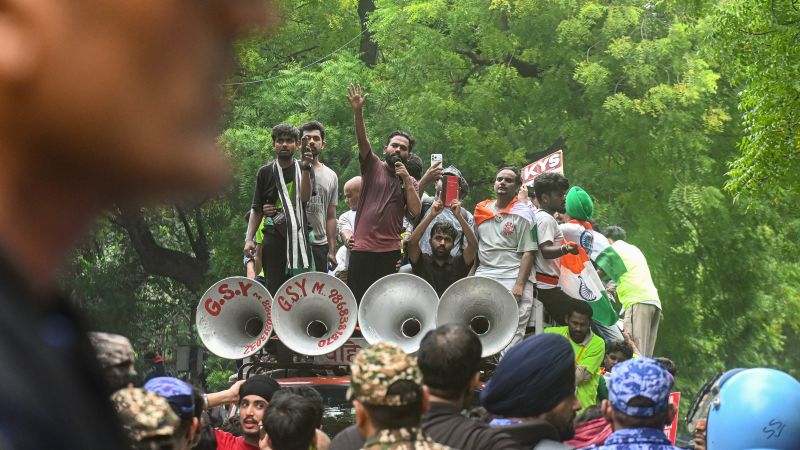
Thousands of Generation Z demonstrators converged upon New Delhi’s streets, organized under the banner of the “Cockroach Janta Party.” This satirical initiative demanded transparency regarding a university entrance examination scandal that allegedly deprived millions of students of equitable opportunities. At the center of their criticism stood Dharmendra Pradhan, the education minister and one of Modi’s most reliable allies, whose tenure coincided with the examination breach.
When Pradhan announced his resignation on Saturday, celebrations erupted at Jantar Mandar. This eighteenth-century astronomical observatory had transformed into the vibrant headquarters for demonstrators. Crowds filled the streets, dancing and singing while waving India’s national flag well past midnight. Many viewed the outcome as proof that collective action and demands for accountability could yield results.
“A week ago you couldn’t really give any feedback to the government,” explained Akshit Tyagi, a twenty-two-year-old software engineer who attended the capital’s protest site. “Now everyone has come out… and there is a validation which is spreading, and people are realizing that they can actually demand things from the government.”
Historical Context and Regional Parallels
This episode marked an unusual withdrawal for the Bharatiya Janata Party, which has successfully countered numerous civil society demonstrations since assuming office in 2014. The retreat also challenged Modi’s image as India’s decisive leader. The movement’s triumph appears to have inspired confidence among citizens who previously doubted meaningful change was achievable.
Observers note that three neighboring countries—Sri Lanka, Nepal, and Bangladesh—have each experienced dramatic youth-driven political transformations in recent years. This similarity has prompted questions about whether India’s “Cockroaches” might signal the start of comparable shifts in a country where youthful frustration has been building beneath the surface for some time.
Many participants at Jantar Mantar grew up under Modi’s leadership, a period characterized by bold commitments to national achievement, economic growth, and patriotic renewal. These promises shaped their understanding of India’s direction and their role within it. While India continues ranking among the world’s most rapidly expanding major economies, and Modi’s three terms have brought substantial investment in infrastructure, technology, and manufacturing, numerous young Indians feel these achievements have not created personal opportunities for them.
Economic Challenges Fuel Discontent
India possesses one of the youngest demographics globally, with more than 360 million citizens aged fifteen to twenty-nine. Despite this demographic advantage, a recent study indicated that approximately forty percent of graduates aged twenty-five and younger remain without employment. When authorities acknowledged in May that medical and dental examination papers had been compromised, requiring millions of students to retake tests nationwide, accumulated grievances erupted into widespread frustration.
The Cockroach Janta Party, founded by Abhijeet Dipke—a Boston University alumnus—capitalized on this moment. What began as a humorous online phenomenon evolved into a channel for expressing generational concerns about job prospects, governance quality, and limited social mobility.
“This indeed is a shock and setback for the BJP,” observed Rahul Verma, a political scientist and fellow at the Centre for Policy Research, a New Delhi-based think-tank. “They didn’t anticipate perhaps the kind of frustration or anxiety that is getting inbuilt in society.”
Throughout its twelve years governing, the BJP has confronted various protest waves. These included public fury over demonetization, which rendered over eighty percent of banknotes worthless overnight, massive opposition to a controversial citizenship legislation, and extended farmer demonstrations against agricultural policy changes. According to Verma, earlier movements primarily addressed policy or ideological disputes, enabling the government to mobilize support through counterarguments. The CJP’s demonstration, by contrast, represents the first movement driven by administrative failure rather than ideological disagreement.
Related Reading
Frequently Asked Questions
What is A weeks old Gen Z protest?
A weeks old Gen Z protest is the main topic of this guide. The article explains the context, practical details, and next steps readers should understand.
Why does A weeks old Gen Z protest matter?
A weeks old Gen Z protest matters because readers are looking for a useful answer, not just a short summary. Good content should match search intent and help them decide what to do next.