Modern Devotees Find Joy Through Ancient Greek Deities
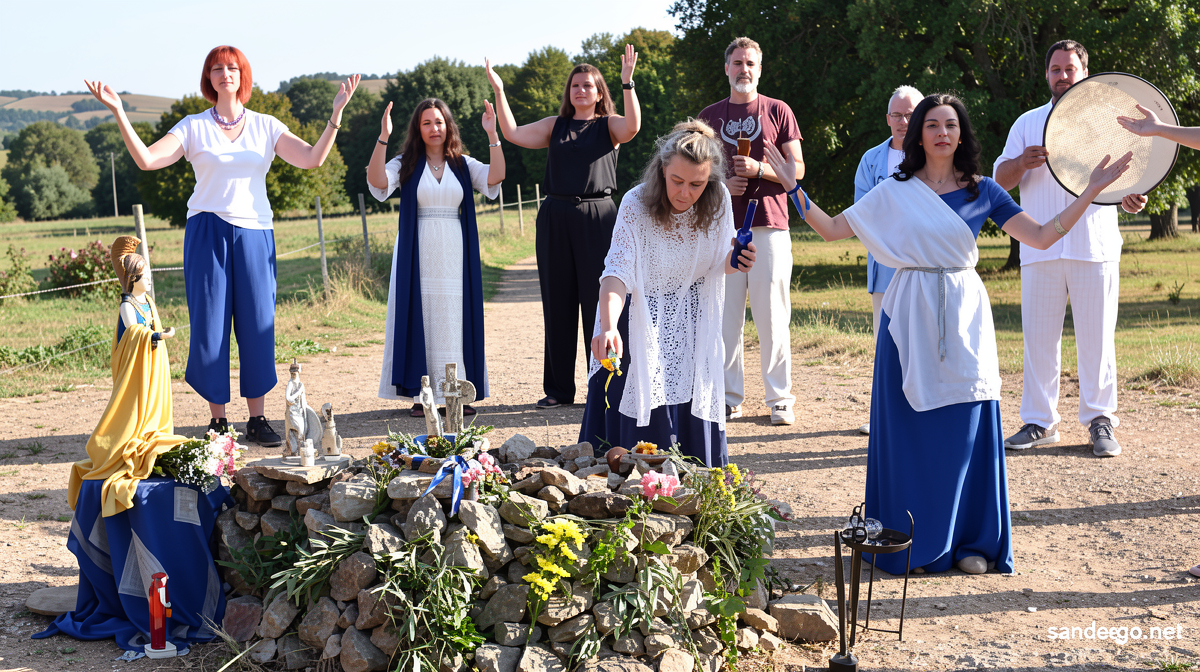
Sandego.net – White ceremonial robes flow as a gathering of women emerges from behind a banner positioned before a modest cave entrance. Around a stone altar, men and women of different generations form a semi-circle while the women guide a gentle procession. One participant carefully sets a miniature statue of Athena—the revered goddess of wisdom—at the altar’s rear, where fragrant frankincense fills the air. Though this moment evokes scenes from antiquity, it is distinctly contemporary. Athens hosts a committed community that actively worships figures such as Athena, Zeus, Dionysus, and Poseidon. They practice more than metaphor or cultural nostalgia; this represents authentic religious devotion in twenty-first century Greece.
The day marks Plynteria, a traditional Athenian purification celebration honoring the ritual cleansing of Athena’s holy statue. Labrys, a contemporary Hellenistic and Greek Polytheist organization, leads these communal gatherings while promoting domestic worship to venerate the ancient deities familiar from masterpieces like Homer’s “The Odyssey.” Christopher Nolan’s upcoming summer feature film reimagines this legendary epic, featuring an impressive ensemble cast with Matt Damon portraying Odysseus and Zendaya embodying Athena. Yet for certain Labrys participants, this cinematic adaptation reinforces their belief that Western entertainment has distanced contemporary Greeks from their ancestral heritage.
A Sacred Connection Beyond Hollywood
Christos Panopoulos, who co-founded Labrys and took the religious name “Pandion” after two legendary Athenian monarchs, expresses disappointment regarding limited Greek representation in Nolan’s production alongside other works drawing extensively from Greek cultural foundations.
“It’s an appropriation,” he explained earlier as Labrys members built an altar of stones for the ceremony. “You don’t have one Greek actor.”
His concern stems from what he perceives as an artificial division created by external forces between ancient and modern Greece. According to Panopoulos, the ancient world belongs universally without Greek input regarding narrative interpretation—something he believes Hollywood would hesitate to replicate when portraying ancient Indian narratives.
These practitioners do not consider themselves historical re-enactors, nor do they characterize their movement as a revival. Instead, they view their faith as an unbroken continuation of spiritual practices spanning Greek history. Even Greek Orthodox Christianity, which became Greece’s dominant religion after Emperor Theodosius I prohibited pagan sacrifices and shuttered temples toward the close of the fourth century CE, incorporated substantial elements from earlier traditions. Deities transformed into religious icons; Poseidon evolved into Saint Nicholas, protector of seafarers.
Personal Spiritual Journey
Panopoulos discovered Greek Polytheism following years of spiritual searching during his adolescence. “I saw that the system that suited me and most explained my established beliefs and experiences of the world was polytheism,” he explains. “Because I’m Greek, I happen to be born here, the closest thing is Greek polytheism.”
With a gentle, self-aware smile, he notes that no dramatic moment involved Zeus descending to issue commands—acknowledging how skeptics might view contemporary followers of the Greek Pantheon. For him, understanding emerged gradually through “getting in tune with something.” Greek Polytheism provides the framework through which he comprehends existence and his place within it.
Like adherents of major world religions, Labrys members may ascribe significance to Zeus or Apollo similar to how others relate to God, Allah, or other divine beings. “The myths and the religious acts are like a symbolic language to do something, in order to achieve something,” he explained. “And what we want to achieve is a connection with the divine. This is the point.”
Labrys represents just one organization supporting Greek Polytheists. The group originated from a 2007 separation from the Supreme Council of Ethnic Hellenes, known as YSEE, following disagreements that Panopoulos characterized as prioritizing political concerns over spiritual practice. YSEE has faced criticism for advancing aggressive anti-monotheistic positions alongside far-right political perspectives.