
Protests and defeat: Chelsea fans run out of patience with club’s billionaire American owners
Protests and Defeat: Chelsea Fans Lose Patience with Billionaire American Owners
Protests and defeat – In the spring of 2022, Todd Boehly, a prominent US billionaire, assumed control of Chelsea, vowing to transform the club into a global powerhouse. “We’re all in – 100%,” he declared to supporters, emphasizing his commitment to securing the best talent and ensuring Chelsea’s sustained dominance in English football. Yet, as the calendar turned to May 2026, the dream of consistent success has been replaced by a growing sense of disillusionment. The latest chapter in this story unfolded on Saturday, when Chelsea’s FA Cup campaign ended in heartbreak, falling to Manchester City 1-0 in the final. The loss not only marked the end of a season filled with underperformance but also reignited frustrations over the club’s leadership and direction.
The Struggle for Consistency
Four years into Boehly’s tenure, Chelsea’s once-robust reputation as a top-tier team has begun to erode. The club currently sits in ninth place in the Premier League, having failed to qualify for the Champions League—a feat considered essential for a club of its stature. While the FA Cup final provided a brief glimmer of hope, it ultimately underscored the lack of progress. The team’s run to the final, though unexpected, did little to mask the cracks in its performance, as recent league games have been marked by inconsistency and a failure to deliver results.
A Fanbase in Turmoil
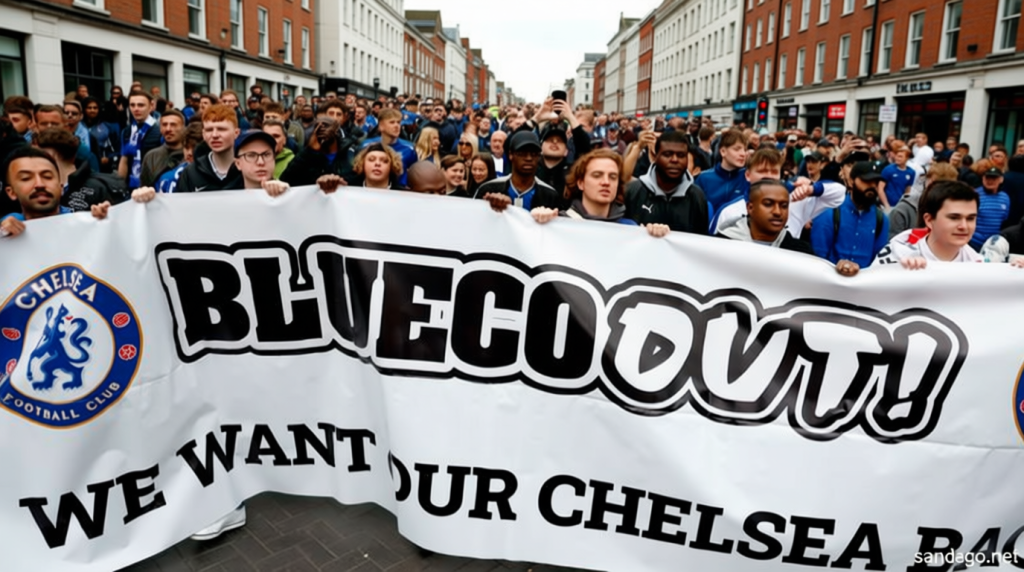
Chelsea’s supporters, known for their loyalty and passion, have found themselves at odds with the club’s new ownership. The protest outside Wembley Stadium before the FA Cup final was a clear reflection of this tension. Fans gathered in solidarity, waving banners that demanded change: “BlueCo out! We want our Chelsea back.” The sentiment was not isolated to the pitch; it echoed through the stands and among the broader fanbase, who have grown increasingly vocal about their dissatisfaction.
For many, the disappointment stems from unmet expectations. The club’s history of success—multiple league titles, Champions League triumphs, and a consistent presence in European competitions—has created a benchmark that is now hard to surpass. Fans, once optimistic about Boehly’s vision, now question whether the new owners have the capability to maintain that legacy. “I think we’re going to get smashed,” a fan remarked on the tube three hours before the match, expressing his doubts about the team’s chances. His friend’s reply, “I think you’re probably right,” highlighted the shared sentiment among supporters, who have watched the season unravel since the turn of the year.
Financial Commitments and Unfulfilled Potential
Despite Boehly’s promises of financial investment, Chelsea has spent over $1 billion on player transfers since the takeover. This hefty outlay has not translated into the kind of competitive edge the club once enjoyed. Instead, it has led to a bloated squad that lacks cohesion and direction. The strategy of signing young talents to long-term contracts, while aimed at future profitability, has also created a squad that is often too large to manage effectively. This approach has left fans feeling disconnected from the team, as they watch players with little experience take the field without the leadership or quality to inspire confidence.
The club’s recruitment decisions have drawn criticism for prioritizing quantity over quality. While some players have shown promise, others have struggled to adapt to the demands of top-level competition. The result is a team that, while occasionally delivering strong performances, has consistently underperformed in key moments. The FA Cup final against Manchester City was a case in point, where Chelsea’s players gave their all but fell short against a more polished and experienced opponent.
Managerial Uncertainty and Leadership Concerns
The managerial instability at Chelsea has further complicated matters. Calum McFarlane, the current interim manager, led the team to the FA Cup final, yet his role suggests the club is still searching for a permanent solution. This turnover of coaching staff has left fans questioning the club’s ability to maintain a coherent strategy. Liam Rosenior, who was recently sacked after a brief stint as manager, is the latest in a line of leaders who have been replaced under the new ownership. His appointment came after he was poached from Strasbourg, another club under Chelsea’s hierarchy, highlighting the internal dynamics at play.
Enzo Maresca, who guided Chelsea to a historic FIFA Club World Cup win in 2025, had already voiced his concerns about the current regime. He stepped down in January, citing a lack of support and frustration with the decision-making process. His departure marked another red flag for the club, signaling a pattern of instability. Reports now suggest Xabi Alonso may take over as manager next, adding to the uncertainty that has plagued Chelsea’s recent campaigns.
The Road to Recovery
With the season drawing to a close, the pressure is on to turn things around. Fans are calling for a reevaluation of the club’s approach, both in terms of recruitment and management. The protest at the FA Cup final, the lack of direction, and the financial investment without corresponding success have all contributed to a sense of urgency. For Chelsea to regain its former glory, the owners must address the structural issues that have led to this state of affairs.
As the club looks to the future, there is a growing hope that a new manager and a revised strategy will restore faith among supporters. The bond between the team and its fans has weakened, but with the right leadership and planning, there is still potential to rebuild that connection. The path to redemption may be long, but for a club with a rich history, the stakes are high, and the expectations are even higher.
