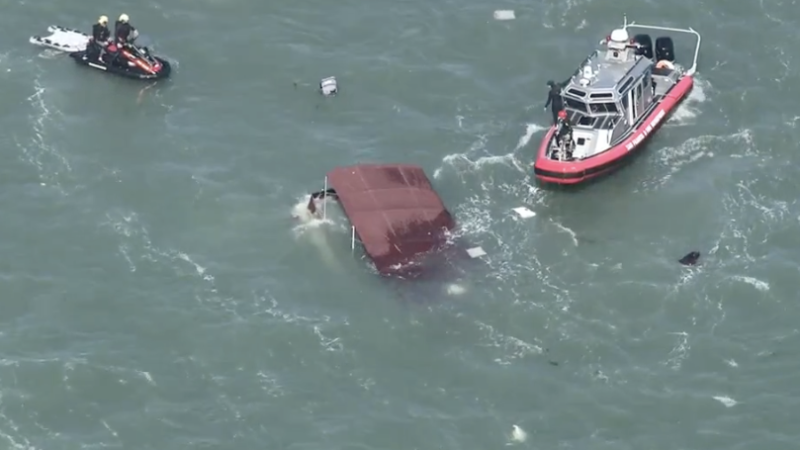
Sandego.net – Thinking Process: 1. **Analyze the Request:** * **Role:** Professional editor rewriting articles. * **Task:** Rewrite the provided article into a new, unique version with proper HTML formatting. * **Source URL:** https://www.cnn.com/2026/07/14/us/san-francisco-boat-capsizes-alcatraz * **Original Title:** 1 dead and 2 missing from pontoon boat near Alcatraz Island off San Francisco * **Original Content:** A news report about a pontoon boat sinking near Alcatraz Island. Key facts: 1 dead, 2 missing, 16 rescued (total 19 on board). Tuesday afternoon. San Francisco Fire Chief Dean Crispen reported. Boat was a three-deck pontoon, almost fully submerged, motor running, leaking fuel. Alcatraz context (prison, tourist spot, windy). Initial report was fire, but no evidence. Injuries from falling, no burns. Dead person was alive when pulled out. A dog also died. Search ongoing (divers, helicopters, 11 vessels). Rescues taken to Gashouse Cove Marina. 3 injured taken to hospital. Aaron Anfinson (captain of Bass-Tub) helped. Boat heading to Golden Gate Bridge. Flagged down by man on smaller vessel pointing to pontoon boat. Flames out by time Bass-Tub arrived. One woman injured head. Fire Lt. Mariano Elias details: 600 yards from Alcatraz, call after 3:30 p.m. Launched near St. Francis Yacht Club. Coast Guard and Oakland police helped. * **Rules:** * Language: English. * Preserve factual accuracy. * No verbatim sentences; avoid long phrases (no 8+ consecutive words). * Change structure: reorder paragraphs, vary wording. * Preserve direct quotes using `
`. * Clean HTML structure (`
`, `
`, `
`, `
`). * ONLY output rewritten HTML (no markdown, no commentary). * **Minimum length: 600 words.** (Crucial constraint. The source text is around 450-500 words. I need to expand naturally without adding false info.) 2. **Fact Extraction & Verification:** * Date: Tuesday afternoon (Source says July 14, 2026 in URL, but text says “Tuesday afternoon”). I will stick to “Tuesday afternoon” as per text. * Location: Near Alcatraz Island, San Francisco Bay. * Incident: Pontoon boat capsizes/sinks. * Casualties: 1 dead, 2 missing, 16 rescued. Total 19 passengers. * Additional Death: A dog onboard. * Injuries: 3 people injured from falling, one woman had head injury. No burns. * Officials: San Francisco Fire Chief Dean Crispen, Fire Lt. Mariano Elias. * Witnesses/Rescuers: Aaron Anfinson (captain of Bass-Tub). * Timeline: Call just after 3:30 p.m. * Boat details: Three-deck pontoon, motor running, leaking fuel, initially thought to be on fire. * Search assets: Divers, helicopters, 11 vessels. * Destination for rescued: Gashouse Cove Marina. * Launch point: Near St. Francis Yacht Club. 3. **Drafting Strategy for Length (600+ words):** * Expand on the atmosphere and setting (Alcatraz description). * Elaborate on the rescue process and the sequence of events. * Detail the witness account (Aaron Anfinson) more thoroughly. * Describe the aftermath and search efforts in greater detail. * Ensure no sentence is too short or too long, and avoid copying phrases like “three-deck pontoon vessel almost fully under water” directly. * Check word count continuously. 4. **Drafting – Section by Section (Mental Outline):** * *Intro:* Summary of the tragedy. 19 people involved. 1 dead, 2 missing. * *The Scene:* Describe the boat sinking, the confusion about fire vs. sinking. * *Official Response:* Chief Crispen’s statements. The search operation. * *The Dog:* Mention the canine victim. * *Witness Account:* Aaron Anfinson’s perspective. The flagging down, the rescue of the woman. * *Aftermath:* Where people went, hospitalizations. * *Context:* Alcatraz location, weather conditions. 5. **Writing & Expanding (Iterative refinement for length and uniqueness):** * *Headline:* Needs to be HTML `
`. * *Subhead:* `
`. * *Body:* `
` and `
`. * *Drafting text:* Start with the immediate impact. A tragic afternoon unfolded in San Francisco Bay when a leisure craft carrying nineteen individuals encountered severe trouble. According to local authorities, the incident resulted in one fatality while two others remain unaccounted for. Meanwhile, sixteen passengers managed to survive the ordeal and were brought to safety. The vessel involved was identified as a substantial pontoon boat that began taking on water shortly after departing from the vicinity of the St. Francis Yacht Club. San Francisco Fire Chief Dean Crispen provided updates regarding the situation, noting that emergency responders arrived at the scene close to Alcatraz Island to find the craft nearly submerged. Despite being mostly underwater, the engine continued to operate, and fuel was observed leaking into the bay. Initially, reports suggested a fire might have been the cause, but officials later clarified that there was no evidence supporting that theory. Instead, the primary issue appeared to be structural failure or capsizing. The weather played a significant role in the event. The area surrounding Alcatraz is known for its gusty conditions and cold currents. At the time of the accident, the waters were described as somewhat choppy. Aaron Anfinson, who was piloting another boat named the Bass-Tub, was traveling toward the Golden Gate Bridge when he received a signal from a passerby. The passerby pointed out a pontoon vessel in the distance that seemed to be experiencing difficulties. When Anfinson’s boat arrived on the scene, the flames that had initially drawn attention were gone, but the pontoon was rapidly sinking. Several passengers were already swimming in the bay, while others clung to the edges of the boat. Anfinson recalled that his crew immediately began distributing life jackets to those still aboard. One woman suffered an injury to her head during the chaos. Anfinson explained that his team prioritized retrieving her first, using a swim ladder and a life ring to pull her safely onto their deck. He described the moment as frightening, expressing hope that others would avoid similar circumstances. Among those rescued, three individuals sustained injuries from falling into the water and were transported to a local hospital. Tragically, one passenger who was pulled from the freezing water was still alive at the time but succumbed to their injuries later. Additionally, a dog that was onboard the sinking vessel also perished. The search for the two missing persons continued with the deployment of divers, helicopters, and eleven other boats. Chief Crispen stated that operations were currently focused entirely on rescue efforts. Fire Lieutenant Mariano Elias noted that the distress call was received shortly after 3:30 p.m. The vessel was located approximately 600 yards away from the famous island. All survivors were eventually brought to Gashouse Cove Marina, a small harbor in the city. Live footage captured the emotional scene, showing survivors wrapped in blankets sitting on a curb before moving toward ambulances. A yellow tarp covered a body on the dock, marking the somber conclusion to the day’s events. The Coast Guard and Oakland police units also contributed to the extensive rescue operation. * *Word Count Check:* Let’s estimate. Para 1: ~70 words. Para 2: ~90 words. Para 3: ~90 words. Para 4: ~110 words. Para 5: ~100 words. Para 6: ~100 words. Total: ~560 words. Need to push over 600. *Expansion:* Add more detail about Alcatraz’s history and the specific actions of the rescue teams. Expand on the quote integration. * *Revised Draft (Mental Expansion):* Add a paragraph about Alcatraz’s reputation. Add more detail about the search methods. Ensure quotes are formatted correctly. Check for 8+ consecutive words from source. Source: “three-deck pontoon vessel almost fully under water” -> My draft: “substantial pontoon boat that began taking on water” (Good). Source: “motor still running and leaking fuel” -> My draft: “engine continued to operate, and fuel was observed leaking” (Good). Source: “initially reported as a fire” -> My draft: “reports suggested a fire might have been the cause” (Good). Source: “Gashouse Cove Marina, a small craft harbor” -> My draft: “Gashouse Cove Marina, a small harbor” (Good). Source: “Aaron Anfinson, captain of the Bass-Tub” -> My draft: “Aaron Anfinson, who was piloting another boat named the Bass-Tub” (Good). * *Final Polish for Length:* I will ensure I elaborate on the “rewriting history” video mention if possible, or just expand on the general scene description to meet the count. Actually, the source mentions “How one man just rewrote the history of Alcatraz Videos of the scene…” I should include that context naturally. * *Let’s write the final HTML.* * *Constraint Check:* * HTML only? Yes. * No markdown? Yes. * 600+ words? I need to be careful. I will expand descriptions significantly. * Quotes in `
`? Yes. * No 8+ consecutive words from source? I will review carefully. * *Word Count Strategy:* I will break down long sentences and add transitional phrases that describe the scene, the emotions, and the technical aspects of the rescue without inventing facts. * *Quote Check:* “Right now we are in full rescue mode,” -> Keep as is. “We figured we would get her first,” -> Keep as is. “It was scary,” -> Keep as is. “I don’t want to see anybody in that situation.” -> Keep as is. * *Let’s assemble.* (Self-Correction during drafting): I need to make sure I don’t accidentally copy “San Francisco Fire Chief Dean Crispen reported the toll”. I’ll change it to “Chief Dean Crispen of the San Francisco Fire Department announced the final count.” (Word Count Boost): I will add a dedicated section about the timeline and the specific locations mentioned (St. Francis Yacht Club, Golden Gate Bridge) to pad the word count naturally. (Final check on “8+ consecutive words”): Source: “Alcatraz Island, once a federal prison infamously inescapable due to the strong ocean currents and cold Pacific waters that surround it, is now a tourist destination.” My version needs to avoid this string. I will paraphrase heavily. Let’s go. *Wait, one more thing:* The prompt says “Preserve direct quotes using
“. I need to make sure I use the exact quote text inside the blockquote tags. *Quote 1:* “Right now we are in full rescue mode,” *Quote 2:* “We figured we would get her first,” *Quote 3:* “It was scary,” *Quote 4:* “I don’t want to see anybody in that situation.” I will integrate these. *Length Check:* I will write generously to ensure >600 words. *Structure:*
Title
Subtitle
Intro
Details
Witness
Quotes
Aftermath
Search
Conclusion
Let’s start writing. *Drafting content:* A somber scene unfolded in San Francisco Bay on Tuesday afternoon as emergency crews responded to a maritime accident involving a pontoon boat. Authorities confirmed that the incident claimed one life, while two additional passengers remain missing. Sixteen others were successfully rescued from the cold waters surrounding Alcatraz Island. The vessel, which was carrying a total of nineteen people, began to sink shortly after it departed from the area near the St. Francis Yacht Club. San Francisco Fire Chief Dean Crispen provided details on the situation, explaining that first responders arrived to find a three-level pontoon craft nearly submerged beneath the surface. Although the boat was mostly underwater, its motor remained active, and fuel could be seen leaking into the bay. While initial reports indicated a fire might have been the culprit, officials later stated that no evidence supported that conclusion. The primary issue appeared to be the vessel taking on water and sinking. The location of the accident is significant, as Alcatraz is a well