Fact Check: Five False Claims Trump Made During a Meeting With Erdogan
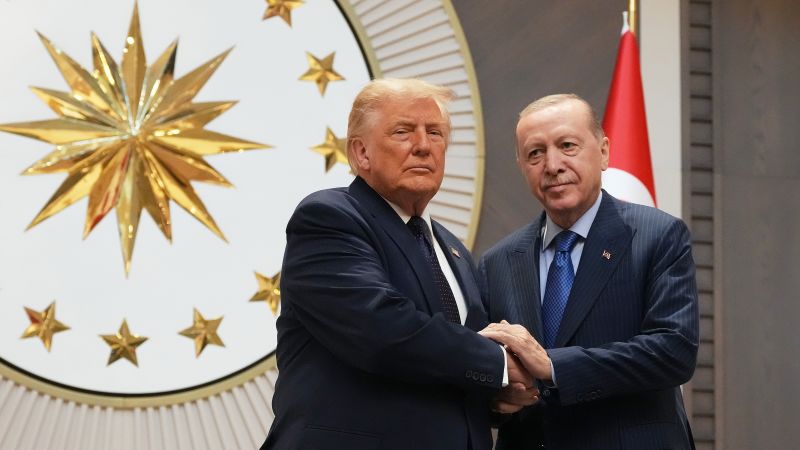
Sandego.net – During a recent meeting in Ankara, former President Donald Trump made several misleading statements about global affairs, including his assertions regarding Greenland, the United States, and his own political legacy. These claims were highlighted during a press briefing held ahead of a NATO summit, where Trump discussed his policies with Turkish President Recep Tayyip Erdogan. The remarks sparked immediate scrutiny from fact-checkers, who identified multiple inaccuracies in his statements. Below is a detailed examination of the five most prominent falsehoods.
Greenland’s Alleged Surrounded Status
Trump asserted that Greenland, a Danish territory with semi-autonomous status, is “surrounded by China’s ships and Russian ships.” This claim, repeated in the meeting, contradicts the reality observed by international experts and naval monitoring systems. Independent analysts and foreign governments, including Denmark, have consistently noted that while Greenland is strategically located near the Arctic, it is not under constant surveillance by Chinese or Russian vessels. The Danish military’s Arctic forces, for instance, confirmed in an interview that they have not detected such activity in or around the territory recently.
“As usual, they did not see Chinese or Russian ships in or around Greenland,” stated the Danish military commander in an interview shared last month.
Trump’s assertion has been dismissed by scholars like P. Whitney Lackenbauer, a Canadian professor specializing in Arctic security. Lackenbauer, who previously criticized the claim, reiterated in an email that the statement “remains inaccurate.” While it’s possible Trump referenced classified intelligence showing limited Russian or Chinese maritime activity near Greenland, this does not support the idea that the island is “surrounded” by these nations’ fleets.
The “Eight Wars” Claim
Trump boasted that he had “settled eight wars” during his presidency, a statement that has been repeatedly debunked. The claim, however, resurfaced during the Ankara meeting. Fact-checkers identified flaws in the list, noting that several of the conflicts Trump cited were not full-scale wars but rather diplomatic disputes or ongoing situations. For example, the Egypt-Ethiopia conflict and the Serbia-Kosovo dispute were not formal wars during his time in office. Additionally, the war between Rwanda and the Democratic Republic of Congo, which Trump included, has not concluded despite a peace agreement he helped broker.
“I settled eight wars,” Trump declared, though his list includes situations that were never classified as wars.
Another point of contention is the Israel-Hamas conflict. While Trump mentioned this as a war he had resolved, Israel has continued launching daily attacks in Gaza, even after a U.S.-facilitated ceasefire agreement. The 2025 Israel-Iran conflict, also listed, was brief but followed by a renewed war in 2026, with Israel and the U.S. collaborating on military actions. These examples demonstrate that Trump’s claim of resolving eight wars is an oversimplification at best and misleading at worst.
Biden’s Ukraine Equipment Claims
Trump reiterated his long-standing accusation that former President Joe Biden “gave them hundreds of billions of dollars worth of equipment” to Ukraine. This figure, however, is an overstatement. According to the Kiel Institute for the World Economy, a German think tank tracking U.S. aid to Ukraine, the total military assistance allocated by the U.S. between late 2021 and April 2026 was approximately $74 billion, not the hundreds of billions Trump claimed. When considering financial and humanitarian aid, the figure rises to about $132 billion.
“When Biden was here, he gave them hundreds of billions of dollars worth of equipment,” Trump said, despite the evidence suggesting a much lower amount.
The Kiel Institute’s analysis highlights the discrepancy between Trump’s narrative and actual data. The $74 billion in military aid was part of a broader effort to support Ukraine during the Russian invasion, but the scale of the funding does not match Trump’s exaggerated figures. This claim has been used repeatedly to criticize Biden’s foreign policy, yet it lacks precise numerical backing.
U.S. Investment Figures
Trump also claimed that the United States had received “$19.2 trillion” in investment since he returned to office, a number he suggested had grown significantly. However, the White House’s own website reported only $10.6 trillion in “major investment announcements” during the first 12 months of his presidency. Even this figure is contested, as it includes vague pledges rather than confirmed investments.
“We have $19 trillion, $19.2 trillion to be exact, being invested in the United States,” Trump stated, implying a surge in economic activity.
Federal data from the previous month revealed that actual foreign direct investment in the U.S. in 2025 was approximately $232 billion. This suggests that the $19.2 trillion figure Trump cited is either a misinterpretation of data or a deliberate exaggeration. Fact-checkers argue that the White House’s calculations often blend investment pledges with economic exchanges, creating an illusion of substantial inflows.
The 2020 Election Rigging Assertion
Trump’s final claim during the meeting was that the 2020 U.S. election was “rigged.” This statement, while frequently repeated, lacks empirical evidence. Multiple independent investigations, including those by the Department of Justice and state election officials, have found no conclusive proof of widespread fraud. The claim has been used to justify his refusal to concede the election and to question the legitimacy of democratic processes.
“The election was rigged,” Trump said, a sentiment that has fueled ongoing political debates and claims of voter suppression.
Despite the absence of concrete evidence, the idea of a “rigged” election has been a recurring theme in Trump’s rhetoric. Critics argue that the claim is designed to cast doubt on the electoral system, particularly in the context of his defeat in 2020. While some disputed votes were identified, they were not enough to alter the outcome, as verified by both domestic and international observers.
These five claims, though distinct in subject, reflect a pattern of strategic misinformation that has characterized Trump’s communication style. By reiterating these assertions in a high-profile meeting, he aimed to reinforce his narrative of political dominance and global influence. However, fact-checkers have consistently shown that these statements, while memorable, are often rooted in selective data or outright fabrication. The accuracy of these claims remains a point of debate, but their recurrence underscores the importance of verifying information, especially in the context of international diplomacy and public discourse.