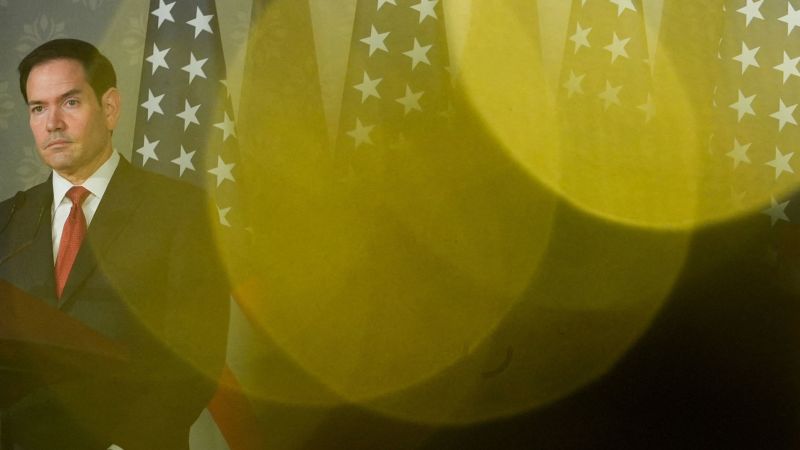
Can Marco Rubio convince Trump that a free Cuba is America First?
Sandego.net – In the current geopolitical climate, Secretary of State Marco Rubio finds himself at the forefront of a high-stakes effort to reshape Cuba’s political landscape. For months, he has worked closely with President Donald Trump to escalate pressure on Havana’s leadership, aiming to secure a future where the island transitions from a communist regime to a democratic one. This mission, however, is complicated by Trump’s tendency to prioritize short-term gains over long-term transformation. As the Cuban-American senator navigates these tensions, his personal ties to the island and his political aspirations have placed him in a unique position: a key architect of America’s Cuba policy, yet a figure caught between the dreams of the diaspora and the pragmatism of the White House.
A Reckoning in the Cuban Revolution
Recent developments have intensified the scrutiny on Cuba’s government. A week after CIA Director John Ratcliffe issued a rare in-person warning to Cuban officials, the Justice Department announced charges against former President Raúl Castro. This legal move, combined with the ongoing fuel blockade that has plunged the island into widespread blackouts, signals a multifaceted strategy to undermine the Castro era. The USS Nimitz aircraft carrier strike group, stationed in the Caribbean, serves as a visible reminder of U.S. military readiness, while sanctions targeting Cuban President Miguel Díaz-Canel, his family members, and pro-government organizations underscore the administration’s resolve.
Rubio’s approach has been both calculated and symbolic. As a son of Cuban immigrants, he carries the weight of generations that viewed the island’s leadership as an obstacle to freedom. His advocacy for democratic reforms echoes his 2016 campaign, when he famously asserted that “free elections, an independent press, and unfettered speech” were non-negotiable for any U.S. engagement with Cuba. Yet, his current role as a negotiator for Trump—a man who once dismissed him as “Liddle Marco”—has transformed his rhetoric into a blend of idealism and pragmatism. While Rubio still championed regime change, he has also embraced the possibility of a “good deal” that could satisfy both political goals and practical constraints.
Echoes of 2016: A Campaign Promise Revisited
Back in 2016, Rubio’s speech in Miami set the tone for his vision of Cuba’s future. The audience, a mix of Cuban-Americans and political allies, erupted in applause as he outlined his demands for electoral freedom and press independence. At the time, Trump’s vague pledge to “work out a good deal” with the Castro regime was seen as a concession to the island’s leadership, rather than a commitment to its people. Rubio’s sharp critique of Trump’s stance not only solidified his image as a reformist but also foreshadowed the challenges he would later face as a diplomat.
Now, with Trump’s focus shifting to the Iran war, Rubio’s role has become even more pivotal. The administration’s pressure campaign on Cuba is a test of his ability to balance his ideological convictions with Trump’s fluctuating priorities. “We’re going to handle that [Cuba] as soon as we finish [the Iran war],” Trump said, emphasizing his methodical approach to foreign policy. This statement, while reassuring, highlights the tension between Rubio’s long-term vision and the president’s need for immediate results. The Cuban-American community, which has long viewed the Castro regime as a symbol of oppression, now looks to Rubio to deliver on promises made years earlier.
The Cuban Dilemma: Ambition vs. Reality
Rubio’s current mission is as much about proving his leadership as it is about advancing U.S. interests. The fuel blockade, which has left Cubans without reliable electricity, is part of a broader effort to destabilize the economy and create conditions for political upheaval. Yet, the effectiveness of such measures remains uncertain. While the Cuban government has shown signs of fatigue, its ability to adapt and maintain control has kept the situation volatile. The recent indictment of Raúl Castro adds a legal dimension to the campaign, but it also raises questions about the feasibility of dismantling the regime entirely.
Trump’s ambivalence toward regime change has further complicated matters. When asked about the specifics of a potential deal, he admitted, “Well, I don’t know about changing the regime.” This hesitation reflects a broader theme in his foreign policy: the preference for incremental progress over sweeping reforms. For Rubio, however, the stakes are higher. As a member of the House Foreign Affairs Committee, he has emphasized the importance of a “negotiated situation” that allows Cuba to move toward democracy while maintaining U.S. leverage. “The United States is open to a negotiated situation that puts Cuba on a path towards democracy, prosperity, freedom, normalcy,” he told lawmakers, a statement that encapsulates both his ambitions and his adaptability.
Rubio’s Strategic Position and Broader Influence
Rubio’s dual role as secretary of state and acting national security adviser has granted him unprecedented authority within the Trump administration. This position, which he held alongside former Secretary of State Mike Pompeo, has enabled him to shape policies on Iran, Venezuela, and China while managing relationships with European allies. Yet, Cuba remains his most personal challenge—a test of his ability to reconcile his heritage with his political pragmatism. “This is the golden ring for Marco Rubio,” remarked Lawrence Gumbiner, a former U.S. Embassy official in Havana. “He has dreamed about this both personally and professionally.”
The Cuban diaspora, which numbers over 1 million in South Florida, has placed its hopes in Rubio’s hands. For many in this community, the end of the Castro era represents not just a political victory but a symbolic return to freedom. Rubio’s testimony before the House Foreign Affairs Committee highlighted this sentiment, as he framed the U.S. strategy as a bridge to a “democratic Cuba.” However, the pressure to deliver results has created internal conflicts within the White House. Officials have expressed frustration over the difficulty of persuading Havana to make significant concessions, a challenge that Rubio must now navigate as both a policy maker and a figurehead for the Cuban-American vote.
Rubio’s efforts also reflect a larger shift in U.S. Cuba policy. While the 2016 campaign focused on radical change, the current administration has adopted a more nuanced approach. This balance between idealism and realism is evident in the administration’s willingness to accept partial reforms while maintaining a firm stance on key issues. The fuel blockade, for example, is a strategic move that aims to weaken the Cuban economy without necessarily toppling the government. Similarly, the sanctions on Díaz-Canel and his family are designed to pressure the regime while avoiding direct confrontation.
Despite these complexities, Rubio’s presence in the administration has allowed him to assert influence beyond his role as a senator. His ability to blend diplomatic strategy with the fervor of the Cuban-American community has made him a central figure in Trump’s foreign policy agenda. Yet, as he prepares for a potential 2028 presidential run, the success or failure of his Cuba efforts could serve as a defining moment in his political career. “This is what he has dreamed about,” Gumbiner said, “both personally and professionally.” For Rubio, the challenge is to translate these dreams into actionable policies, while ensuring they align with Trump’s vision of America First.
In the end, the Cuban Revolution’s next chapter may depend on the interplay between Rubio’s idealism and Trump’s pragmatism. Whether the island will emerge as a beacon of democracy or settle for a “good deal” that leaves its leadership in power remains an open question. But for Rubio, the journey is as much about proving his leadership as it is about fulfilling a lifelong promise to his people. As he continues to navigate the complexities of U.S.-Cuba relations, the world watches to see if his vision can outlast the challenges of the moment.