Russia Faces Widespread Fuel Shortages Amid Escalating Ukrainian Drone Campaign
Almost every Russian region hit by fuel – As Ukraine intensifies its aerial assaults, a severe fuel crisis has swept across Russia’s 83 administrative regions, according to a detailed CNN analysis. The situation, initially concentrated in Crimea, has now spread to nearly every corner of the country, spanning its 11 time zones. Regional leaders and local media reports indicate that over 50 areas have officially documented supply disruptions, while unofficial accounts suggest issues in nearly all regions. The crisis has prompted emergency measures, with some areas restricting fuel sales to civilians to curb shortages.
Impact of Ukrainian Strikes on Russia’s Energy Infrastructure
The crisis escalated dramatically in late June when Crimea, under Russian control, declared a state of emergency. Fuel sales were fully halted for regular citizens, marking a stark shift in the country’s energy strategy. This trend has since extended to other regions, forcing authorities to implement rationing at gas stations. CNN’s investigation into the situation revealed that officials from multiple areas have reported logistical challenges, with some citing damaged refineries as a primary cause. The attacks have not only disrupted production but also created a sense of urgency for Russia to bolster its defenses.
“We are currently seeing certain shortages, although they are not critical,” said Russian President Vladimir Putin in a Sunday state TV interview. The statement appeared to be part of a last-minute public relations effort aimed at reassuring citizens that the situation was manageable.
Despite Putin’s reassurances, the threat of Ukrainian strikes looms large. His remarks highlighted a critical priority: “rapidly and significantly increase production of air defense systems,” signaling growing concerns about Russia’s vulnerability to further attacks. This shift in focus reflects the severity of the crisis and the need for immediate countermeasures.
A Historic Crisis in Scale and Duration
This is not the first time Russia has encountered fuel shortages, but the current situation is more intense. Last August, an increase in Ukrainian attacks led to temporary supply issues across several regions, yet experts suggest the present challenge is far greater. Sumit Ritolia, a lead analyst at Kpler, noted that the scale and persistence of the attacks have created a new level of disruption. “The key difference is the scale and persistence of the attacks,” Ritolia explained, emphasizing that the ongoing strikes are testing the limits of Russia’s energy infrastructure.
Ritolia estimated that gasoline production is currently running at 20% below domestic demand, a significant decline attributed to the sustained assault on refineries. Refinery operations have also dropped to multi-year lows, compounding the problem. Sergey Vakulenko, a senior fellow at the Carnegie Russia Eurasia Center, added that the attacks have become more frequent and coordinated, with Ukraine deploying larger numbers of drones in recent weeks. “In this race between the repairers and the attackers, the balance is shifting,” Vakulenko wrote in a recent article, underscoring the strain on Russia’s recovery efforts.
Public Tensions and Government Measures
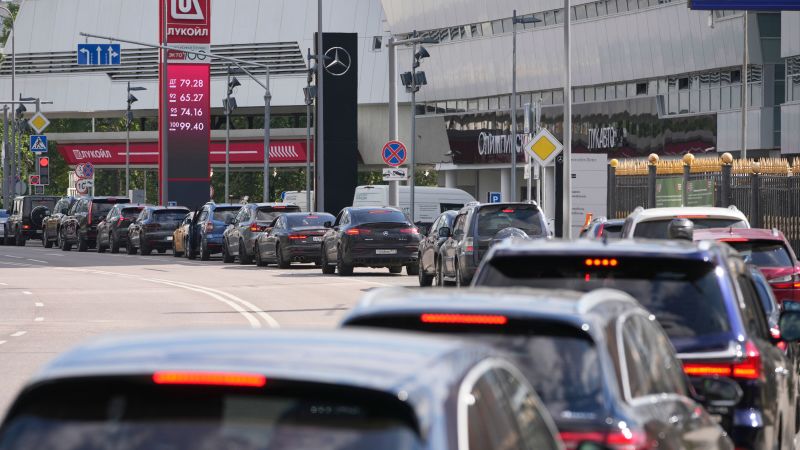
As the fuel crisis deepens, public frustration is mounting. Gas stations are now limiting the amount of fuel customers can purchase, with some restricting to 20 liters per day. To assist drivers, online platforms tracking fuel availability have emerged, guiding citizens to the most accessible stations. However, these efforts are only partially effective, as long lines of vehicles grow at major filling points. Social media has become a stage for heated disputes, with videos capturing arguments over fuel access in Moscow. One clip shows two women yelling at each other, one accusing the other of cutting in line.
Similar scenes are playing out in Krasnodar, a southern city near Crimea. A video shared online depicts a man refueling his car while two women scold him for violating the rules. The incident highlights the growing tensions as citizens compete for limited resources. In response, several regions have banned the use of large canisters for fuel storage, aiming to prevent hoarding. These measures, while intended to stabilize supply, have also sparked complaints about restricted access and rising costs.
“It’s kind of a double-edged sword. It hits the public mood, and it also hits inflation,” remarked Alexander Kolyandr, a senior expert on fuel markets. His comment reflects the dual challenge of managing both consumer behavior and economic consequences.
Authorities are also cracking down on those exploiting the crisis for profit. In Irkutsk, a Siberian region heavily affected by the strikes, police fined four individuals for selling fuel at inflated prices. One case involved a 20-year-old man who was caught in a sting operation after anti-corruption officers posed as buyers. He was allegedly charging four times the national average price, drawing attention to the black market’s role in exacerbating the shortages. The region’s governor, who has declared a “state of heightened alert,” has imposed strict controls, including banning canister sales to non-emergency services.
Broader Implications for Russian Society
Putin’s interview on state media revealed his awareness of the crisis’s societal impact. He warned that the strikes were designed to “create uncertainty for us, or even better to lead to a schism in Russian society,” a sentiment echoed by analysts. The fuel shortages are not only affecting logistics but also testing the resilience of the population. With daily life increasingly disrupted, the crisis has become a symbol of broader vulnerabilities, from military preparedness to economic stability.
While the government has taken steps to mitigate the situation, the challenges remain immense. The combination of prolonged attacks and the need for rapid repairs is putting pressure on both the energy sector and the public. As the crisis continues, its long-term effects could reshape Russia’s energy strategy and deepen social divisions. For now, citizens are navigating the fallout, with tensions rising and the search for fuel becoming a daily struggle.
The situation underscores the evolving nature of the conflict, where energy infrastructure is a critical battleground. Ukraine’s strategy of targeting refineries has not only disrupted supply chains but also forced Russia into a reactive posture. As the attacks persist, the question remains: can the country sustain its energy output and maintain public morale in the face of escalating adversity? For now, the answer appears to be uncertain, with the crisis spreading across regions and intensifying with each passing day.