Cuba’s Military Wants to Show Readiness. Footage Reviewed by CNN Reveals Its Limits
Sandego.net – As the United States intensifies its diplomatic and economic pressure on Cuba, the island nation’s military has turned to a powerful narrative of defiance. Recent videos and images shared online by Cuban officials and the Ministry of the Revolutionary Armed Forces (MINREFA) highlight the country’s efforts to project strength, even as its forces struggle to maintain operational readiness. A CNN analysis of these materials reveals a stark contrast between the rhetoric of preparedness and the reality of Cuba’s diminished military capabilities, particularly in light of the U.S. embargo and the loss of Soviet-era support.
A Defiant Legacy from the 1990s
In the early 1990s, Cuban President Fidel Castro faced a critical juncture in his leadership. With the Soviet Union’s collapse looming, the promise of Russian military aid that had sustained Cuba’s armed forces for decades began to fade. Castro, known for his unyielding stance, famously invoked the ancient Roman siege of Numancia as a symbol of resistance. The story of the 133 BC Spanish city, which held out against Roman invaders before being destroyed, became a rallying cry for Cuban military morale during that era.
“La Numancia” became a motif in defiant speeches late into Castro’s presidency,” said Frank Mora, a Cuba policy expert. “It was a way to remind people that even without the backing of a superpower, Cuba could stand firm.”
At its peak, Cuba’s military was described as a “first-world force in a third-world country” by analysts, boasting over 235,000 active-duty personnel and a network of reservists. The Soviet Union had provided advanced weaponry, including anti-aircraft systems and mobile missile launchers, which enabled Cuba to project military power beyond its geographic size. However, with the USSR’s dissolution in 1991, the Cuban military began to shrink, relying on dwindling resources and outdated technology to maintain its presence.
The Art of Deception in Modern Warfare
Today, Cuban military planners are using a different strategy to communicate their readiness. CNN’s review of recent footage shows a deliberate effort to emphasize aging equipment and historical imagery, framing it as a testament to perseverance rather than a sign of weakness. According to Mora, these videos are designed to evoke a sense of resistance, not to showcase actual combat capability.
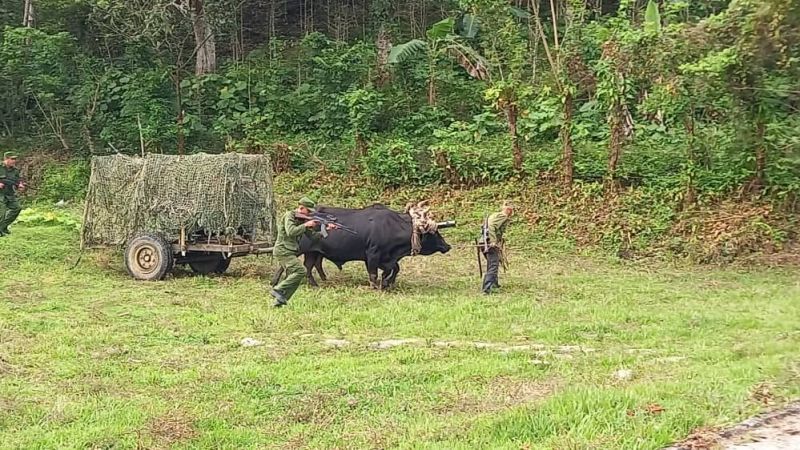
In one April 2026 clip, a Soviet-era ZU-23 anti-aircraft system is dragged by oxen, a stark visual of the nation’s reliance on decades-old technology. Local reports suggest this was part of a regional training exercise, but the image underscores the challenges of maintaining a modern military without consistent access to resources. Another video features a modified BM-21 Grad rocket launcher, a system originally developed during the Cold War, being maneuvered by soldiers in army green uniforms. The launch tubes are not loaded, yet the men adjust the launcher’s angle and wave colored flags, creating a performative display of military preparedness.
Cuban officials maintain that their forces are ready to defend the nation if necessary, even as they admit to using symbolic gestures. “If military aggression occurs, and should we fall in battle, to die for the homeland is to live,” said President Miguel Díaz-Canel in an interview with Newsweek. This sentiment reflects a broader narrative that prioritizes national pride over practical military effectiveness.
The Hedgehog Strategy and a Shrunken Force
Experts note that Cuba’s military has shrunk significantly over the past three decades, with active-duty personnel now numbering at most 50,000. This reduction, driven by economic struggles and the loss of Soviet subsidies, has forced the armed forces to adapt. Retired U.S. Marine Colonel Mark Cancian explained that Cuban planners have adopted a “hedgehog strategy,” focusing on defense rather than offense. The term, borrowed from the classic game, describes a tactic where a nation concentrates its strength in a few key areas to maximize impact.
“The idea is to make themselves harder to conquer,” Cancian said. “By narrowing their focus, they can maintain a level of capability that serves as a deterrent.”
This strategy is evident in the way Cuba’s military has repurposed Soviet-era equipment for symbolic and strategic use. For example, the Ural brand on a modified BM-21 Grad launcher indicates a recent Russian upgrade, blending vintage design with modern modifications. Such innovations, however, are limited in scope, as the military continues to operate with a shrinking budget and unreliable supply chains.
During the 2000s, the Cuban military’s infrastructure began to deteriorate, with frequent power outages and oil shortages complicating training and operations. Despite these challenges, the force remains a critical component of the nation’s identity, symbolizing resilience in the face of adversity. Cuban officials emphasize that while their military may not match the U.S. in terms of technological superiority, it is still capable of defending the homeland when needed.
A Deliberate Display of Defiance
The use of vintage equipment in modern footage is not accidental. By showcasing relics of the Cold War, Cuba aims to evoke nostalgia and a sense of historical continuity. This approach is particularly effective in a nation where the military has long been a pillar of national pride. The videos often interweave archival footage of Cuban troops in their prime with current images of aging hardware, reinforcing the idea that the country’s spirit endures despite its material decline.
For instance, a January 2026 Facebook post featured soldiers handling a Soviet-era Grad rocket launcher, a system once used to strike U.S. targets during the Cuban Missile Crisis. The slow-motion sequence of a rocket launch, paired with a dramatic orchestral score, transforms the act into a theatrical performance. Such storytelling, while not a substitute for modern military might, serves to inspire domestic morale and signal determination to the international community.
Cuba’s current military posture also reflects a strategic shift in how it engages with the United States. While the Trump administration’s policies have targeted economic sectors and diplomatic ties, the Cuban military has positioned itself as a symbol of resistance. This dual role—as both a defensive force and a cultural icon—allows Cuba to maintain influence despite its reduced military footprint.
Analysts argue that the Cuban military’s efforts to project readiness are a necessary response to U.S. pressure. “They’re not trying to win a war, but to avoid one,” Mora noted. “The goal is to make the United States think twice before taking action.” However, the reality is that Cuba’s forces are stretched thin, with many units operating on outdated equipment and limited training. The challenge lies in balancing the need for psychological warfare with the practical demands of military preparedness.
As Cuba continues to navigate its post-Soviet future, the military remains a central figure in the nation’s strategy. Whether through the symbolic use of old hardware or the integration of modern upgrades, the armed forces are adapting to a new era of conflict. While their capabilities may be constrained, their commitment to defending the island—no matter the cost—remains unshaken. In this way, Cuba’s military not only serves as a tool of resistance but also as a testament to the country’s enduring spirit.