Burning Throats and Persistent Headaches: Life in Boyle Heights Amid a Weeklong Warehouse Fire
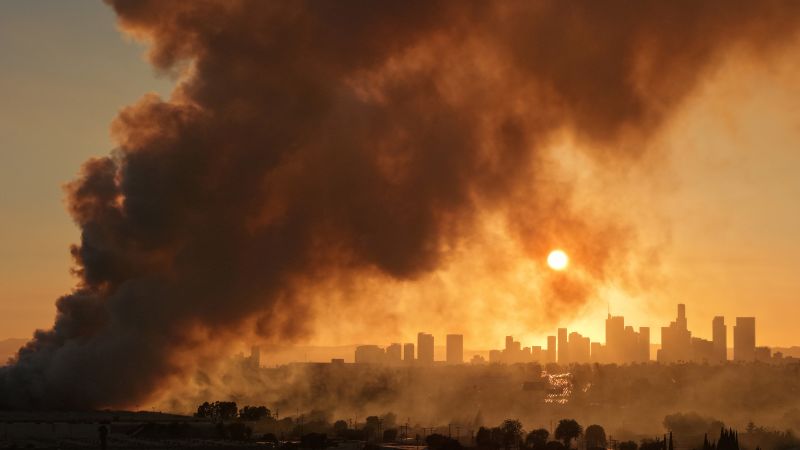
Sandego.net – The smoky haze that has lingered over Boyle Heights for nearly a week has transformed daily life into a battle against the elements. For Ethan Salter, a 23-year-old musician, the fire’s presence was almost imperceptible on its first day. Returning home from a recording session on June 17, he assumed the blaze—a block away—had already been contained. “It seemed totally fine,” he said, recalling the initial days of the fire. Yet by the following morning, his body betrayed him. “My lungs felt heavy, my chest was just closing up,” Salter described, prompting him to abandon his neighborhood for safety. He has since been couch-surfing, moving between friends’ homes in nearby areas and eventually settling at his parents’ house in Long Beach, a 22-mile drive away. “I have to go back up to LA, because my whole entire life is out there,” he said, emphasizing the dilemma of leaving behind his music career and home. His loft, once a creative sanctuary for his alt-pop band SALTER, now feels like a distant memory as he scrambles to secure a space to rehearse ahead of a show organized through his promotion company.
The Fire’s Lingering Effects
June 17 marked the beginning of a prolonged fire that has left Boyle Heights residents grappling with both physical and emotional tolls. The blaze, originating from a privately owned cold-storage warehouse, has sent thick plumes of smoke into the skies, enveloping neighborhoods and forcing families indoors. While air quality readings have returned to safe levels for some areas, the South Coast Air Quality Management District extended a particle pollution advisory until Wednesday, highlighting the ongoing threat. Despite the improvement, the smoke’s persistence has created a sense of unease, with residents questioning the long-term consequences of the pollutants they’ve inhaled.
“It’s affecting our lives,” said Christina Ayala, a 58-year-old resident. “We don’t have another place to go. We have dogs, cats, our whole family is here.”
Ayala, who has lived in Boyle Heights for over five decades, has been particularly affected. She and her family reside in a duplex directly behind the warehouse, where the smoke has seeped into every corner of their home. The symptoms she’s endured—intense headaches, dizziness, and nausea—are so severe that she’s lost her appetite. “I can feel it in the morning, the smoke all in my room,” she said, describing the invisible but constant presence of the fire. Her grandchildren, home on summer break, add to the emotional strain. The youngest, a 3-year-old boy, is confused by the need for masks and the restriction on outdoor play, a situation Ayala says has tested her patience and resolve.
The fire’s impact extends beyond personal health, affecting the neighborhood’s economic fabric. Local businesses have struggled to maintain operations as customers opt to stay indoors, fearing the effects of the haze. For many, the uncertainty of when the fire will be fully extinguished has created a ripple effect, disrupting routines and straining resources. Even those with access to temporary shelter have found themselves in a paradoxical situation: the relief of moving away from the smoke is tempered by the cost of adapting to new environments.
Community Resilience in the Face of Disruption
While the fire has displaced some, others have shown remarkable resilience. A nearby shelter, just a 10-minute drive from the blaze, has become a temporary haven for residents seeking relief from the smoke. On Tuesday, the sky was clear, and people walked their dogs without masks, a small victory. However, not all felt comfortable. Some visitors arrived hoping for air purifiers, only to leave with masks and other supplies, underscoring the community’s anxiety over the air quality. Manuel Perez, a Boyle Heights resident living a mile-and-a-half from the fire, has taken precautions by keeping his windows closed for days. “It’s the same there,” he said in Spanish, referring to nearby cities like Montebello and Alhambra, where the smoke has followed. He had intended to purchase an air purifier but was surprised to find it priced at $30, a cost that adds to the financial strain.
The Los Angeles Fire Department, in a Monday press briefing, expressed confidence that the fire would soon reach its conclusion. Deputy Fire Chief Derek Chapman noted that efforts to contain the blaze have made steady progress, though the full resolution remains a few days away. “We expect to continue making gains and bring the fire under control in the coming days,” he stated, offering a glimmer of hope amid the haze. Yet for many, the relief is premature. The fire’s aftermath has not only damaged property but also disrupted the rhythm of life, creating a sense of instability that lingers long after the flames are extinguished.
A History of Smoke and Survival
Ayala’s experience echoes a broader narrative of endurance in Boyle Heights. She remembered a similar fire at the same warehouse two years ago, but this time, she insists the situation is “10 times worse.” “Our concern is what’s in the air? What’s going to happen to us? Are we going to have consequences after?” she pondered, highlighting the community’s fear of long-term health effects. The warehouse, a recurring source of danger, has become a symbol of the area’s vulnerability to environmental crises. Residents like Ayala, who have built their lives in the neighborhood for decades, now face the challenge of balancing their deep-rooted connections with the need to protect their families from the fire’s consequences.
For Salter, the fire has not only disrupted his physical health but also his creative process. His rehearsal space, once a place of inspiration, is now a distant memory. “It’s been really hard,” he admitted, reflecting on the stress of finding new accommodations and the uncertainty of when he can return. His story, like that of Ayala, represents the diverse ways the fire has impacted individuals. While some prioritize their health by fleeing, others, like Salter, are compelled to stay because their livelihoods depend on it. The fire has thus become a microcosm of the broader struggle faced by residents in the face of prolonged environmental challenges.
As the smoke continues to settle, the community remains on edge. The fire’s duration has stretched beyond expectations, with residents adapting to life in masks and confined spaces. While officials provide assurances of containment, the lingering effects of the blaze serve as a reminder of the resilience required to weather such disasters. For Boyle Heights, the fire is more than an event—it is a test of how communities endure, adapt, and rebuild in the shadow of uncertainty.
Residents are now looking ahead, hoping for a return to normalcy. Yet the question remains: how long will the haze and its effects persist? For those like Salter and Ayala, the answer may depend on the fire’s complete extinguishment and the gradual clearing of the air. Until then, their lives will continue to be shaped by the invisible presence of smoke, a constant reminder of the fragile balance between progress and peril in their neighborhood.