Understanding the Threat of New World Screwworm
Sandego.net – In the early part of June, Texas Governor Greg Abbott issued a warning to residents, urging them to prepare for a “particularly difficult summer.” His remarks came amid the resurgence of a flesh-eating parasite that had previously caused over hundreds of millions of dollars in damage across the state during the 1960s and 1970s. This organism, which had been absent from the United States for decades, is now reemerging and threatening livestock, wildlife, and even pets. The initial detection of the New World screwworm in the current outbreak occurred on June 3, 2026, in a 3-week-old calf in South Texas. While the calf recovered, the infestation has since expanded far beyond the southern border, prompting concerns about its potential to disrupt the southwestern region’s agricultural economy.
A Public Health Concern with Economic Implications
Although the primary focus of the outbreak is on animals, experts note that the risk to humans remains relatively low. However, the infestation could indirectly affect food prices, as the beef industry faces challenges in maintaining supply. The USDA reports 15 confirmed cases in the U.S. as of the latest update, with cattle being the most vulnerable. Other affected animals include sheep, goats, and a dog in New Mexico. The parasite’s spread has raised alarms, particularly given the current record-high costs of beef in the U.S. The CDC has classified the outbreak as a Level 3 public health emergency, indicating active monitoring and expert intervention. Doctors are being asked to report any suspected cases, highlighting the need for vigilance in both human and animal populations.
“The name might be misleading, but it’s a fly, not a worm,” explains Dr. Jonathan Cammack, a livestock entomology and parasitology expert at Oklahoma State University. “It’s not contagious in the traditional sense; instead, it’s an infestation that spreads through eggs laid in wounds or mucous membranes.”
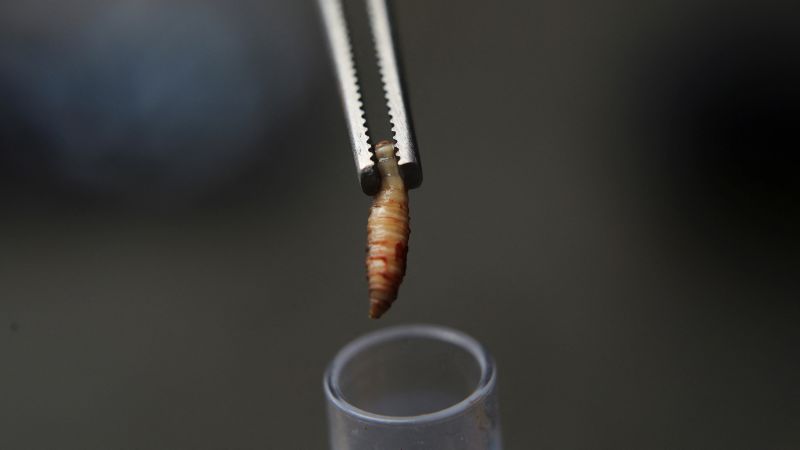
Contrary to its name, the New World screwworm is not a worm at all. It is a parasitic fly whose larvae feed on the living tissue of warm-blooded animals. Unlike many other flies that target decaying flesh, these larvae burrow into the body, creating deep sores and secondary infections. The CDC highlights that the infestation can lead to severe complications, including arterial rupture and anemia, which may be fatal if left untreated. Early detection and intervention, however, can prevent such outcomes. Veterinarians typically remove visible eggs and larvae, then apply insecticides to eliminate the threat and prevent recurrence.
Historical Context and Global Spread
The New World screwworm, *Cochliomyia hominivorax*, has a complex history. First identified as a distinct species in 1933 by Emory Cushing and Walter Patton, it was initially referred to simply as a screwworm. However, when the same name was used for a different species found in North Africa, scientists needed a way to differentiate between the two. As a result, the Central and South American variant was officially labeled the New World screwworm, while the African and Southeast Asian type became the Old World screwworm. This classification has since become crucial for tracking and managing outbreaks.
The latest outbreak began in Central America in 2023 and has since spread extensively. Reports from the CDC indicate over 185,000 animal cases and 2,100 human cases in Mexico and the region. While the U.S. has seen fewer instances, the 15 confirmed cases so far are a significant concern. The last recorded case in the U.S. was a travel-related incident in Maryland in 2025, but the resurgence in Texas suggests a new phase of the infestation. The parasite’s ability to travel across borders via infected animals or eggs poses a challenge for containment efforts.
“It’s called a screwworm because the larvae actively penetrate the flesh of living hosts, unlike many other flies that rely on dead tissue,” says Dr. Jonathan Cammack. “This distinction is key to understanding how it spreads and how to combat it.”
The lifecycle of the New World screwworm begins when adult females lay eggs in open wounds or mucous membranes. Within 12 to 24 hours, the eggs hatch into larvae that immediately begin feeding on the host’s tissue. This feeding process causes sores to expand, sometimes leading to bacterial infections. The odor of decaying flesh can attract additional flies, exacerbating the problem and potentially introducing other species into the infestation. For livestock, the consequences are severe, with the potential for death within seven to 14 days if treatment is delayed.
Impact on Livestock and the Economy
As the largest beef producer in the U.S., Texas is particularly vulnerable to the economic fallout of the outbreak. Cattle, which are central to the state’s agricultural output, have been the primary targets. The infestation threatens not only the health of animals but also the profitability of ranchers. If containment measures fail, the southwestern U.S. could face billions of dollars in losses. The USDA and federal agencies have intensified surveillance, implementing restrictions on animal movement and enhancing diagnostic protocols. Despite these efforts, the parasite has continued to spread, underscoring the urgency of the situation.
Scientists are working to understand the full scope of the outbreak and its implications. The New World screwworm’s return has reignited discussions about the importance of early detection and rapid response. While the risk to humans is low, the CDC emphasizes the need for continued awareness. The parasite’s presence in the U.S. serves as a reminder of the interconnectedness of global ecosystems and the potential for pests to reestablish themselves in regions where they were once eradicated. With the current outbreak, experts are closely monitoring the situation to prevent further spread and mitigate its impact on both agriculture and public health.
As the summer progresses, the fight against the New World screwworm intensifies. State and federal officials are collaborating to implement targeted interventions, including the use of insecticides and improved biosecurity measures. The USDA has also declared a special status for the outbreak, allowing the FDA to expedite the approval of necessary treatments. Meanwhile, researchers are studying the parasite’s behavior to develop more effective strategies for long-term control. The success of these efforts will determine whether the outbreak can be contained before it causes widespread economic damage.
Preparing for the Future
With the threat of the New World screwworm still looming, stakeholders across the agricultural sector are preparing for the worst. Ranchers are being advised to inspect their herds regularly and report any signs of infestation. Veterinarians are also playing a critical role in diagnosing and treating affected animals. The CDC and USDA have issued guidelines to help communities respond quickly, reducing the likelihood of large-scale outbreaks. While the situation remains challenging, the combined efforts of experts, officials, and farmers may prevent the parasite from gaining a foothold in the U.S. and protecting the region’s vital livestock industry.