Reflecting Pool woes: Trump administration turns to hydrogen peroxide in latest bid to beat back algae
Sandego.net – The Lincoln Memorial Reflecting Pool, a iconic symbol of American heritage, faced an unexpected challenge just days after its $14 million renovation was completed. While the project aimed to restore the water feature to its former glory, it quickly became apparent that algae had reappeared, casting doubt on the administration’s efforts to revive the landmark. The pool, spanning over 300,000 square feet, was refilled with 6.5 million gallons of clean water, yet its current state has sparked debates about the effectiveness of the cleanup measures.
Immediate Response to the Algae Outbreak
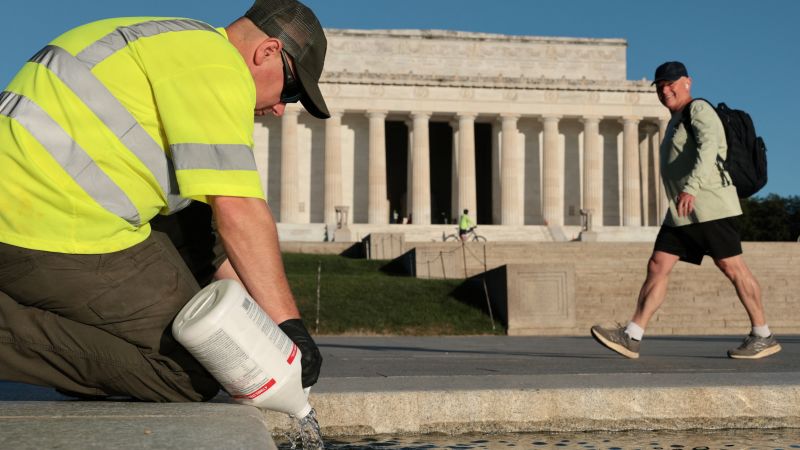
Within days of the pool’s refill, the Trump administration took immediate steps to address the algae issue. Workers in hip-waders were deployed to manually remove visible patches of the green substance, while additional crews were tasked with dispersing hydrogen peroxide into the water. Despite these efforts, the algae continued to proliferate, turning the pool into a murky green hue. This situation has raised questions about whether the president’s vision for a pristine, country-representative pool can be fully realized.
“It would take an entire lifetime to clean this pool,” remarked a worker who spoke to CNN on Tuesday, highlighting the persistent nature of the problem. The comment underscores the challenges faced by maintenance teams as they grapple with what some describe as a recurring issue.
The Department of Interior, responsible for overseeing the project, has defended its approach, claiming that the algae problem is manageable. A spokesperson for the department stated, “Due to deploying the advanced nanobubbler technology, the algae is dead and being vacuumed up as we speak. The nanobubbler technology has successfully destroyed the algae bloom that has plagued every pool reopening.” This statement positions the ozone nanobubbler as a state-of-the-art solution, though its efficacy remains under scrutiny.
Technological Claims and Company Involvement
The department emphasized that the nanobubbler, a filtration system designed to break down contaminants, is now in operation. However, the algae issue has not been entirely resolved, with some observers noting that the problem persists despite these measures. The White House, meanwhile, has deflected questions about the president’s awareness of the situation, directing inquiries back to the Department of Interior.
Public records reveal that an Ohio-based company, Greenwater Services, was contracted to install the filtration system. The company’s website proudly states that its patented technology is “backed by government and academic research,” offering “breakthrough solutions” to reduce toxins, microcystins, nitrates, and phosphates from contaminated water. Yet, the company has not provided further comments on the algae outbreak, leaving its role in the current crisis unclear.
Mixed Reactions from the Public
As the pool’s algae issue gained attention, reactions from visitors and locals varied widely. Danielle Khan, a Washington, DC-based professional, expressed skepticism about the renovation’s impact. “I know a lot of money went into this, but I can clearly see algae growing,” she said. “It looks exactly the same, so I’m really unclear what exactly was done.” Her sentiment reflects the frustration of those who expected a more dramatic transformation.
“It’s not good. I mean, it looks green,” said Valerie, a visitor from Chicago. “I was excited to see it, but it just looks swampy.” The comment illustrates the growing concern among the public, particularly those who had anticipated a more visually appealing outcome.
On the other hand, Dinika Seth, a traveler from North Carolina, saw the pool’s condition as an improvement. “It’s getting cleaner,” she noted, pointing to the water. “If it was still in not good shape, you wouldn’t see a good reflection.” Her perspective highlights the subjective nature of public opinion, with some appreciating the progress while others remain critical.
Steve Hay, a resident of Harrisburg, Pennsylvania, suggested that the diverse reactions might stem from political affiliations. “Either way, all I know is I’m looking at it, and I’m enjoying it,” he remarked. This viewpoint adds a layer of complexity to the situation, as the pool’s appearance is now tied to broader perceptions of the administration’s work.
Origins of the Algae Problem
The algae outbreak appeared almost immediately after the pool was refilled last week. Within a day of the water being restored, CNN first reported the presence of the green algae, visible even from the water’s edge. A worker who was wading through the pool confirmed the substance was indeed algae, though the Interior Department initially hesitated to classify it as such. At first, the department’s spokesperson said the Fish and Wildlife Services division was “not convinced” it was algae, citing the possibility of residual particles from supply lines.
Hours later, the department clarified that the algae was “residual from supply lines,” which had been dormant during the eight weeks of construction. The spokesperson added, “It’s part of the normal startup process. We are removing the algae, and the nanobubblers will maintain the pool and keep it algae-free.” This explanation aims to reassure the public that the problem is temporary and that the new technology will prevent future outbreaks.
However, the algae’s rapid resurgence has led to speculation about the long-term effectiveness of the measures. Critics argue that the nanobubbler and hydrogen peroxide treatments may not be sufficient to address the root causes of the issue. The Department of Interior also noted that hydrogen peroxide is being used as a “milder treatment” for algae, touting its safety for marine life and the environment. While this aligns with the administration’s broader environmental goals, the algae’s persistence challenges those claims.
Historical Context and Ongoing Concerns
The algae issue is not new to the Reflecting Pool. Previous administrations have faced similar challenges, with the problem often resurfacing after renovations or repairs. This recurring issue raises questions about the long-term maintenance strategies in place. For instance, Eddie Wood of Atlantic Industrial Coatings, the company that resurfaced the pool, emphasized that his team’s role was limited to waterproofing and tightening, not water management. “My company had nothing to do with water, only waterproofing and water tightening,” he told CNN, expressing pride in his contribution to the project.
Despite these efforts, the algae has become a focal point of public discourse. The pool’s transformation, once hailed as a major undertaking, now seems overshadowed by the challenges of keeping it free from green growth. As the weeks pass, the administration’s ability to address the issue will be closely watched, with the outcome potentially affecting perceptions of its commitment to public spaces and environmental stewardship.
While the Department of Interior remains confident in its approach, the algae problem has sparked a broader conversation about the balance between cost, technology, and results. The pool’s condition serves as a microcosm of larger debates about infrastructure projects and their ability to meet lofty goals. Whether the algae issue will be fully resolved or continue to haunt the pool remains to be seen, but one thing is clear: the problem has turned the once-anticipated cleanup into a test of the administration’s resolve.