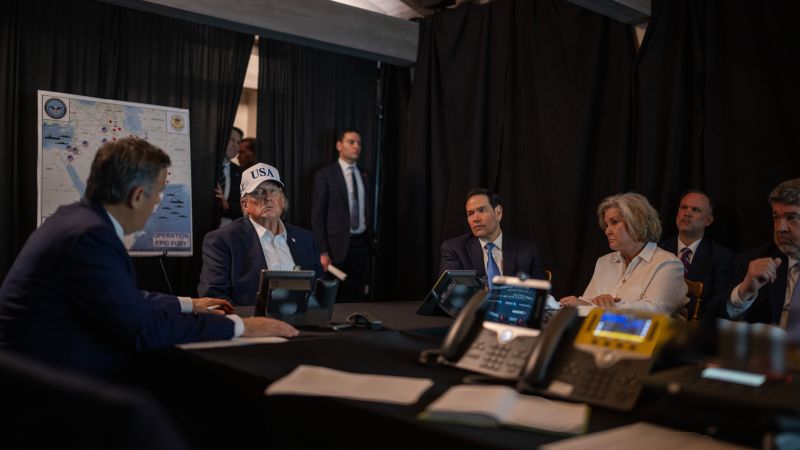
How Trump Sidelined National Security Experts Ahead of His War with Iran
The NSC’s Historical Role and Trump’s Reforms
Sandego.net – During World War II, Congress took action to ensure a president had access to reliable advice as the country navigated global conflict. The National Security Council (NSC), established under Franklin D. Roosevelt, became a central hub for integrating military, diplomatic, and intelligence insights. This structure proved vital in shaping decisions during the war, serving as a bridge between various government agencies and the executive branch. Over the decades, the NSC remained a key institution, supporting 14 U.S. presidents in their strategic planning. However, under Donald Trump, the council faced significant restructuring, raising concerns about its effectiveness during the lead-up to a military confrontation with Iran.
Staff Cuts and the Influence of Far-Right Allies
Recent estimates indicate that Trump’s administration reduced the NSC’s staff from approximately 200 to fewer than 100, a sharp decline that critics argue diminished its capacity to provide comprehensive analysis. This reduction occurred as the president prepared for a war with Iran, a conflict that saw frequent shifts in strategy. Some officials attribute these cuts to pressure from far-right figures like Laura Loomer, who accused the NSC of harboring individuals unfaithful to Trump’s vision. Loomer’s influence reportedly led to a prioritization of loyalty over expertise, altering the council’s traditional function.
Before the war, the NSC was meant to serve as a collaborative platform, drawing on a wide network of specialists. Instead, Trump increasingly relied on a select group of allies, including National Security Adviser Marco Rubio and envoy Steve Witkoff, for decision-making. This shift left military planners with limited input during early discussions, forcing them to adapt quickly once operations began. “There’s no doubt there were missed opportunities with a smaller NSC,” said a former Trump administration official, highlighting how diminished staffing affected the thoroughness of pre-war assessments.
Impact on Foreign Policy and Strategic Planning
The changes to the NSC had far-reaching consequences for U.S. foreign policy, particularly in the context of conflicts with Iran and Ukraine. Veterans of Trump’s second term noted that the council’s reduced size made it harder to coordinate with Gulf allies, a critical need during the war. One official explained that a larger NSC could have facilitated better dialogue with regional partners, ensuring a unified approach to Iran’s response to U.S. strikes. Additionally, the council’s diminished role may have contributed to an underestimation of Iran’s willingness to close the Strait of Hormuz, a strategic chokepoint for global trade.
Despite the cuts, the NSC continued to play a role in crisis management, though its influence waned. Trump’s approach emphasized rapid action over prolonged deliberation, a style that some argue improved decision speed but compromised depth. The administration’s surprise at Iran’s aggressive missile strikes, as stated by Trump in March, reflects this pattern. “The biggest surprise of the war was the ferocity with which Tehran hit Arab Gulf states,” he remarked, underscoring the lack of anticipated escalation.
Benefits and Drawbacks of a Streamlined NSC
While the smaller NSC offered advantages, such as reduced bureaucratic hurdles during crises, its limitations became evident. Two former officials acknowledged that the streamlined structure allowed for quicker responses but at the cost of thorough analysis. “The NSC is more effective and responsive to the President’s priorities than ever before,” claimed White House spokesperson Anna Kelly, emphasizing that Trump’s team remained engaged with diverse perspectives. However, critics argue that this responsiveness came at the expense of interagency collaboration, which was essential in past administrations.
The NSC’s role in the 2015 Iran nuclear deal provides a stark contrast to its current state. At the time, the council was deeply involved in negotiating the agreement, working alongside Robert Malley, a lead negotiator who also held a senior position in the NSC. Nate Swanson, a State Department official focused on Iran, described the NSC as “extremely involved” in both shaping and implementing the deal, highlighting its historical efficacy. Now, under Trump, the council’s involvement in such complex negotiations appears diminished, with some key analyses sidelined in favor of speed.
Agency Involvement and the Disconnection from Expertise
Though the NSC was a central body, other agencies like the Department of Energy and Treasury played secondary roles in the Iran war planning. Sources reported that while officials from these departments attended early meetings, their analyses were not given the same weight as in previous administrations. Sriprakash Kothari, a Treasury official nominated by Trump, admitted to Senate staff that he was unaware of any energy market experts at Treasury contributing to the decision-making process. “No one at Treasury conducted analysis on energy markets prior to the military operation,” Wyden stated, citing Kothari’s testimony.
Scott Bessent, the Treasury Secretary, defended the agency’s role, asserting that it relied on hundreds of career economists for guidance. Yet, the lack of direct engagement with energy market specialists during the planning phase suggests a disconnect between policy and expertise. This trend may have led to miscalculations, such as the underestimation of Iran’s capacity to disrupt oil shipments by closing the Strait of Hormuz. Despite years of war-gaming scenarios involving this move, the administration was caught off guard by the speed and scale of Iran’s response.
Reaffirming Presidential Authority Amid Criticism
Anna Kelly, the White House spokesperson, defended Trump’s approach, stating that the president met frequently with his team and considered multiple viewpoints. “Any suggestion that relevant entities weren’t involved is laughable,” she added, citing the NSC’s ongoing collaboration with agencies like the CIA and Department of Defense. However, the broader critique remains that Trump’s leadership style prioritized decisiveness over consensus, sidelining experts who might have provided a more balanced perspective.
While the NSC’s changes reflect a shift in how national security is managed, they also highlight a tension between centralized authority and institutional expertise. Critics argue that this restructuring has made the U.S. more vulnerable to miscalculations, particularly in high-stakes conflicts. Yet, supporters of the approach maintain that a leaner NSC allows for faster execution of policies, aligning with Trump’s preference for immediate action. As the war with Iran unfolded, the NSC’s evolution became a focal point in debates over the balance between speed and strategic depth in modern governance.
Conclusion: A New Era for National Security?
The transformation of the NSC under Trump signals a departure from its traditional role as a collaborative advisory body. While the cuts were justified as streamlining operations, they also raised questions about the long-term implications for U.S. foreign policy. The council’s reduced size may have expedited decisions but also increased the risk of oversight. As the war with Iran continued, the NSC’s diminished capacity served as a reminder of the challenges of managing global conflicts without a robust network of experts to inform strategy.
Ultimately, the debate over the NSC’s effectiveness underscores the broader tension between presidential autonomy and institutional support. Trump’s emphasis on rapid action, while efficient in some contexts, may have left critical assessments to the sidelines. The administration’s reliance on a smaller, more loyal team of advisors, rather than a diverse array of specialists, has become a defining feature of its approach to national security. Whether this model proves sustainable remains to be seen, but for now, it has reshaped the landscape of strategic decision-making in Washington.