
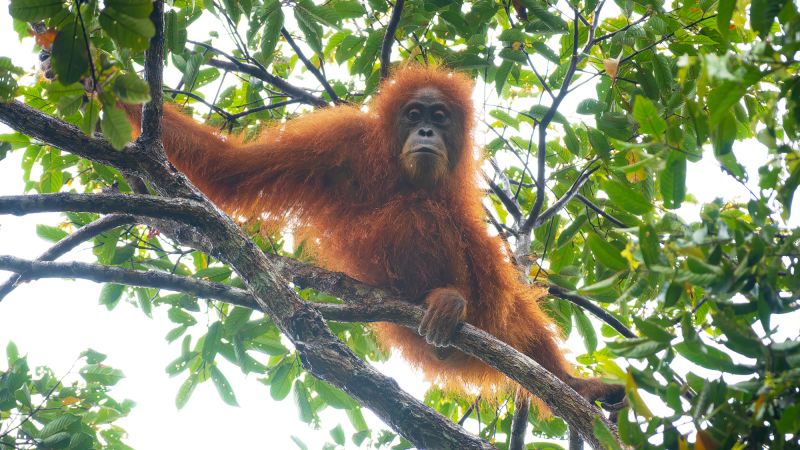
How one devastating cyclone wiped out 7% of the planet’s rarest great apes
Sandego.net – Recent research has revealed that Cyclone Senyar, which struck Indonesia in late November 2025, caused the deaths of over 60 Tapanuli orangutans, accounting for approximately 7% of the global population of these critically endangered primates. The findings, published this month in the journal *Current Biology*, highlight how extreme weather events driven by climate change are intensifying the challenges faced by the world’s rarest great apes. The storm’s impact extended beyond human casualties, as it devastated the Batang Toru ecosystem in North Sumatra, the primary habitat for the species.
A Natural Catastrophe’s Unseen Toll
While Cyclone Senyar displaced over a million people and claimed more than 1,000 lives, its ecological consequences were equally severe. The storm delivered over 16 inches of rain to Indonesia, creating one of the region’s most intense rainfall events in recent years. According to the Tsunami and Disaster Mitigation and Research Center, climate change amplified the cyclone’s rainfall by 9% to 50%, making it more destructive than average. This surge in precipitation triggered landslides that swept through the West Block of the Batang Toru ecosystem, wiping out nearly 12% of the forest cover in the area.
Researchers analyzing satellite imagery identified more than 20,000 acres of landslide scars—patches of rock, soil, and debris that altered the landscape. These collapses, often sudden and unpredictable, left little time for orangutans to escape. The Tapanuli orangutans, already struggling with habitat loss due to deforestation, faced an additional crisis as their forested home was shredded by the storm. The study estimates that 58 individuals perished in the disaster, but scientists warn the actual toll could be higher. Estimates of population density may have underestimated the number of deaths, and other factors like food scarcity or canopy destruction were not fully accounted for in the analysis.
Species on the Brink
“It could well be that up to 120 animals died during the landslide events,” said Erik Meijaard, the study’s lead author and managing director of Borneo Futures in Brunei. “The numbers could also be lower than 58, he added.”
The Tapanuli orangutan’s vulnerability is compounded by their slow reproductive rate. Female apes give birth every six to nine years, which limits the population’s ability to rebound from losses. This makes even a single cyclone or landslide a potentially catastrophic blow. The study’s lead author, Meijaard, emphasized that the species’ survival hinges on its capacity to recover from such setbacks. “Whether these orangutans can recover will depend on what happens next,” he noted.
Conservationists argue that the cyclone’s impact underscores the fragility of the Tapanuli orangutan’s existence. The apes are already threatened by the clearing of forests for roads, agriculture, and industrial development. With annual losses exceeding 1% and a death rate that could rise further, the species is at risk of extinction. “The damage may increase if surviving orangutans face reduced breeding success after the disaster,” Meijaard warned. The combination of natural disasters and human activities has pushed the population to the edge, with the study suggesting the species may now be on a path toward oblivion.
Expert Insights and Calls for Action
Friederike Otto, a climate science professor at Imperial College London, stressed the importance of halting deforestation and reconnecting fragmented habitats. “If this tragedy serves as a wake-up call to really halt deforestation, reconnect some of the fragmented forest habitats where that is possible, and bring governments, local communities, and industries together to support conservation efforts, the species may still have a chance,” she told CNN.
However, Otto also highlighted the looming threat of future extreme weather events. “Another heavy rainfall event, which climate change is making more likely, poses a huge risk to their recovery,” she said. Adriano Lameira, a primatologist from the University of Warwick, echoed these concerns. “After decades of sustained conservation efforts, it is clear the current system is not working and cannot guarantee the protection of the country’s unique natural resources,” he stated. Lameira emphasized that the orangutans’ survival is not just about their numbers but also about their role in understanding human evolution.
“The Tapanuli orangutan also provides unique insights into the potential lives of ancient human ancestors and why and how humans came to become who we are today,” Lameira added.
The loss of these apes is a significant blow to biodiversity and scientific research. Their habitat, the Batang Toru ecosystem, is one of the last remaining strongholds for the species. The study’s findings have prompted urgent calls for stronger conservation measures from the Indonesian government. Scientists and conservationists are urging immediate action to mitigate further damage, including reforestation initiatives and stricter regulations on land use in the region.
While the cyclone’s immediate impact was devastating, the long-term consequences of climate change and deforestation could be even more severe. The Tapanuli orangutan’s survival depends on a delicate balance between natural threats and human intervention. As the global population dwindles, the species becomes a symbol of the broader challenges facing wildlife in an increasingly unstable climate. “The damage to the orangutan population is a stark reminder of how interconnected environmental and human factors are in determining the fate of endangered species,” Otto concluded. The question now is whether the world will act quickly enough to prevent the extinction of this rare and remarkable great ape.
In the wake of Cyclone Senyar, the urgency to protect the Tapanuli orangutan’s habitat has never been greater. The Indonesian government faces pressure to implement more effective conservation strategies, particularly in regions where deforestation continues at an alarming rate. Without intervention, the species may not survive the next wave of extreme weather or human encroachment. The study serves as both a warning and a call to action, emphasizing that the survival of these apes is a critical test for global conservation efforts.
Experts agree that the Tapanuli orangutan’s plight is a microcosm of the challenges faced by many endangered species. As climate change intensifies, the frequency and severity of extreme weather events will likely rise, threatening ecosystems worldwide. The orangutans’ slow reproduction and fragmented habitats make them particularly susceptible to such disruptions. Their story underscores the need for a more holistic approach to conservation—one that addresses both climate-related risks and human-driven environmental degradation. The hope is that the cyclone’s aftermath will galvanize efforts to save the species before it is too late.