Jalen Brunson’s NBA Finals Triumph Elevates Him as a Knick Legend
Sandego.net – In a moment that will be etched into basketball history, Jalen Brunson’s performance in Game 5 of the NBA Finals did more than secure a championship for the New York Knicks—it redefined their identity as a franchise. For the first time in 53 years, the Knicks stood atop the league, and at the heart of their resurgence was Brunson, a player whose relentless determination and clutch execution have transformed him into a symbol of New York’s enduring basketball spirit.
The Seeds of Resilience
The journey to this moment began long before the 2026 NBA Finals. In 2017, Brunson found himself at the center of a tempest as a sophomore at Villanova, choosing to leave Temple—a decision that split families and fueled the ire of local fans. His father, Rick Brunson, had once led Temple to glory under John Chaney, and for many, Jalen’s switch to the Wildcats felt like a betrayal. Yet, as the crowd jeered and the chants of “traitor” echoed through the stands, Brunson responded with a quiet, unshakable focus. He drained 31 points in a game where Villanova’s dominance was unchallenged, a performance that silenced critics and set the stage for his future as a leader.
That college rivalry, once a fierce battle for supremacy in the Big 5, became a backdrop to Brunson’s rise. The 22nd consecutive win over Temple that year was more than a victory for Villanova—it was a turning point for Brunson, who began to embrace the weight of expectation. His ability to thrive under pressure, even when the odds seemed insurmountable, hinted at the grit that would later define his NBA career. It was a lesson in resilience, one that would carry him through years of challenges and accolades.
The Crucible of the NBA Finals
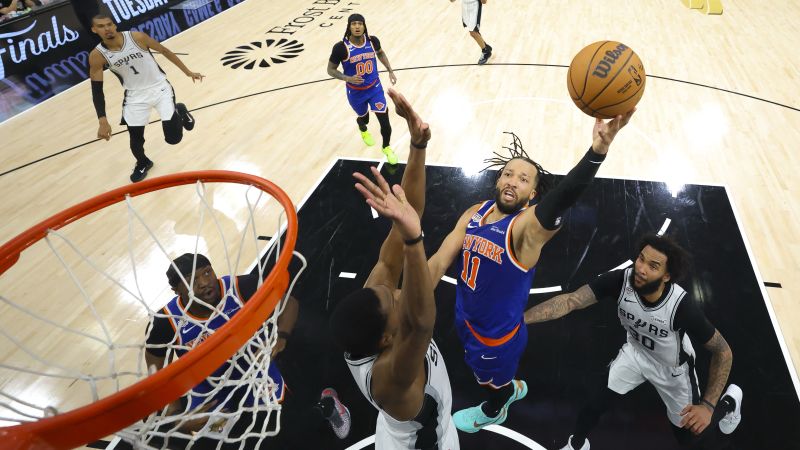
Nine years later, the Knicks faced a different kind of crucible. In Game 5 against the San Antonio Spurs, the stakes were monumental. With the series tied at 2-2, the crowd in Madison Square Garden was a mix of anticipation and anxiety, knowing the team had been down the entire season. The Spurs, with their veteran core and proven track record, seemed to have the edge. But when Wemby, the rookie phenom, blocked Brunson’s 3-pointer during the third quarter, the crowd’s gasps turned into murmurs of disbelief. The referee, rather than calling the flagrant foul, let the play stand, and Brunson’s reaction was explosive.
He chased the officials across the court, his frustration boiling over before he returned to the bench, eyes blazing. That moment wasn’t just about a single play—it was a testament to the fire that had always driven him. Over the next 18 minutes, Brunson unleashed a torrent of energy, scoring 24 of his 45 points to rally the Knicks from a 55-50 deficit. The game, which had seemed lost, became a testament to his ability to turn tides. As the Knicks closed the gap and eventually seized the lead, the city’s collective heart swelled with pride.
“Whenever someone counted us out, we found a way to do something about it,” Brunson said after the game, a quote that captured the essence of his leadership. The Knicks had trailed in every game of the series, facing seemingly insurmountable deficits in the fourth quarter. Karl Anthony Towns fouled out, Landry Shamet limped off with a sprained ankle, and Mitchell Robinson was left with one functional hand. Yet, they pressed on, fueled by Brunson’s unyielding resolve.
A Legacy Forged in Fire
Brunson’s impact extended beyond the scoreboard. His heroics in the Finals weren’t just about the numbers—they were about the narrative he created. At 29, he had already claimed two college championships, national honors, and now an NBA title. But what truly set him apart was his ability to embody the spirit of the city. The Knicks, once a team of underdogs, became champions through his unwavering belief in their potential.
“I have no words,” Brunson told ESPN’s Lisa Salters, his voice trembling with emotion. “It’s everything I ever dreamed of. I don’t know what I’m feeling. I’m just, like, in awe.” These words, raw and heartfelt, underscored the culmination of a journey that had taken him from the scorn of Temple fans to the pinnacle of the NBA. His career arc was a story of perseverance, from being a sophomore at Villanova to leading the Knicks to glory in 2026.
Brunson’s leadership style was unique. He didn’t just play the game—he imposed his will on it. The Knicks, gifted with the advantages of being a professional team in New York, had often struggled to capitalize. But Brunson’s presence transformed them into a unit of grit and determination. His persona, a blend of quiet intensity and unshakable confidence, became contagious. As he stepped onto the court, the team followed, absorbing his energy and adopting his mindset.
The Spurs, despite their dominance, were outmatched in the end. They led for more minutes than the Knicks and built seemingly insurmountable leads. Yet, every time they seemed to have the upper hand, Brunson’s ability to make clutch shots and lead in the most critical moments reminded them of the Knicks’ unrelenting will. This season had been a marathon, and Brunson’s performance in the Finals was the final sprint that propelled them to victory.
From Critic to Champion
What makes Brunson’s story so compelling is the contrast between his early challenges and his later triumphs. The same critics who once called him a traitor in 2017 now celebrated him as a savior. His refusal to yield, even when the odds were stacked against him, became a defining trait. The comparison to Secretariat is apt—both were born to excel, their natural talent matched by an unbreakable spirit. Brunson’s belief in his team, even when the numbers suggested otherwise, turned the narrative on its head.
“How else to explain such relentlessness?” a writer mused after the Finals, reflecting on Brunson’s ability to thrive in the worst moments. His NBA Finals MVP crown wasn’t just a reward for his 45-point outburst—it was a recognition of his entire season, a season where he transformed a team into champions. The Knicks, once a symbol of struggle, now stood as a testament to his legacy. With New York greats like Patrick Ewing and Charles Oakley watching from the stands, Brunson’s achievement was a new chapter in the franchise’s storied history.
As the dust settled on the 2026 NBA Finals, the Knicks were no longer just a team—they were a symbol of perseverance. Brunson’s journey from the court of Villanova to the hardwood of Madison Square Garden had been a masterclass in resilience. His performance in Game 5, a game that meant everything, was the final chapter of a story that began with a single decision. In the end, it wasn’t just the Knicks who had risen; it was Jalen Brunson, a player who had turned criticism into fuel and underdog status into legend.