Why the Recent Kyiv Assault by Russia Was Among the Most Lethal of the War
Russia s latest attack on Kyiv – On Thursday, a severe Russian attack on Kyiv claimed at least 30 lives, surpassing previous strikes in terms of casualties. This makes it the third deadliest assault targeting the Ukrainian capital since the war began. While Kyiv has weathered numerous aerial attacks, the intensity of this week’s strike stood out due to the specific choice of targets and the arsenal of weapons employed. Moscow focused on residential buildings, using a combination of ballistic missiles, loitering munitions, and jet-powered drones to inflict maximum damage.
The use of jet-powered drones, such as the Geran-4 UAV, marks a recent evolution in Russia’s military technology. First observed early in the year, these drones can achieve speeds of up to 500 kilometers per hour, allowing them to bypass traditional defenses. Their velocity also complicates interception efforts, as Kyiv’s mobile fire units struggle to keep up. To neutralize these threats, Ukraine must rely on ground-to-air missiles or fighter jets, which are less readily available and more resource-intensive.
“The enemy is using them more and more frequently, and the percentage of jet-powered Shaheds in their arsenal is increasing; which depletes (our) resources,” said Yurii Ihnat, a spokesperson for the Ukrainian Air Force, on Friday.
Analysts from the Institute for the Study of War (ISW), a U.S.-based conflict monitoring organization, emphasized that Russia’s tactical use of faster drones reflects a deliberate strategy to heighten civilian casualties. “Faster-moving drones that are harder for Ukraine to intercept will likely generate increased civilian harm, much as other strike package adaptations have in the past,” the ISW stated in a report released Thursday. The group argued that such innovations are part of Moscow’s broader approach to target urban areas with precision and efficiency.
Ihnat also noted that the attack’s uniqueness lay in the high proportion of ballistic missiles used. Out of the 77 projectiles deployed, 28 were ballistic, a figure he described as “very, very high.” This shift from conventional aerial assaults to a heavier reliance on ballistic missiles and drones underscores a change in Russia’s offensive tactics. The Ukrainian Defense Ministry confirmed that over 90% of cruise missiles and 90% of Shahed-type strike drones were intercepted during the attack, yet the sustained bombardment still left many residents injured or displaced.
Among the weapons involved was the Zircon, a hypersonic cruise missile designed for anti-ship and land-attack purposes. Ihnat explained that the Zircon’s speed resembles that of a ballistic missile, making it a formidable challenge for Ukraine’s defenses. “It flies like a ballistic missile at a very high speed, and only the Patriot system can intercept such a missile,” he added. However, Ukraine’s limited stock of Patriot missiles remains a critical issue, as the nation faces a persistent shortage.
The shortage of Patriot missiles has been worsened by the conflict in Iran, which diverted some of Ukraine’s initial supply shipments to the Middle East. Despite having contracts for future deliveries of hundreds of these missiles, the immediate need is urgent. The defense ministry has reached out to nearly 40 countries, requesting that they provide Patriot missiles from their existing stock in exchange for future deliveries already secured for Ukraine.
ISW suggested that Russia had been preparing the attack for months, stockpiling drones and missiles in June. The group observed that while Moscow had maintained a regular schedule of strikes from January to May, the frequency of large-scale attacks dropped in June. This strategic buildup implies that Russia may be saving its most advanced weaponry for a future escalation, particularly if it believes it can overwhelm Ukrainian air defenses.
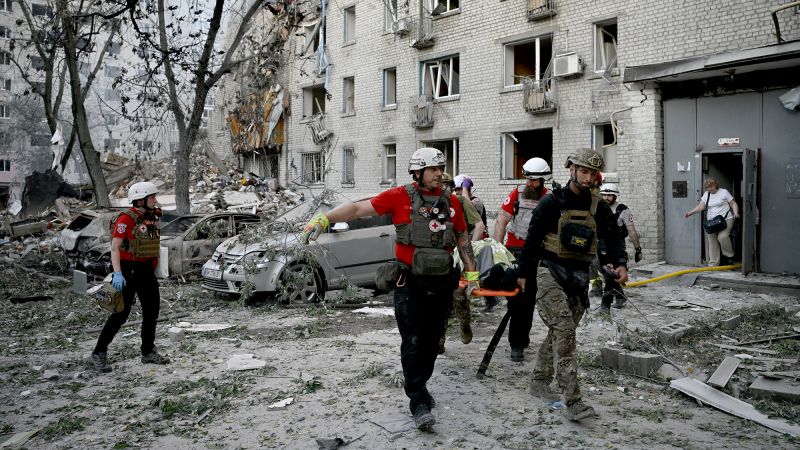
Kyiv authorities reported that 25 locations in the city were hit, with a significant portion of the damage concentrated in residential areas. This focus on civilian infrastructure likely intensified the death toll, as one missile destroyed a residential block containing 64 apartments, killing several people and leaving dozens of families homeless. The Russian Ministry of Defense framed the attack as retaliation, claiming it targeted “military-industrial facilities and fuel and energy complex sites.” However, this explanation contradicts the extent of civilian casualties, which were extensive.
President Volodymyr Zelensky condemned the assault, stating that over 130 residential buildings were damaged and accusing Russia of targeting civilian areas on a daily basis. The attack highlights a pattern of deliberate destruction aimed at destabilizing Kyiv’s urban fabric. As Ukraine continues to defend its capital, the challenge of countering increasingly sophisticated drone technology and hypersonic missiles remains a pressing concern for both military and civilian populations.