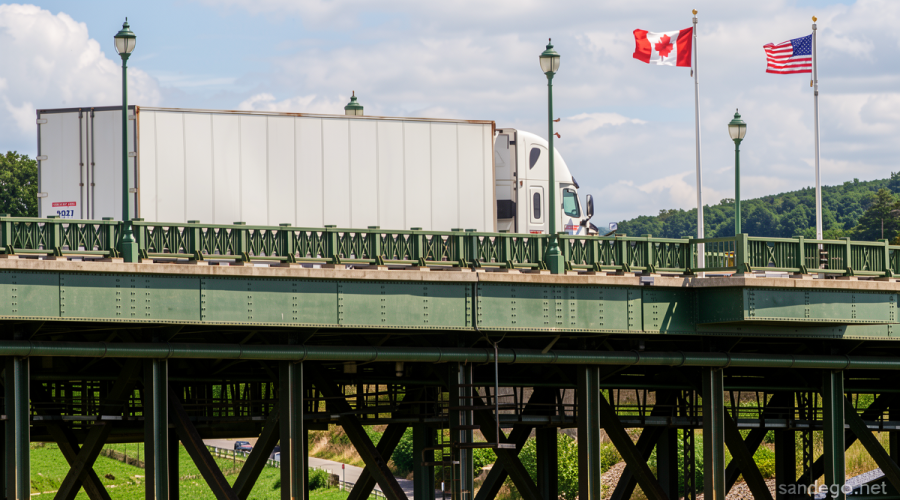
Canada Escapes a 50% Tariff at the Last Minute as Trump Cites an Unfinalized “Deal”
Sandego.net – A sweeping 50% duty on roughly $20 billion in Canadian imports was set to activate at midnight Tuesday, but President Donald Trump pulled the trigger hours before the deadline, announcing a three-day postponement while claiming the two governments had reached a deal. The move spared Canadian dairy producers, furniture manufacturers, alcohol distillers, and a long list of other exporters from what would have been the sharpest single-country tariff in recent memory — though the pause is explicitly conditional and the underlying dispute remains unresolved.
The Midnight Deadline and the Truth Social Post
Trump used his Truth Social platform late Tuesday to announce the reprieve, describing the delay as lasting three days and contingent on “finalization of documents.” In the same post, he invoked the long-stalled Keystone XL pipeline, declaring it “may be awoken from the grave!” without elaborating on what that revival would entail or whether it formed part of any negotiated package.
By Wednesday morning, the president was on the White House lawn telling reporters the episode was effectively over.
“We’ve come to a deal with Canada,” Trump said, referencing phone conversations he held with Prime Minister Mark Carney the previous evening. “We’re going to give something, and we’re doing certain things,” he added, declining to specify what concessions either side would make.
The deal, by his own admission, had not been finalized. No text of an agreement was released, and no Canadian official confirmed a completed package as of Wednesday.
Ottawa’s Response: Progress, Not Resolution
Carney, who had spoken with Trump on both Monday and Tuesday as negotiations intensified, characterized the talks as “very delicate and intense.” In a statement issued late Tuesday, the prime minister confirmed the tariffs were postponed through the close of business on August 21 and offered a measured assessment of where things stood.
“Substantial progress has been made, although there is important work still to be done,” Carney said.
On Wednesday, Minister for Canada-US Trade Dominic LeBlanc posted on social media that “efforts remain ongoing” toward a finalized agreement. His message was accompanied by a photograph showing him shaking hands with US Trade Representative Jamieson Greer — a visual signal that working-level talks were continuing even as the political leaders traded public statements.
“We are working collaboratively towards a finalized agreement between our two countries,” LeBlanc wrote.
The Legal Weapon: Section 338
What made the threatened tariffs unusual was the statute behind them. Trump had planned to invoke Section 338 of the Trade Act of 1974 — a provision rooted in a 1930s-era law that had never before been used to impose duties of this kind. The administration anticipated immediate legal challenges, but as with the sweeping reciprocal tariffs the Supreme Court struck down earlier this year, the president could apply the measure while courts deliberated.
A critical distinction set Section 338 apart from other statutes Trump has deployed: it carries no built-in sunset clause. Had the 50% duties taken effect, they could have persisted indefinitely unless a future administration chose to rescind them. That permanence, combined with the breadth of the product list, gave the threat considerable weight even before it ever reached a dock or a distribution center.
Scope: Far Beyond Dairy and Cars
Trump publicly framed the tariffs as a response to Canadian practices that, in his telling, made it harder for American firms to export dairy, automobiles, and alcohol. But the actual product schedule extended well past those headline categories. Industrial equipment, plastics, furniture, clothing, and a wide array of other manufactured goods were all within scope — collectively representing about 5% of the total value of US imports from Canada in the prior year.
Equally significant was what was absent from the proposal: no carve-out for goods that comply with the United States-Mexico-Canada Agreement. Under the existing North American trade pact, qualifying products receive preferential, often zero, duty treatment. The Section 338 tariffs would have overridden that preference, meaning even USMCA-compliant items could have been hit with the full 50% rate. Carney had called the tariffs a “direct violation” of the pact earlier in the year and warned in July that the trade dispute had “raised costs for families, particularly in the U.S.”
Retaliation, Leverage, and the USMCA Review
Canada was the only nation besides China that retaliated against Trump’s earlier tariff actions, though Carney subsequently rolled back most of those countermeasures. That episode left Ottawa’s economy already strained by previous rounds of duties, complicating its negotiating posture. At the same time, the USMCA itself is up for periodic review, giving Washington another major point of leverage in any broader settlement.
The US Chamber of Commerce weighed in Tuesday, warning that higher tariffs “would damage both economies, drive up costs for U.S. families, further disrupt critical supply chains, and risk the 13 million American jobs that depend on trade” under the North American agreement. The chamber’s intervention underscored how deeply integrated the two economies remain despite the political friction.
What Comes Next
The three-day window runs through August 21. If documents are not finalized by then, the tariffs could be reinstated — or the deadline extended again. For Canadian exporters and American importers alike, the uncertainty itself carries a cost: supply contracts, pricing decisions, and inventory planning all depend on knowing whether a 50% duty will land on a shipment next week or next month. Until the “deal” Trump described is reduced to signed text, that ambiguity persists, and the economic stakes of roughly $20 billion in annual trade hang in the balance.
Related Reading
Frequently Asked Questions
What is Trump pauses 50 Canada tariffs says?
Trump pauses 50 Canada tariffs says is the main topic of this guide. The article explains the context, practical details, and next steps readers should understand.
Why does Trump pauses 50 Canada tariffs says matter?
Trump pauses 50 Canada tariffs says matters because readers are looking for a useful answer, not just a short summary. Good content should match search intent and help them decide what to do next.