The website where crypto promoters pay people to tattoo ads on themselves
A shocking transaction in Chennai
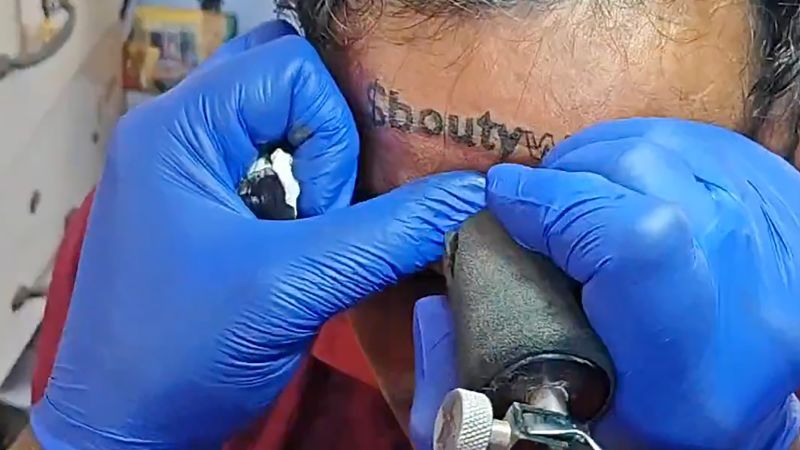
Sandego.net – On June 6, a man with a slightly receding hairline visited a beachside tattoo stand in Chennai, India, and agreed to have a line of text permanently inked across his forehead. The process was recorded on video, and the man, identified as Arivu, followed instructions shared by a 21-year-old named Ayush, who resides in Florida. Ayush had posted the directions on Pump.fun, a cryptocurrency trading platform, offering Arivu payment in crypto worth approximately $3,000 for the task. Arivu, who chose to remain anonymous, cited privacy concerns when declining to reveal his last name.
Pump.fun is known for its role in promoting memecoins—cryptocurrencies with little intrinsic value but high potential for viral attention. The site recently launched a feature called Pump.fun GO, allowing users to place public bounties for tasks completed by others, with rewards paid in cryptocurrency. The concept, as described on the platform’s social media account, is to “leverage the power of humans & money across the globe,” enabling individuals to incentivize actions that gain traction in the digital attention economy.
Quick cash and artistic compromise
A few days later, a 27-year-old Toronto-based artist named Jordan (a pseudonym) accepted a similar offer. He got a tattoo promoting a crypto casino on his leg, earning about $3,000 in return. “I’m struggling financially, and my girlfriend is a tattoo artist, so it was a little easier for me,” Jordan explained in a direct message. The bounty system, he said, required participants to post video evidence on platforms like X, ensuring transparency in the transaction.
While the tattoos themselves may seem like a quirky way to advertise, the underlying mechanism is part of a broader trend. Pump.fun’s bounties often target individuals in regions where wages are minimal, exploiting their need for immediate financial gain. The platform’s rules demand proof of completion, which can include social media posts, videos, or photos. This creates a cycle where crypto enthusiasts seek visibility, and those in precarious situations are incentivized to trade their personal experiences for quick money.
The attention economy’s dark side
Experts have noted the inherent volatility of the memecoin market, which thrives on hype and novelty. Vetle Lunde, head of research at K33, described Pump.fun’s operations as “operating at the controversial edge of the internet’s attention economy.” During the 2024 memecoin craze, the site’s livestreams became infamous for encouraging extreme behavior, such as threats of self-harm or violence, as creators vied for viral traction.
Pump.fun initially removed livestreams after public backlash, citing the need for better moderation. The site later reintroduced them with updated policies to ban violent or explicit content. However, the bounty system has since evolved into a more direct form of exploitation, where users can reward actions that range from mundane to macabre. Nicholas Vrousalis, a philosophy professor at Erasmus University in Rotterdam, linked this trend to the dynamics of global capitalism, noting that “the greater the precarity and vulnerability of a given population, the higher the predatory instincts there are toward them.”
Examples of bounties highlight the platform’s shifting priorities. Some tasks, like visiting a McDonald’s and posting proof, are relatively harmless. Others, such as bailing out a jailed individual, demonstrate how the system can be used for altruistic purposes. A user once offered 15 Solana (around $1,000) to free someone from custody, with another participant capturing the moment on video. The rewards, however, have also taken a more unsettling turn. According to BeIn Crypto, on the first day Pump.fun GO launched, someone posted a bounty of 10,000 Solana—equivalent to about $690,000 at the time—for a person to film their own suicide. The listing was later removed, but the incident underscored the platform’s ability to fuel both innovation and exploitation.
Privacy, profit, and the cost of visibility
Despite the platform’s efforts to regulate content, the bounty system remains a breeding ground for unconventional deals. Users can offer crypto for anything, from physical modifications to digital performances, often without significant oversight. This has led to a situation where individuals trade their time, body, or even their lives for rewards, raising questions about the ethics of such exchanges. The anonymity of cryptocurrency transactions further complicates accountability, making it easier for creators to offer bounties without immediate consequences.
Alon Cohen, one of Pump.fun’s co-founders, has not responded to multiple requests for comment. His team’s social media accounts and email addresses remain silent, suggesting a deliberate avoidance of public scrutiny. Stephen D. Palley, Cohen’s lawyer, confirmed this when he stated, “I’m not able to talk” during a phone interview. The lack of engagement from the platform’s leadership highlights a disconnect between its users and its creators, as well as a broader trend of decentralization in the crypto space.
As the memecoin economy continues to grow, so too does its capacity for creative and controversial incentives. The case of Arivu and Jordan illustrates how the platform has transformed into a marketplace where attention is currency, and human effort is commodified. While some may view these bounties as a novel way to engage with crypto, others argue they represent a form of modern exploitation, where the most vulnerable are coerced into selling their personal narratives for profit. The future of Pump.fun’s bounty system will likely depend on its ability to balance innovation with responsibility in an increasingly interconnected digital world.