Four UK Pro-Palestinian Activists Face Over 20 Years for Factory Attack Linked to Terrorism
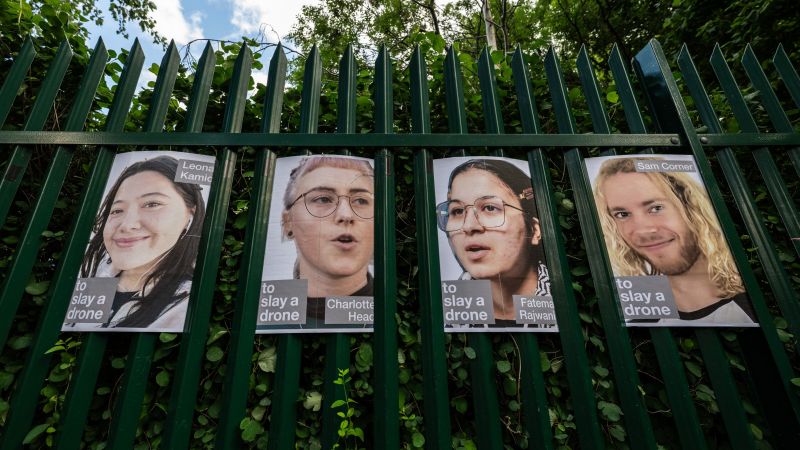
Sandego.net – In a significant legal ruling, four British activists who support Palestine were sentenced to a combined total of more than 20 years in prison for a 2024 assault on an Israeli defense company’s facility in Bristol, England. The incident, which caused over £1 million in damages, was deemed to have a “terrorism connection” by the judge, leading to extended sentences for the individuals involved. The activists—Charlotte Head, 30; Samuel Corner, 23; Leona Kamio, 30; and Fatema Zainab Rajwani, 21—were members of the banned organization Palestine Action, which orchestrated the attack on the Elbit Systems UK plant during Israel’s ongoing military operations in Gaza.
The raid, which took place in 2024, occurred around 10 months into Israel’s bombardment of Gaza, a response to a Hamas-led attack in October 2023. The group Palestine Action was later proscribed under terrorism laws, a decision that the High Court in London ruled unlawful. However, the ruling is still pending as the UK government prepares an appeal, with a final decision expected by Monday. Despite this legal controversy, the activists were convicted of criminal damage at Woolwich Crown Court in May 2024. Corner, who was found guilty of inflicting grievous bodily harm after striking a police officer with a sledgehammer, received a seven-year and eight-month sentence. Kamio and Head were given five years each, while Rajwani was sentenced to four years and eight months for the damage caused.
Outside the courtroom, police reported that over 100 individuals had been arrested for demonstrating solidarity with Palestine Action. This broader crackdown highlights the group’s role in organizing the attack, which targeted the Elbit Systems UK facility. The activists argue that their actions were a direct response to what they described as Israel’s “genocide” in Gaza and were aimed at disrupting the production of military equipment. However, prosecutors insisted that the offense should be classified under terrorism, emphasizing the intent to influence British government policy toward Israel. This classification, they claimed, justified harsher penalties than those typically applied to criminal damage cases.
During the sentencing, Judge Jeremy Johnson acknowledged the “aggravating factor” of the terrorism link, noting that the damage to property and the goal of affecting UK-Israel relations elevated the case’s significance. Yet he also highlighted the defendants’ previous good character as a mitigating factor. Corner’s sentence, which included time for both criminal damage and grievous bodily harm, was influenced by the judge’s assessment of the force he used, which he called “extreme and gratuitous.” The defense, however, maintained that Corner’s autism did not explain his actions, though the judge ultimately ruled that the sledgehammer attack was deliberate.
Elbit Systems, the firm targeted in the raid, stated in impact statements that it had received nearly £1.2 million from insurers to cover the damage. The company also emphasized the lasting effect on staff safety and morale, noting that critical military drone systems, IT infrastructure, and computer equipment were among the items destroyed. The activists, meanwhile, asserted that their goal was to remove weapons from production and not to harm people, a claim that their legal representatives supported. They argued that the conviction for terrorism was unjustified, as the group had not been charged with any specific terrorist offense at the time of the attack.
Human rights organizations and prominent supporters have criticized the decision to treat the offense as terrorism. Kerry Moscogiuri, CEO of Amnesty International UK, warned that equating criminal damage with terrorism in the UK justice system was a dangerous precedent. “It is completely disproportionate to punish protesters for criminal damage as if they were terrorists,” she said. “A sentence of this severity will remain with them for the rest of their lives.” The open letter signed by over 100 public figures, including author Sally Rooney, environmental activist Greta Thunberg, and actor Steve Coogan, urged the court to reconsider the severity of the sentences, calling it a “miscarriage of justice.”
The case has sparked debate over the balance between national security and civil liberties in the UK. Critics argue that the classification of the activists’ actions as terrorism, rather than a political protest, risks overreaching into the realm of free speech. They point to the fact that criminal damage has historically been treated as a lesser offense, with sentences typically ranging from months to a few years. The current rulings, however, reflect a shift toward more severe penalties for actions perceived as linked to terrorism, even if they were not explicitly targeted at people.
Palestine Action, which had been operating in the UK for years, was designated a proscribed terrorist organization following the 2024 raid. This move, though challenged by the High Court, has left the group in a legal limbo. The decision to ban the organization was based on its alleged involvement in the attack, which prosecutors claimed was intended to sway British government policy on Israel. The group’s leaders, including the four convicted activists, have consistently denied any connection to terrorism, framing the raid as a necessary act of resistance against what they view as an oppressive military campaign in Gaza.
Legal experts have raised concerns about the potential implications of the ruling. If criminal damage is increasingly viewed as terrorism, it could lead to the prosecution of other activists under similar charges. This might create a climate of fear among pro-Palestinian groups, deterring them from engaging in protests or demonstrations. The activists’ defense, which stressed the non-violent nature of their actions, has been met with mixed reactions. While some support their cause, others question whether the sentences are appropriate given the context of the attack and its timing within the broader conflict in Gaza.
Amnesty International and other rights groups have called for the sentences to be reviewed, arguing that the evidence does not conclusively prove a terrorism link. They highlight that the activists’ intent was to disrupt the production of weapons, not to target individuals, and that the extended prison terms could set a precedent for similar cases. Meanwhile, Elbit Systems has maintained that the damage inflicted during the raid was a serious blow to its operations, underscoring the economic and strategic impact of the protest.
The ruling also reflects the UK’s growing alignment with Israel in its approach to the Gaza conflict. By classifying the activists’ actions as terrorism, the government has signaled its willingness to use stricter legal measures against groups it perceives as threats to national interests. However, the decision to ban Palestine Action has drawn criticism from legal professionals and human rights advocates, who argue that it undermines the principle of fair trial and due process. As the appeal moves forward, the case will likely serve as a pivotal moment in the UK’s legal response to pro-Palestinian activism.
Outside the courtroom, the arrests of over 100 supporters of Palestine Action have intensified public scrutiny. Demonstrators, many of whom were arrested for displaying banners or chanting slogans, have expressed frustration over the treatment of their group. They argue that the charges against the activists are part of a broader campaign to suppress dissent and marginalize pro-Palestinian voices in the UK. The case, therefore, is not only about the individuals convicted but also about the broader implications for activism and the legal system’s approach to political protest.