
Panic on the streets of Beirut as Israeli rhetoric sparks fears of all-out war
Panic on the streets of Beirut as Israeli rhetoric sparks fears of all-out war
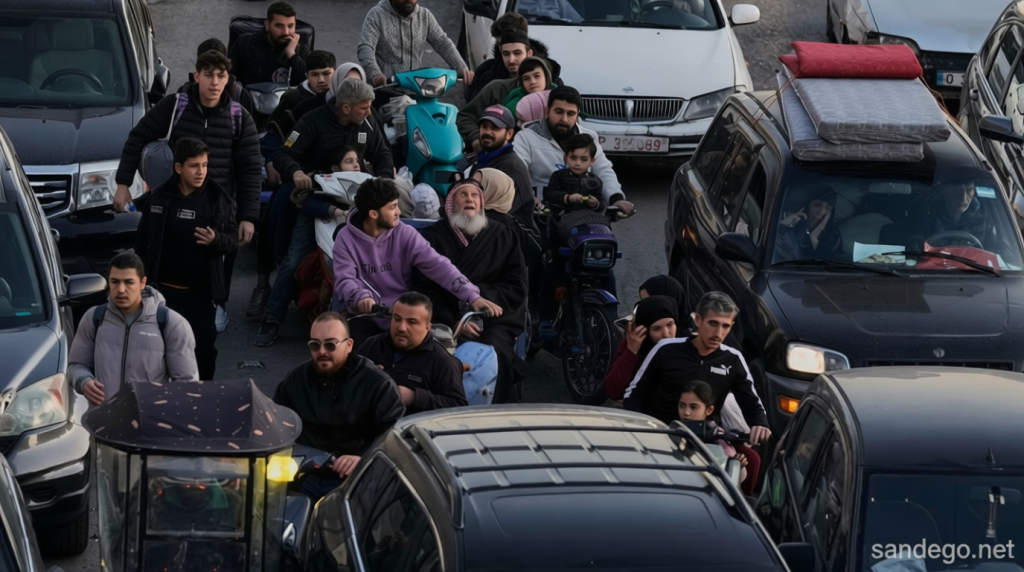
Word of the situation spread rapidly, sending waves of alarm through Beirut’s streets. Within moments, crowds surged into vehicles or scrambled onto sidewalks, clutching belongings as they sought escape.
Evacuation orders and mass movement
The Israeli military issued evacuation orders affecting four distinct districts in the city’s southern suburbs. Over half a million people took to the roads, driven by a shared goal: to distance themselves from the capital as swiftly as possible.
“The whole place is under threat; it seems they’re going to strike, we’ve got to pick up our family and flee,” said a man preparing to flee. His wife held a small child on the back of his weathered moped, their belongings strapped in tight.
“With all these threats and strikes, it’s so dangerous, it is not safe at all,” added his wife, her voice tinged with urgency.
As the man guided his bike into the chaotic flow of traffic, the atmosphere thickened with fear. The looming possibility of Israeli airstrikes had turned the city into a scene of frantic movement.
Comparisons to Gaza heighten anxiety
A far-right Israeli cabinet minister’s remarks deepened the unease. Referring to Beirut’s suburb of Dahiya, he warned it would mirror the devastation seen in Khan Younis, Gaza. “You wanted to bring hell on us, you brought hell on yourselves. Dahiyah will look like Khan Younis. Our citizens of the north will live quietly, in peace and in security,” he declared.
Residents now sense that Israel is dictating the course of the conflict. In southern Lebanon, orders to vacate homes and move north of the Litani River have intensified, with aerial operations already underway in Tyre.
Scenes of destruction and uncertainty
Visitors were shown a damaged site by Hezbollah’s media team, identified as the city’s power station. A diesel tank lay pierced with holes, while a solar panel support tower had collapsed. The area reeked of smoke and destruction, leaving Tyre without electricity.
Despite the chaos, some chose to remain. Hussein Chehadeh, a resident of the south, explained the reason: “I have no money. I’m struggling to cover children’s expenses, fuel, housing, and rent.” His words echoed the plight of many, who felt trapped with no safe haven left.
Exclusive footage from Sky News revealed Israeli Defence Forces (IDF) positioning in southern Lebanese hills. Lieutenant General Eyal Zamir hinted at broader ambitions, stating, “We are striking forcefully, deeper inside Lebanon, and we will strengthen control in the south. We will not stop until Hezbollah is disarmed.”
With these statements, the conflict appears poised to escalate into a full-scale war, threatening to engulf the region in a new round of destruction and upheaval.
