Air Force Major Detained Again Days After Publicly Demanding Trump’s Impeachment
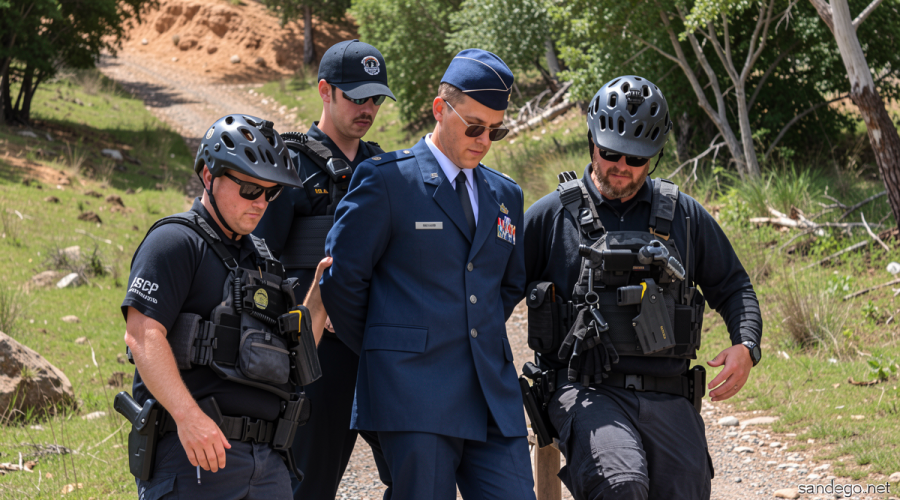
Sandego.net – Major Jason Watson, the active-duty Air Force officer who drew national attention last month by delivering an impeachment speech on the steps of the U.S. Capitol, found himself locked behind bars once more on Tuesday, August 18, 2026. The detention came mere days after Watson appeared on a major television interview to renew his call for the president’s removal from office — a timing that his legal team believes is no coincidence.
The officer was placed in what the Air Force calls “pretrial confinement” at a county detention facility in Maryland, where he remains on a military hold. A public information officer at the facility confirmed his status. No specific charges have been made public, and the service branch has not yet detailed what “continued misconduct” it alleges.
The Air Force Statement
In a written statement issued Wednesday, an Air Force spokesperson outlined the rationale for the confinement order:
“Military members are required to comply with the Uniform Code of Military Justice and all applicable regulations. Based on probable cause to support allegations of continued misconduct, Maj. Watson was ordered into pretrial confinement on Aug. 18, 2026. Maj. Watson is presumed innocent and will be afforded all rights under Rule for Courts-Martial 305 as his pretrial confinement is reviewed.”
The spokesperson added a standard institutional disclaimer:
“Maj. Watson’s personal statements do not reflect the views or policies of the Department of the Air Force.”
Watson’s attorney, Chris Mutimer, said he had not yet spoken directly with his client as of Wednesday but suspected the television appearance earlier that week factored into the decision to detain him. Questions seeking further detail from the Air Force had been sent but remained unanswered at press time.
Watson’s Unwavering Message
On Monday, Watson sat down for an exclusive interview with a national news anchor and used the platform to sharpen his critique of the administration. His remarks left no ambiguity about where he stands:
“What is happening with President Trump is not normal. He has failed us. And not only is he a failure as president, he is flagrantly violating the Constitution, breaking the law, engaged in rampant corruption and is killing Americans. And that is unacceptable to me and it should be unacceptable to all of us.”
Watson framed his continued advocacy as a matter of personal conviction rather than political calculation. Speaking to the same interviewer earlier in the week, he described his decision to keep speaking out as a deliberate choice about how much personal cost he was prepared to absorb:
“We just have to be willing to accept that we can change what is happening in our country if we’re just willing to pay a price for it. So all that I could do was ask myself what’s the highest price that I’m willing to pay. And this is what I ultimately came up with.”
The Original Capitol Arrest
The current detention follows a July 1 incident that thrust Watson into the national spotlight. That day, dressed in full uniform, he climbed onto the Capitol steps and delivered a speech demanding the impeachment and removal of both President Trump and Vice President JD Vance. Capitol Police removed him shortly afterward, explaining that members of the public may not demonstrate on the House steps unless accompanied by a sitting member of Congress. In this case, a member had escorted Watson to the platform and then departed the area, per police accounts.
Notably, no charges tied to that demonstration had been filed as of the latest reporting. Military regulation prohibits wearing a uniform while engaging in political activity, yet Watson had not been formally charged with violating that rule.
Military Law and the Question of Dissent
Watson’s case sits at the intersection of two long-standing principles: the constitutional right of citizens to petition for redress of grievances, and the military’s insistence on hierarchical discipline. Under Article 88 of the Uniform Code of Military Justice, service members face criminal penalties for contemptuous words directed at the president, vice president, Congress, or other senior officials. Public dissent from active-duty ranks is therefore uncommon, and when it occurs it tends to generate institutional friction.
The Air Force’s invocation of “continued misconduct” without specifying the underlying allegations raises questions about how broadly the service interprets its authority to confine a member who has spoken publicly against the sitting president. Rule for Courts-Martial 305, cited in the statement, governs the review process for pretrial confinement and is designed to ensure that a detained member receives periodic judicial scrutiny of whether continued detention is justified.
For Watson, the calculus appears settled. Whether the next chapter involves a court-martial proceeding, a negotiated resolution, or simply a return to duty remains to be seen. What is clear is that he has positioned himself as a willing test case for how far an active-duty officer may speak against the executive branch before the institution moves to silence him.
Related Reading
Frequently Asked Questions
What is US airman arrested at Capitol after?
US airman arrested at Capitol after is the main topic of this guide. The article explains the context, practical details, and next steps readers should understand.
Why does US airman arrested at Capitol after matter?
US airman arrested at Capitol after matters because readers are looking for a useful answer, not just a short summary. Good content should match search intent and help them decide what to do next.