
Security Awareness Campaigns: How to Train Safer Teams
Security awareness campaigns are structured training efforts that reduce human-driven security incidents by teaching employees how to recognize threats, follow safe processes, and respond correctly under pressure. They work best when they are continuous, role-based, and measured like any other business program. A strong campaign does not rely on fear or one-time webinars, but on repeated practice that builds reliable habits. When designed properly, security awareness campaigns lower phishing click rates, reduce data mishandling, and improve incident reporting speed.
What Security Awareness Campaigns Really Are (And Why Most Fail)
Security awareness campaigns are not the same as annual compliance training. Compliance training focuses on proving attendance, while security awareness focuses on changing behavior. A campaign is a coordinated system: messaging, microlearning, simulations, reporting workflows, and metrics. The goal is to reduce risk in daily work, not to “educate” in theory.
Most programs fail because they are too generic. Employees get broad advice like “use strong passwords” without seeing how it connects to their real tasks. Another common failure is using long, boring modules that people rush through. When training is treated like punishment, the organization gets fake completion and zero behavioral change.
A third failure is lack of reinforcement. Humans forget quickly unless knowledge is repeated in context. If the only training happens once per year, the organization is training people to forget. Effective security awareness campaigns operate like a fitness routine: small sessions, repeated over time, with measurable progress.
Build the Campaign Around Real Risks and Real Workflows
Start by identifying the threats that actually impact your organization. For most teams, phishing is the top risk, but it is rarely the only one. Common issues include credential reuse, unsafe file sharing, weak approval processes, and device security mistakes. Your campaign should focus on the few behaviors that create the highest risk.
Security training must also match real workflows. If employees use Google Drive daily, train them on safe sharing settings and access reviews. If finance teams handle invoices, train them on vendor impersonation and payment verification. If developers handle secrets, train them on credential storage and code scanning. The closer training is to daily work, the higher the retention.
Avoid building the campaign around technical jargon. People do not need to memorize security vocabulary to be safe. They need clear decisions and simple rules they can follow quickly. For example, “Verify payment changes through a second channel” is more useful than explaining business email compromise in detail.
A strong campaign also includes reporting workflows. Training is incomplete if employees cannot easily report suspicious activity. Your campaign should teach not only what to detect, but also what to do next. If reporting is slow or confusing, employees will stay silent.
Design Training That Creates Habits, Not Memorization
Effective security awareness campaigns use repetition and practice. Microlearning works better than long lectures because it fits attention span and real schedules. Short modules of 5–10 minutes can teach one skill at a time and reinforce it later. This approach is especially effective for non-technical roles.
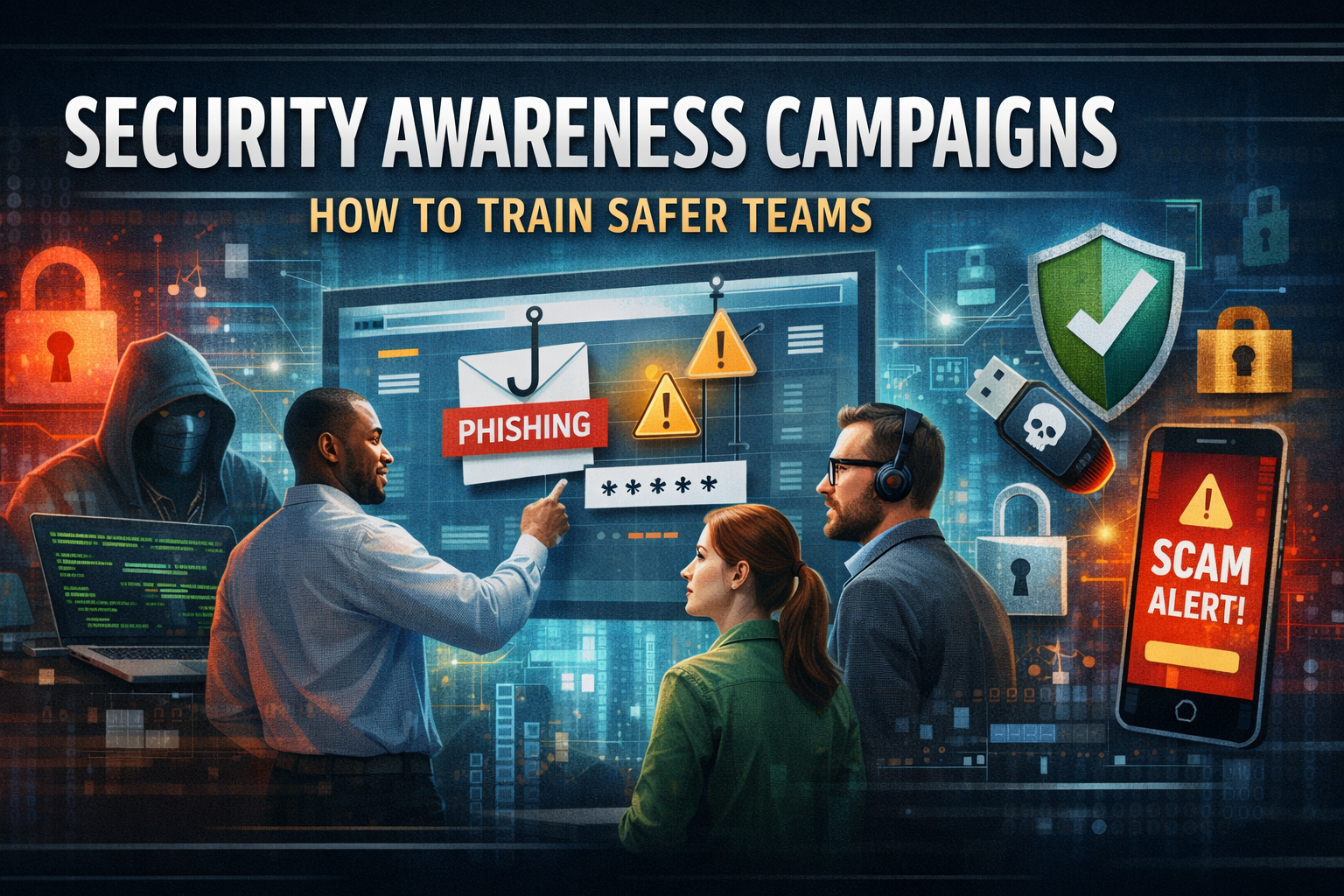
Simulations are essential, especially for phishing. Employees learn faster when they experience realistic scenarios. However, simulations must be designed to teach, not to shame. If employees feel trapped, they will hide mistakes instead of learning. The training should reward correct reporting and improve confidence.
Use scenario-based learning instead of generic rules. A good example is a short story: an employee receives a file-sharing request from a “manager” using a personal email address. The training asks what to check, what to verify, and how to report. These scenarios build decision-making patterns employees can reuse.
Training should also include “just-in-time” reminders. For example, when employees use file-sharing tools, the interface can show a quick reminder about external sharing. When teams handle invoices, they can receive a short checklist for verification. These small reinforcements reduce errors more effectively than long lessons.
Segment by Role: One Campaign Cannot Fit Everyone
Role-based training is one of the fastest ways to improve results. Different teams face different risks, and the same lesson will not be equally useful for everyone. Security awareness campaigns should include a baseline program for all staff, then specialized modules for higher-risk roles.
Finance and procurement teams need training on invoice fraud, vendor impersonation, and approval controls. HR teams need training on handling sensitive employee data and social engineering attacks. Executives need training on targeted spear-phishing and account takeover risks. IT and engineering teams need training on secrets management, access controls, and secure change processes.
Segmentation also reduces training fatigue. Employees are more engaged when they feel the content is relevant. This increases completion quality and decreases resistance. A shorter, relevant lesson is more effective than a longer, generic one.
Role-based campaigns should also align with policy and tooling. If you require multi-factor authentication, train employees on what to do when MFA prompts appear unexpectedly. If you use password managers, teach practical usage and recovery steps. Training must match the tools employees are expected to use.
Run the Campaign Like a Program: Metrics, Feedback, and Iteration
Security awareness campaigns must be measured like any other operational initiative. Without metrics, you will not know whether behavior is improving. The most common and useful metrics include phishing simulation outcomes, reporting rates, and time-to-report. You can also measure policy compliance, such as adoption of MFA or password manager usage.
Be careful with vanity metrics. Completion rates are not proof of learning. A 100% completion rate can still result in high incident rates if people click, share, and approve unsafe actions. Focus on behavior metrics that correlate with risk reduction. If phishing click rates drop and reporting increases, the campaign is working.
Feedback loops are critical. After each simulation or training cycle, gather patterns: which departments struggle, which scenario types cause confusion, and which policies are misunderstood. Then update training and internal guidance. The campaign should evolve as threats evolve.
Avoid using training to blame employees. The best programs treat mistakes as signals. If many people fail the same simulation, the problem is likely design, process, or tooling. Security awareness campaigns should improve systems, not just individuals. A culture of learning creates better reporting and faster containment.
Strengthen Culture: Make Security the Normal Way of Working
Culture determines whether training becomes real behavior. If employees think security is only the security team’s job, the campaign will stay superficial. The goal is to make safe actions feel normal, expected, and easy. This requires consistent messaging from leadership and managers.
One effective method is using security champions. Champions are volunteers or assigned representatives within each team who reinforce good habits. They can share short reminders, answer basic questions, and act as a bridge to the security team. This improves adoption without turning security into a bottleneck.
Make reporting safe and positive. Employees should feel that reporting suspicious messages is helpful, not embarrassing. Reward fast reporting and transparency. The organization benefits more from early reporting than from silent perfection. A culture that punishes mistakes creates hidden incidents.
Security awareness campaigns should also include clear, simple policies. If policies are long and unreadable, employees will improvise. Use short checklists and “decision rules” that fit into daily work. When people can follow security guidance quickly, they will actually use it.
Conclusion
Security awareness campaigns succeed when they focus on behavior, not checkbox training. The most effective programs are continuous, role-based, and measured with real risk metrics such as reporting rates and simulation performance. They teach practical decisions, reinforce habits through repetition, and improve workflows so safe behavior is easy. When treated as a living program instead of a yearly event, security awareness campaigns create safer teams and reduce incidents in a measurable way.
FAQ
Q: What is the main goal of security awareness campaigns? A: The goal is to reduce security risk by changing employee behavior, not just delivering information or meeting compliance requirements.
Q: How often should security awareness campaigns run? A: They should run continuously throughout the year using short training cycles, periodic simulations, and regular reinforcement.
Q: Are phishing simulations necessary in security awareness campaigns? A: Yes, because simulations teach recognition and reporting through practice, which is more effective than passive learning.
Q: How do you measure whether security awareness campaigns are working? A: Track behavior metrics such as phishing click rates, suspicious email reporting rates, and time-to-report incidents.
Q: Should security awareness campaigns be different for each department? A: Yes, because different roles face different threats, and role-based training improves relevance and retention.
