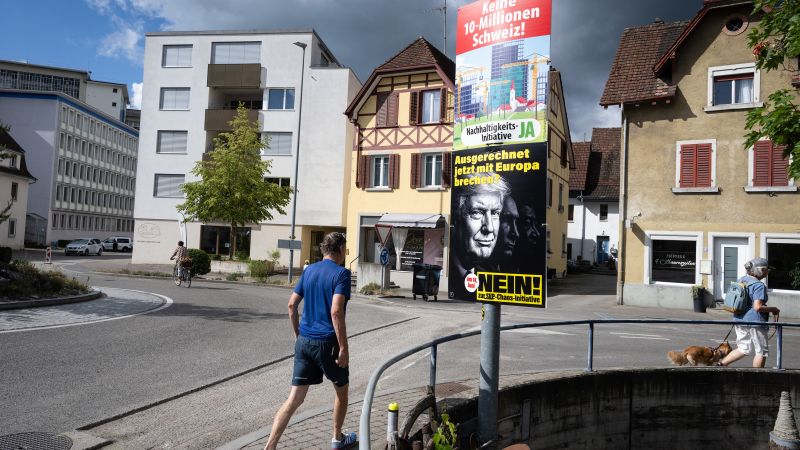
Switzerland’s Brexit Moment: Population Cap Referendum Tests EU Ties
Sandego.net – Switzerland’s Brexit moment arrives as voters prepare to decide on a groundbreaking referendum about a population cap. This proposed limit, set at 10 million, has sparked intense debate over immigration, national identity, and Switzerland’s economic future. The measure, championed by the Swiss People’s Party (SVP), could reshape the country’s relationship with the European Union, especially as it challenges the free movement principles that have long underpinned bilateral ties.
Immigration and National Identity at the Heart of the Debate
The referendum, held on June 13, asks whether Switzerland should cap its population at 10 million—a figure just above its current 9 million residents. The SVP argues this is essential to preserve Swiss cultural heritage and manage resources effectively. “Switzerland’s identity is at risk without control over its population,” the party’s manifesto states, framing the issue as a critical step to protect the nation’s traditions. Critics, however, warn that the proposal risks deepening divisions, particularly with its emphasis on restricting immigration.
“The population cap is not just about numbers—it’s about the future of our shared values and social cohesion,” said Delphine Klopfenstein, a Green Party member. “It’s a symbolic move that could have lasting effects on how we engage with Europe.”
Economic Implications and Policy Challenges
Supporters of the cap claim it will stabilize public services and ease housing shortages, while opponents argue it could hinder economic growth. The Swiss economy, which has thrived on a steady influx of skilled workers, faces uncertainty as the proposal may limit access to a diverse labor market. Jürg Müller of Avenir Suisse noted that the country’s recent population growth has bolstered its economic resilience, stating, “Restricting this flow could jeopardize Switzerland’s ability to adapt to global challenges.”
Proponents, including the SVP, point to the country’s growing foreign-born population—over a quarter of residents—as evidence of the need for change. Yet, the campaign has also been accused of leveraging anti-immigrant sentiment to gain political traction, particularly through narratives that link migration to cultural erosion. While the economic argument is central, the referendum’s outcome could have far-reaching consequences beyond domestic policy.
EU Relations and the Road Ahead
The population cap referendum poses a potential conflict with the EU, which has long been Switzerland’s economic and political partner. Since joining the Schengen area in 2002, the country has enjoyed seamless mobility with EU nations, a privilege that could now be under threat. If the cap is approved, Switzerland may need to renegotiate its free movement agreement, which has been a cornerstone of its integration with Europe.
Analysts suggest that the referendum reflects a broader shift in Swiss politics, with growing public concern over migration’s impact on society. “This is a turning point for Switzerland’s EU relations,” said an EU diplomat. “The outcome will determine whether the country can maintain its current model of cooperation while addressing domestic priorities.” The vote may also influence other European nations considering similar policies.
Public Sentiment and Political Strategy
Switzerland’s political landscape has been increasingly polarized by the issue of immigration. The SVP’s campaign has successfully tapped into fears of overcrowding and social tensions, using targeted messaging to sway public opinion. “The referendum is a strategic move to align with Swiss citizens’ anxieties,” noted an observer. “It’s not just about numbers—it’s about reclaiming a sense of control over national destiny.”
Meanwhile, opponents argue that the proposal risks alienating key EU partners and complicating Switzerland’s role as a neutral, economically stable nation. The referendum’s result could signal a new era of stricter immigration policies in Europe, potentially setting a precedent for other countries grappling with similar challenges.
Global Significance and Long-Term Impact
Switzerland’s decision to impose a population cap could have implications beyond its borders. As a key EU trading partner, the country’s ability to maintain open labor markets and cultural exchanges may be tested. The referendum underscores a growing trend in Europe where nations are reevaluating their stance on migration, balancing economic benefits with concerns over social integration and resource allocation.
With the vote approaching, the outcome remains uncertain. For Switzerland, it represents a pivotal moment in its history, one that could redefine its relationship with the EU and shape the future of immigration policy in the region. As the nation prepares to cast its ballots, the stakes are high for both domestic identity and international cooperation.