
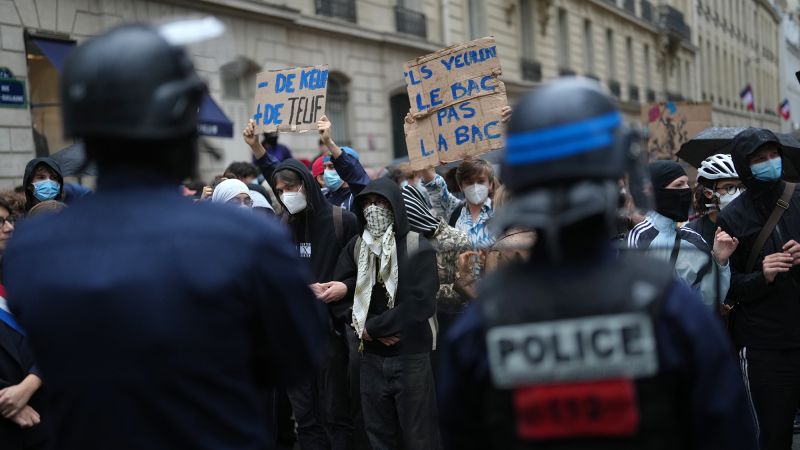
Young Europeans are turning frustration into a cross-border protest movement
Sandego.net – A growing wave of demonstrations is putting Europe’s younger generation at the center of political debate. From classrooms and university campuses to streets shaped by housing pressures, Gen Z activists are voicing concerns that differ in detail from one country to another but share a common fear: that the future available to them may be less secure, affordable and hopeful than the one their parents expected.
Education funding, unaffordable rents, weak job prospects, climate resilience and public services have all become part of the same wider argument. Young people are not only demanding immediate solutions; they are challenging the idea that patience alone will deliver better opportunities over time.
Different triggers, similar pressures
Each national movement has its own starting point. In Spain, anger intensified after the eviction of 87-year-old Maricarmen Abascal from her home. In France, students initially rallied alongside striking teachers. Albania has seen student unrest recur for months, beginning with opposition to a luxury development supported by Jared Kushner, the son-in-law of US President Donald Trump.
Yet these events have increasingly drawn in broader grievances. A protest that begins with a specific dispute over a school, a home or a development can quickly become a forum for complaints about the cost of living, public investment and the sense that younger citizens are being asked to accept declining standards.
Connections between movements have become more visible. Demonstrators in Italy and Greece have invoked the French protests in their messaging, while Spanish housing activism has influenced protests in neighboring Portugal. Student unions across the continent are also exchanging tactics, experiences and advice.
“I see so many more similarities than differences,” said Alice de Brito, vice president of UNEF, France’s main student union. “We are all talking about the need for investments in education, in the universities, in youth in general. But we are also talking about the cost of living, about housing.”
Education becomes a symbol of wider neglect
Schools and universities have become especially powerful symbols in the current unrest. In France, student demonstrations at the beginning of the academic year have taken place in September and October for the past nine years. Returning students repeatedly encounter shortages of teachers and inadequate equipment, turning the start of term into an annual reminder of unresolved problems.
This year, the protests expanded beyond those recurring concerns. Students called for smaller class sizes, greater spending on teachers, stronger infrastructure capable of coping with climate pressures and an end to police violence against young people.
“People are just tired of waiting for an answer,” de Brito said.
The issue reaches well beyond France. Thousands of students and teachers marched in Greece, including protesters outside parliament in Athens who chanted: “from Greece to France, we want public, free education.” In Rome, students occupying a high school on October 7 opened their statement with the words “like in France,” signaling that the protests are being understood as part of a broader European moment.
Italy’s government has resisted comparisons with France. Education Minister Giuseppe Valditara said earlier this month that conditions in Italy were substantially different, echoing a far-right argument that unrest in France is tied to challenges surrounding the integration of second-generation migrants into schools.
Housing and work deepen generational anxiety
Housing has become another unifying concern. For many young people, high rental costs and insecure accommodation make independence harder to achieve, even for those studying or entering employment. Italian activists have closely followed the housing demonstrations that gathered force in Spain in September, illustrating how concerns over homes can travel across borders as readily as student slogans.
The pressure is compounded by a changing labor market. Julius Fintelmann, co-founder and editor-in-chief of the European Correspondent daily newsletter, has described the protests as evidence of a belief that European politics is not delivering for those who will inherit it. Entry-level roles are particularly exposed to disruption from artificial intelligence, while climate change adds another layer of uncertainty to long-term planning.
“I think fundamentally what we see is this promise that liberal democracy had, which was that the next generation will enjoy a better life than the current one, that promise simply doesn’t hold true anymore,” Fintelmann said.
For many protesters, this is the central issue. The anger is not confined to one budget line or one policy decision. It reflects a feeling that education, housing, work and environmental safety are all becoming harder to rely upon at the same time.
Governments face limited room to respond
The countries experiencing some of the most significant protests — Greece, Italy, France, Belgium, Spain and Portugal — also face difficult economic conditions and substantial national debt. Those constraints make calls for larger public budgets politically and financially challenging.
In France, bond yields rose to their highest level since 2002 on Wednesday, adding further pressure to government finances. Such developments matter because higher borrowing costs can narrow the space available for new investment, even as protesters demand more spending on schools, housing and public services.
That tension is likely to define the next phase of these movements. Young people are making increasingly clear that they see their concerns as connected rather than separate. Governments, meanwhile, must respond to demands for investment while managing strained budgets and polarized political environments.
The demonstrations do not represent a single organization or identical political program. They are instead linked by a shared generational assessment: that waiting for improvement no longer feels like a credible plan. Across Europe, that assessment is moving from private frustration into public action.
Related Reading
Frequently Asked Questions
What is Gen Z are leading the European?
Gen Z are leading the European is the main topic of this guide. The article explains the context, practical details, and next steps readers should understand.
Why does Gen Z are leading the European matter?
Gen Z are leading the European matters because readers are looking for a useful answer, not just a short summary. Good content should match search intent and help them decide what to do next.