Gadi Eisenkot’s rise reshapes Israel’s election contest
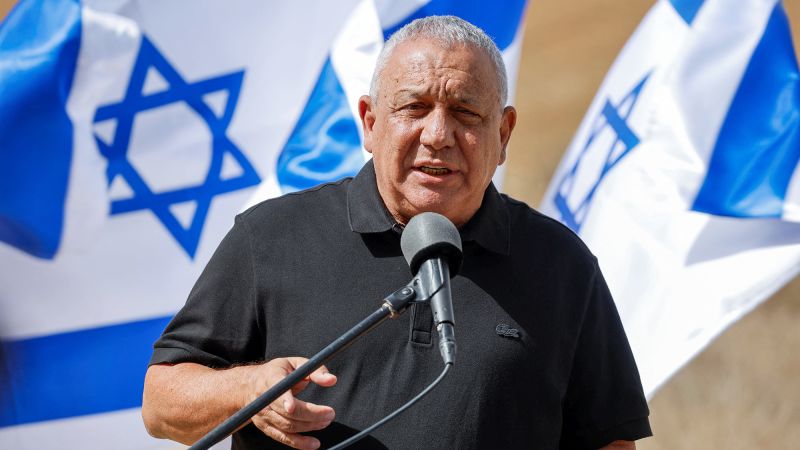
Sandego.net – As Israel approaches its October 27 election, Gadi Eisenkot has become the opposition figure with the strongest chance of challenging Benjamin Netanyahu. His appeal rests partly on a stark political contrast: for voters seeking a change after years of Netanyahu’s leadership, Eisenkot represents an alternative with deep military credentials and a markedly different personal story.
Eisenkot, 66, is the son of Moroccan immigrants and grew up in Tiberias and Eilat, far from the political and social circles that shaped Netanyahu’s early life in Jerusalem. His background carries particular significance in a country where divisions between Mizrahi Jews, whose families came from the Middle East and North Africa, and Ashkenazi Jews of European origin have long influenced politics and public life.
Israel has never elected a Mizrahi prime minister. Eisenkot does not regularly foreground his heritage, yet analysts see it as one element of his connection with voters. For decades, many Mizrahi voters have formed an important part of Likud’s base. A victory by Eisenkot would therefore mark both a political shift and a historic first.
Ethnicity becomes a campaign issue
That aspect of Eisenkot’s identity was thrust into the campaign after Yinon Magal, a well-known television host often viewed as close to Netanyahu, made remarks about him that prompted widespread outrage. Magal referred to Eisenkot as a “monkey” of Mizrahi-Moroccan background who was supposedly directed by Ashkenazi elites.
The comments revived debate over enduring inequalities and cultural tensions within Israel’s Jewish population. Magal later said he had not intended to ridicule Eisenkot’s ethnic background, arguing that he had used an underworld expression meaning a figurehead controlled by others. Netanyahu also criticized the comments.
For Eisenkot, the dispute highlighted a biography that differs substantially from that of his chief opponent. He is the second of nine children, a father of five and a comparatively recent arrival in elected politics. Most of his adult life was spent in the Israel Defense Forces, where he built a career over four decades.
From the Golani Brigade to national politics
Eisenkot joined the Golani Brigade in 1978 and eventually became the IDF chief of staff, serving from 2015 until 2019 during Netanyahu’s premiership. His time at the military’s highest rank included a fiercely contested episode in 2016, when Sgt. Elor Azaria killed a wounded Palestinian attacker in Hebron.
Right-wing politicians, including Netanyahu, pressed for Azaria to be defended. Eisenkot instead supported an internal investigation and criminal proceedings, framing his stance as necessary to preserve discipline and ethical standards within the military. The episode cemented his image as a security figure willing to resist political pressure.
He moved into politics in 2022 with Benny Gantz, another former IDF chief of staff. Following the Hamas-led attack on Israel on October 7, 2023, Eisenkot and Gantz entered Netanyahu’s emergency war cabinet. They departed in June 2024, saying the government had failed to produce a clear strategy for the period after the war.
Personal loss and a political mission
The Gaza war brought an especially painful personal cost to Eisenkot’s family. His youngest son, Gal, was 25 when he was killed while fighting in Gaza in December 2023, two months after the conflict began. Two of Eisenkot’s nephews were also killed in combat.
In an April 2026 newspaper article, Eisenkot connected that loss directly to his public purpose.
“Over Gal’s grave, I swore that the price he paid, he and his friends, those he knew and those he didn’t, would not be in vain.”
He has described that commitment as central to his political work. The combination of military experience, bereavement and criticism of the government’s wartime direction has helped define his campaign at a time when security, Gaza and the country’s future political direction remain central concerns for voters.
Poll lead does not guarantee power
A year ago, Eisenkot’s support was in single digits. He now heads the Yashar party, which recent polls place at roughly 20 to 23 of the Knesset’s 120 seats, ahead of Likud in those surveys. He also holds an advantage over Netanyahu in polling that asks voters who is better suited to serve as prime minister.
Yet Israel’s parliamentary system makes the party finishing first only one part of the calculation. The president gives the mandate to form a government to the lawmaker considered most capable of assembling a governing coalition, not automatically to the leader whose party wins the most seats.
That distinction may be decisive. Current polling suggests that neither Netanyahu’s alliance of far-right and ultra-Orthodox parties nor the bloc opposing him is likely to reach the 61 seats needed for a majority. A prolonged impasse is therefore possible.
Eisenkot would need support across ideological lines, drawing from centrist, left-wing and right-wing parties. In some possible outcomes, Arab parties could prove important. Netanyahu has spent years portraying cooperation with Arab parties as illegitimate, while some opposition leaders have already said they will not work with them.
Eisenkot has said he would attempt to establish a government even without 61 seats, opening the possibility of a minority administration that survives with outside support from Arab parties. Whether enough right-wing partners would join such an arrangement remains one of the election’s unresolved questions.
The campaign has made Eisenkot more than Netanyahu’s principal challenger. It has placed a former general, shaped by a working-class immigrant family and profound wartime loss, at the center of a contest that could determine how Israel navigates its next political and security chapter.
Related Reading
Frequently Asked Questions
What is Who is Gadi Eisenkot Netanyahu s main?
Who is Gadi Eisenkot Netanyahu s main is the main topic of this guide. The article explains the context, practical details, and next steps readers should understand.
Why does Who is Gadi Eisenkot Netanyahu s main matter?
Who is Gadi Eisenkot Netanyahu s main matters because readers are looking for a useful answer, not just a short summary. Good content should match search intent and help them decide what to do next.